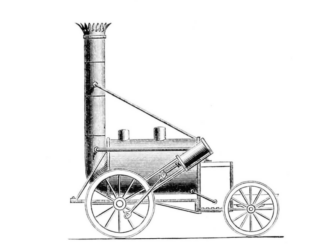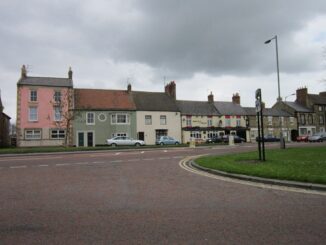
You may be surprised to learn that a working time machine has already been invented in County Durham. It exists because one man refused to let the region throw its own history into the skip.
© Paranoid Android, Going Postal 2026
Now, before we begin, I must warn you this is a lengthy article. I visited Beamish many times as a child and feel obliged to relay to you, in obsessive bordering on anorak-wearing levels of detail, the history of this very unique museum. You will also find several of my own photos here from my most recent visit in August.
But who created Beamish in the first place?
The man who collected a region
Frank Atkinson was a museum curator in the 1950s, and he had the gift of being able to see the future. The coal pits were closing. The shipyards were going quiet. The whole industrial world that had built the North East, and built much of modern Britain along with it, was being demolished faster than anyone thought to photograph it. Atkinson watched it disappear and decided somebody ought to catch it before it was gone for good.
The idea that fixed it for him came from abroad. In 1952 he toured Norway and Sweden and visited their folk museums, open-air places like Skansen in Stockholm where whole farmhouses and workshops had been saved and rebuilt and brought back to life. He came home convinced that England needed one of its own, and that it should cover both the rural North East and the industrial one that was vanishing around him.
His collecting policy became famous, and slightly mad. He called it ‘unselective collecting’, and the rule was simple: “you offer it to us and we will collect it.” Where other museums agonised over what was worth keeping, Atkinson said yes to nearly everything. Prams, mangles, shop signs, tram tickets, false teeth, entire chemist’s shops (yes, literally). He took it all, and stockpiled the flood of donations in sheds and old huts until there was somewhere to put it. People emptied their attics and their dead relatives’ houses into his care, and he kept the lot.
He was appointed the first director in 1970, and the museum opened to the public in 1972, based at first around Beamish Hall. It was the first regional open-air museum in England.
What he was really building was a people’s museum, made of ordinary lives rather than the portraits of great men. The pit boots and the prams mattered to Atkinson because nobody else was saving them. By the time the rest of the museum world came round to the idea that everyday history was worth keeping, Beamish had a 50-year head start and a hillside full of proof.
Brick by brick
Most museums bring the objects to the building. Beamish brings the buildings too. A great deal of what you walk through has been moved here from somewhere else, dismantled stone by numbered stone at its original site and rebuilt on the hillside, down to the chimney pots.
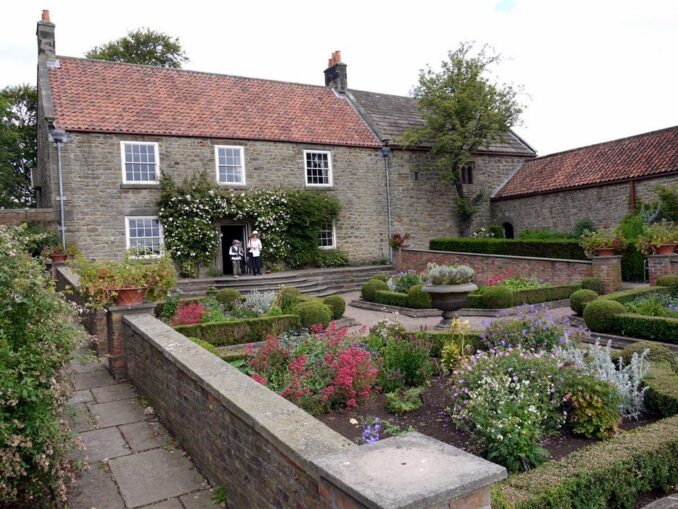
Andrew Curtis / Pockerley Old Hall, Beamish Museum
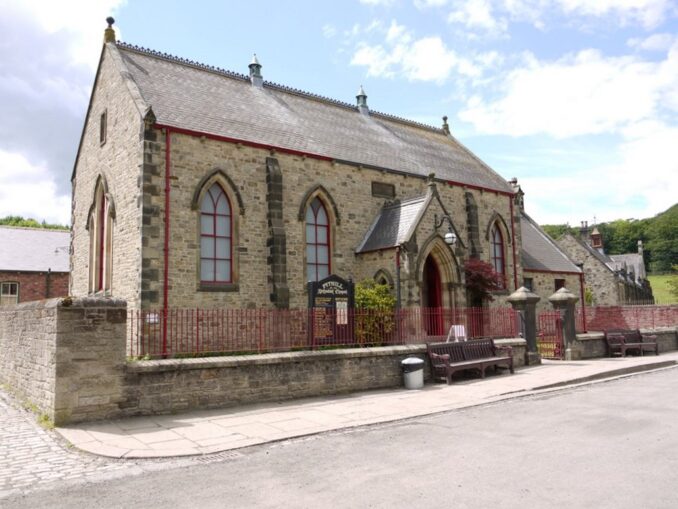
The early arrivals, in the first years after opening, were a railway station and a colliery winding engine. After that the place grew into a sprawl of rescued streets and farms. A bank, a pub, a sweet shop, a row of pit cottages, a chapel, a school, a dentist’s surgery with a genuinely alarming chair, all of them salvaged from real North East towns and reassembled in period order.
The most dramatic rescue was a church. St Helen’s had stood at Eston in Teesside since the 12th century, but by the 1990s it had been left empty, burned out by vandals and half pulled down, with demolition already signed off. Beamish stepped in at the last hour, took the surviving stonework apart piece by piece, carted it 40 miles north, and rebuilt it. A medieval church that was days from the bulldozer now holds weddings again.
Then there is Rowley, a small country station that stood near Consett until it was taken down in 1972 and rebuilt here, board by board. The cast-iron footbridge crossing the line was carried up from Dunston in Gateshead. Half of industrial Tyneside has been quietly moved here and bolted back together, and most visitors never realise how far the buildings have travelled to stand where they do.
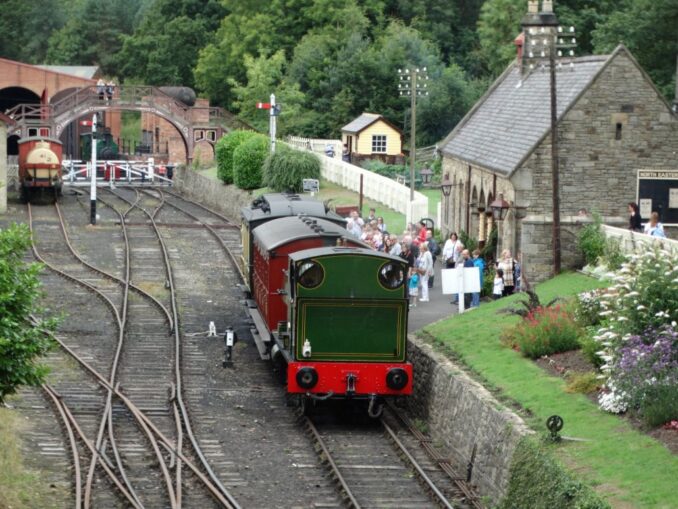
Beamish Open Air Museum – Train at Rowley Station by Colin Park, CC BY-SA 2.0, via Wikimedia Commons
A working day in several centuries
Walk through the gates at Beamish and you really will feel as though you just stepped back in time. I’m not kidding; it hits you the moment you step on the very first platform just after the main entrance. A tram clatters past with a conductor in a peaked cap. Coal smoke drifts off a chimney. Somewhere a blacksmith is actually hammering iron, not miming it for a camera, and the people you meet are dressed in 1913 attire and will talk to you as though the Titanic went down last Spring.
The thing that makes Beamish work is the people. The museum is staffed by costumed actors who don’t just stand beside the exhibits explaining them, they live in them. The woman frying your chips, the man driving the tram, the teacher drilling children in a Victorian classroom: all of them stay in character and in period, and most of them know their trade for real. You can chat as much as you like with them and they love nothing more than to tell you all about their ‘lives’ in the past.
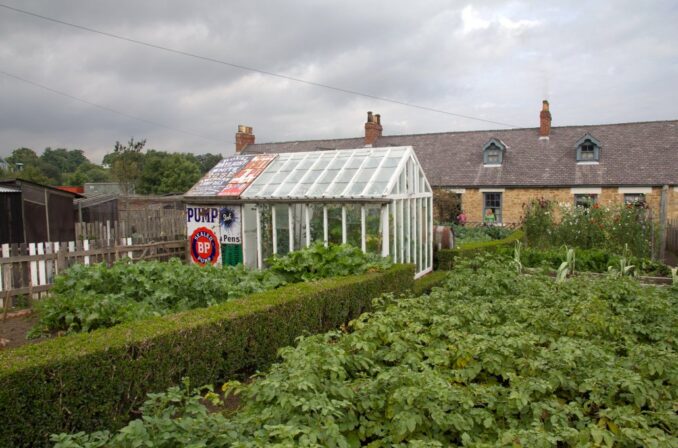
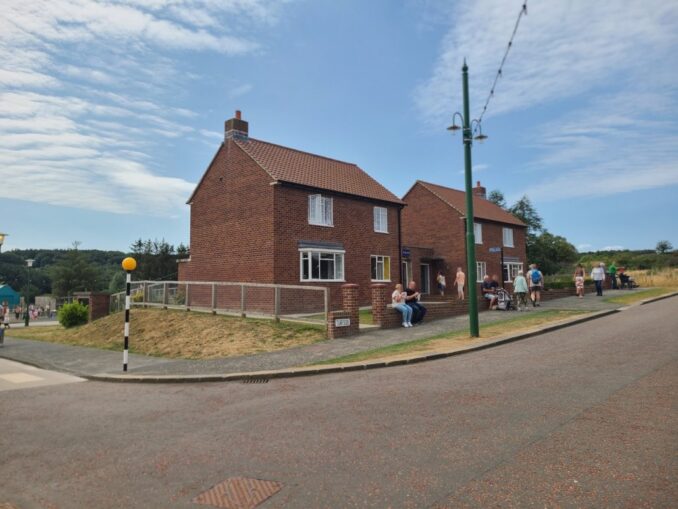
The site is split into different times. There is the 1820s at Pockerley, with its waggonway, its old hall and a horse plodding in a circle to wind the pit. There is the 1900s Town, a full Edwardian high street of shops, bank and pub. There is the 1900s Pit Village clustered round its colliery, a 1940s farm, and, newest of all, a 1950s town that brings the story up to living memory.
© Paranoid Android, Going Postal 2026
The Town is a proper working high street. There is a Co-operative store with its grocery, drapery and hardware counters, a branch bank, a solicitor’s office, a photographer who will take your portrait on a plate camera, and a pub, the Sun Inn, rebuilt from Bishop Auckland and pulling real pints.
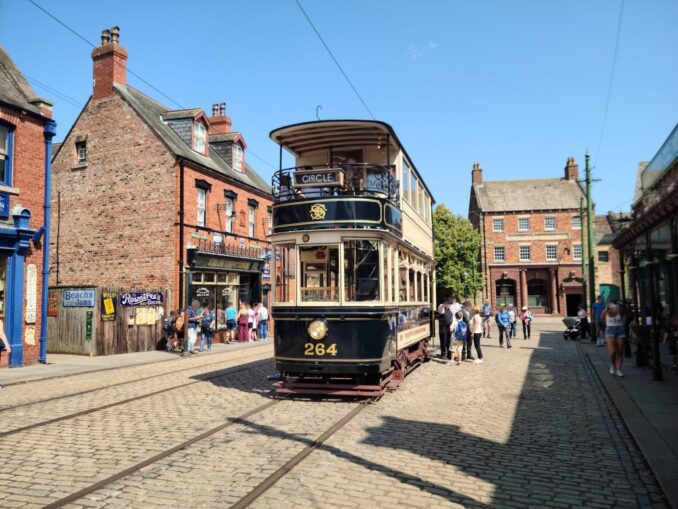
Tying it together is the tramway. Restored electric trams, gathered from cities across Britain and beyond, run a circuit of about a mile and a half around the whole site, and have done since the early 1990s. Hopping on an Edwardian tram to get from the Georgian countryside to the 1950s is a perfectly normal scenario at Beamish.
At the Pit Village you can go get a lamp and hard hat and be led into a real drift mine cut into the hillside. Bent double under a low roof in the dark, it explains a miner’s day better than any interactive touch screen ever could. Up top the colliery’s steam winding engine still turns, and the pit cottages next door are set out as they were when whole families lived four to a room with a netty across the yard.
The village school next door is Victorian, moved from East Stanley with the date 1891 still cut into the stone over the door. My own children were treated to a surprise arithmetic lesson on chalk boards whilst also being shown the punishment log (and cane) for misdemeanors such as “serious indifference”. They worked diligently for about ten minutes. Lessons still run inside and the playground is stocked with the games of the era; visitors of any age can try bowling an iron hoop across the yard with a stick. The only person who managed it whilst I was there was a gentleman who appeared to be in his 70s.
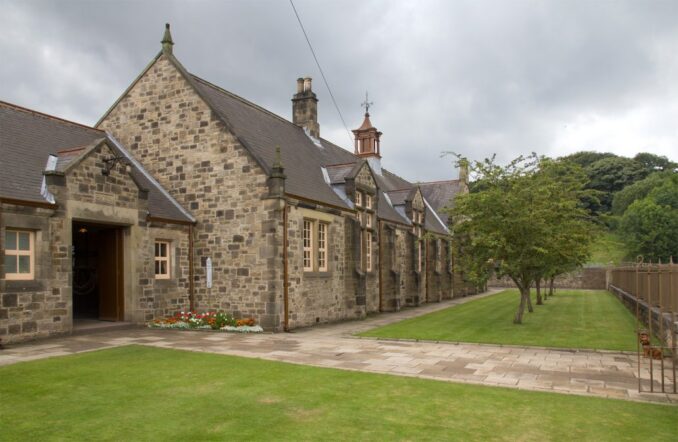
David P Howard / Beamish Board School
The figures hiding in plain sight
For readers of this series, Beamish is quietly full of familiar ghosts. The locomotives that run on the Pockerley Waggonway are working replicas, and some of the names behind them will be recognisable from my previous articles.
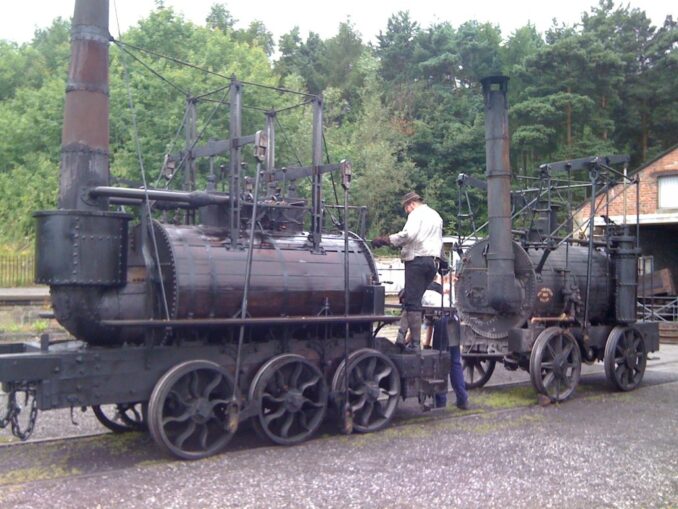
Darrin Antrobus / Steam Engines
There is Puffing Billy, the engine William Hedley built at Wylam in 1813 with his enginewright Jonathan Forster and his foreman blacksmith Timothy Hackworth. The working replica at Beamish first steamed in 2006 and was part-funded by a charitable foundation Hedley’s own descendants endowed.
Alongside it sits the Steam Elephant, a replica of a curious 1815 Tyneside engine credited to John Buddle, the “King of the Coal Trade,” and the engineer William Chapman, built for the colliery at Wallsend. There is also a replica of George Stephenson’s Locomotion No. 1 of 1825, completed in 1975 for the 150th birthday of the Stockton and Darlington Railway, the line Edward Pease’s money built. Even the big engine shed at Pockerley is a copy, modelled on Hackworth’s erecting shop down the road at Shildon. These are working exhibits; the engines are fired up and run, and on gala weekends like the Great North Steam Fair.
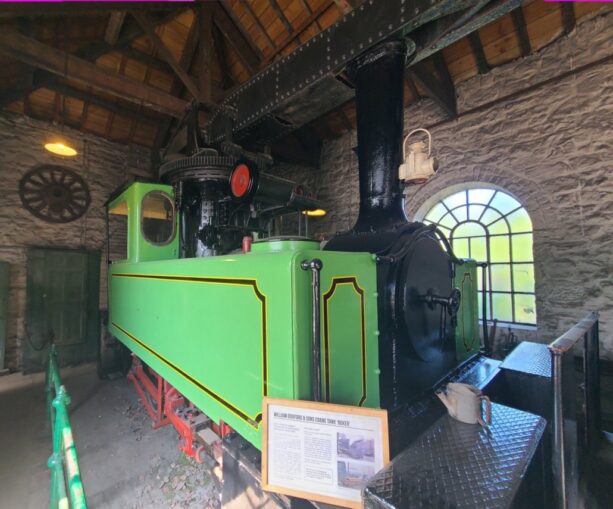
Down at the colliery the engines are originals. In the shed sits No. 18 Lewin, built in 1877, which spent 93 years shunting coal at Seaham Harbour and came to Beamish in 1975, returning to steam in 2012 after a seven-year rebuild. Next to it is Roker, a crane tank built in 1940 by Robert Stephenson and Hawthorns of Newcastle, the firm that grew out of Robert Stephenson’s works, for the Doxford shipyard in Sunderland, where it spent its working life lifting steel plate to the slipways.
© Paranoid Android, Going Postal 2026
Lesser-known and quirky facts
The fish and chips are fried in beef dripping on a coal-fired range and handed to you in printed newspaper, exactly as they would have been a century ago, and people queue for them in a way they never queued for the originals. The sweet shop makes its own boiled sweets in copper pans by hand.
The chemist is named after a real one, William Smith of Silver Street in Durham, and it still works: they make pills by hand in moulds and bottle their own soda water in flavours like sarsaparilla, blood tonic and kola. Syrups go in blue glass and poisons in green, which was how you avoided killing a customer in a badly lit shop.
Andrew Curtis / Reconstructed Pit Hill Wesleyan Chapel, Beamish Museum
The collecting has never really stopped. In 2023 the museum opened replicas of the aged miners’ homes from Marsden Road in South Shields, the little terraced cottages charities once built for retired pitmen, recreated so visitors could see how the region looked after its old.
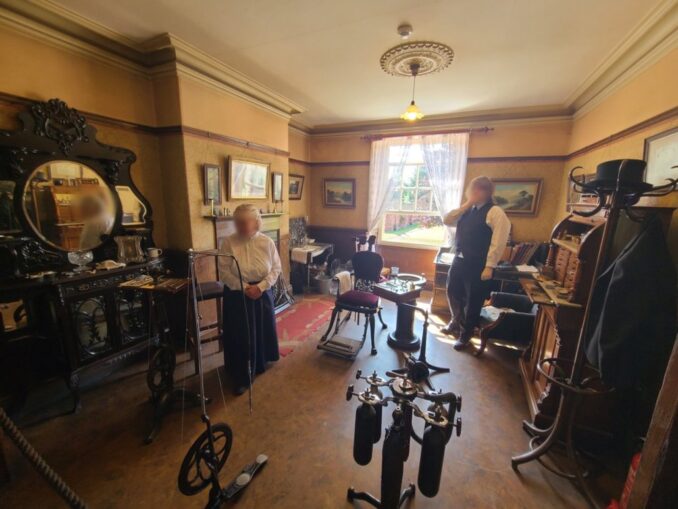
The Town will surprise you with just how much hidden detail there is around every corner. There is a printer setting type by hand, a garage of brass-lamped motor cars, among them a 1906 Armstrong Whitworth tourer built on Tyneside by Lord Armstrong’s firm, a bandstand, a working bakery and even a dentist’s surgery. Almost nothing sits behind a rope, and almost everything actually works.
© Paranoid Android, Going Postal 2026
The transport is also fairly eclectic. Among the trams is Oporto 196, a Portuguese single-decker built in 1935 that was shipped over from Porto in 1989 and now trundles round County Durham as though it had always belonged there. On the fairground, the steam Gallopers built by Frederick Savage in 1893 still spin to the wheeze of an 87-key Gavioli organ, turned by a little steam engine that somebody, at some point, decided to name May Queen.
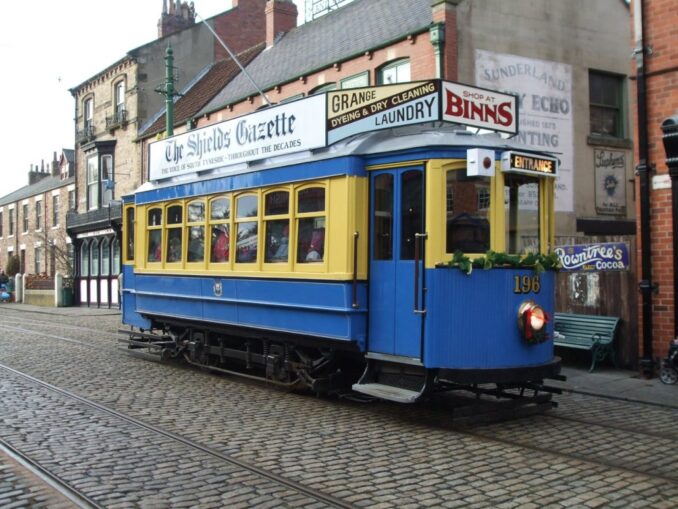
THTRail2013, CC BY-SA 3.0, via Wikimedia Commons
The colliery’s oddest resident is Coffee Pot No. 1, a vertical-boilered engine that looks exactly like its nickname, was built by Head Wrightson on Teesside in 1871 for £462 and spent most of its working life at a lime quarry in Surrey. It came back north in 1960, reached Beamish in 1975, and with a new boiler it steams again, which makes it one of the oldest working locomotives anywhere in the world.
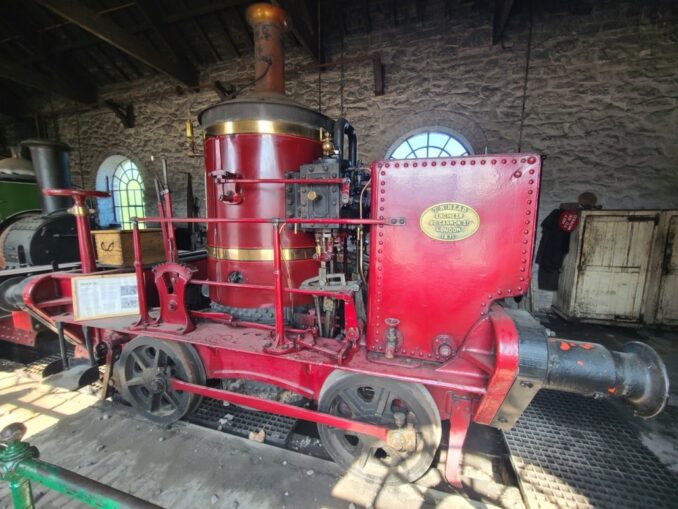
© Paranoid Android, Going Postal 2026
The farm is a working one, and it doubles as an ark for old northern livestock. Durham Shorthorn cattle, Cleveland Bay and Clydesdale horses, Dales ponies, Teeswater sheep and Saddleback pigs, the breeds that worked the region’s land before farming went uniform, are kept and bred on site.
And if parts of it look like a period drama, that is because they have been one. Through the 1990s the Catherine Cookson television films, adaptations of the South Shields author whose 100 million sales make her one of the most-read writers Britain has produced, used Beamish as a backdrop again and again. The Fifteen Streets, The Cinder Path, The Tide of Life: when the producers needed a convincing Edwardian North East, they came to the one that had been rebuilt on a hillside near Stanley.
Then there is the pub. The Sun Inn began life as the Tiger Inn in Bishop Auckland before it was taken apart and rebuilt here in 1985, and it sells ales similar to those that would have been available at the time. The front bar comprises bare wooden boards, sawdust thrown down on the floor, and spittoons set out for the tobacco-chewers (which you are not allowed to use). Mrs. PA can attest to the authenticity of this establishment as, stepping through the threshold and inhaling its various odours, she delivered her verdict on a century of progress. “Nothing has changed about pubs in 100 years,” she said. “They still stink.”
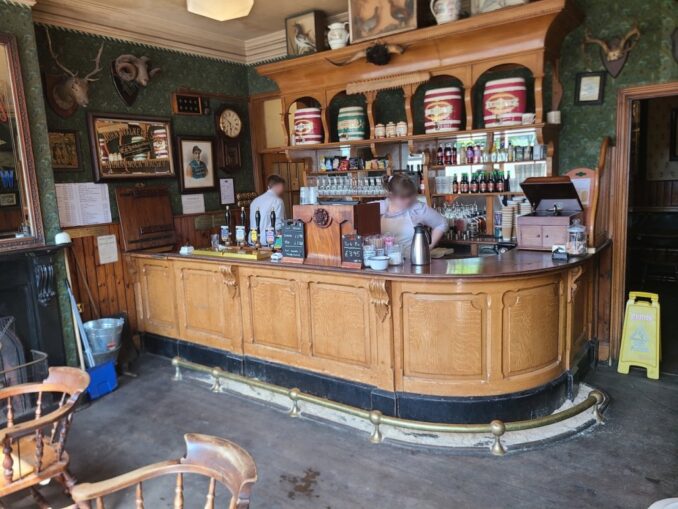
© Paranoid Android, Going Postal 2026
Museum of the year
In June 2025 Beamish won the Art Fund Museum of the Year, the largest museum prize in the world at 120,000 pounds, beating every grand national institution in the country to it. The judges singled out the way the place is made by its community rather than handed down to it.
On that note, the recent Remaking Beamish project, which built the 1950s town and much else, was put together with the help of more than 32,000 local people, over 14,000 schoolchildren and some 35,000 hours of volunteer time, and produced 31 new exhibits. A museum that started by asking the public to hand over their junk had, half a century on, asked them to help build the thing itself.
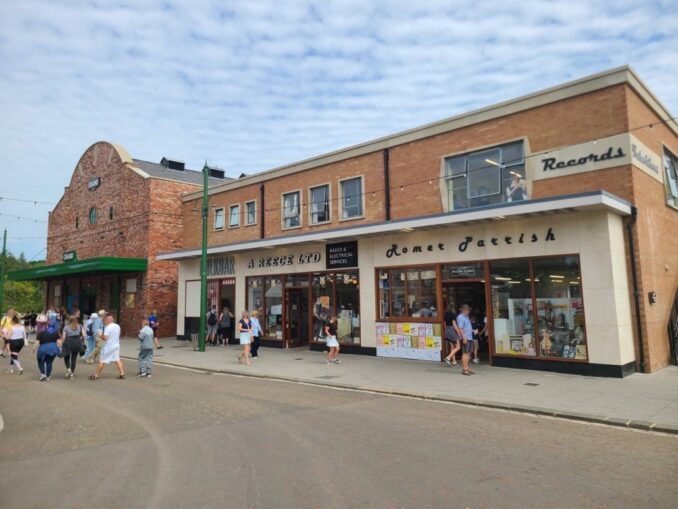
© Paranoid Android, Going Postal 2026
You must visit this place at least once in your life
Beamish is where the past is kept alive.
Frank Atkinson set out to save a way of life that nobody else thought worth keeping. He ended up building the best possible monument to what otherwise have become the region’s forgotten history.
© Paranoid Android 2026