He couldn’t read his own name until he was 18. Then he built the technology that shrank the planet.
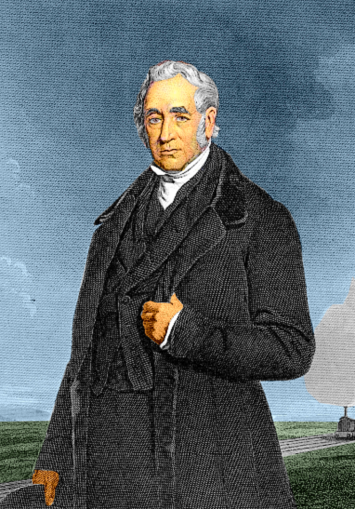
Jan Arkesteijn at nl.wikipedia, Public domain, via Wikimedia Commons
George Stephenson was born in a two-room cottage in Wylam, Northumberland, on 9 June 1781. There was no running water and no schooling. His father, Robert, shovelled coal into the Wylam Colliery pumping engine for pennies. His mother, Mabel, couldn’t write her name. Neither could his dad. Neither, for the first 18 years of his life, could George.
This is the man who decided how wide most of the railway track on earth should be.
The boy who paid to learn the alphabet
Young George’s first job was herding cows away from the waggonway that ran past his cottage. He was 8. By 14, he was working alongside his father at the colliery, shovelling coal and tending engines. Formal education was a luxury the Stephensons couldn’t afford, and Northumberland in the 1790s wasn’t exactly overflowing with free schools for pitmen’s sons.
At 17, Stephenson could strip and rebuild a Newcomen pumping engine blindfolded. He could diagnose mechanical faults by ear alone. But he couldn’t read the word “engine.”
He fixed this the hard way. At 18, he enrolled in night school, paying out of his own wages. By 19, he could read and sign his name. Then he moved on to a more expensive teacher for arithmetic, and discovered he had a talent for numbers. The whole thing was brutal: a full shift underground followed by evening classes, then home to practise letters by candlelight. He also mended clocks and repaired shoes on the side to cover costs.
His son Robert got a different deal. George was so determined that Robert would have the education he’d missed that he bought the boy a donkey to carry him the 10-mile round trip to school each day. That investment paid off spectacularly (Robert went on to become arguably the finest engineer of the Victorian age), but the fire came from George. Everything started with a man who decided, at 18, that being illiterate was a problem he could solve.
(Robert will be covered separately in a second article)
The lamp that nearly made him famous (for something else entirely)
Samuel Smiles, Public domain, via Wikimedia Commons
Before railways, Stephenson nearly became famous for something completely different: keeping miners alive.
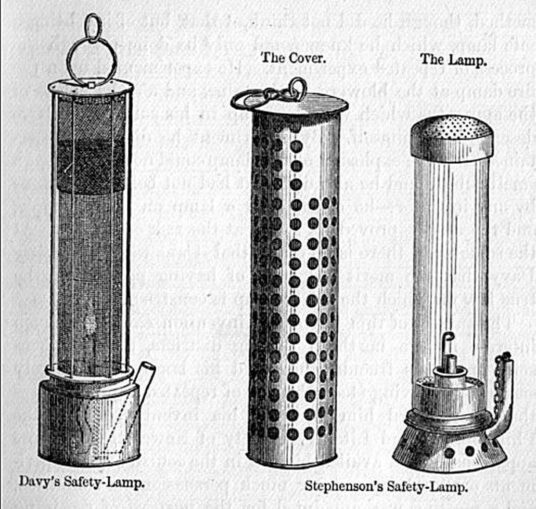
Firedamp (methane) killed pitmen constantly. A naked flame near a pocket of gas and the whole tunnel became an inferno. In 1815, Stephenson built a safety lamp that enclosed the flame in a glass cylinder capped with tiny perforated holes, preventing the fire from igniting the gas outside. He tested it himself, walking into Killingworth Colliery and holding the thing directly in front of a fissure leaking methane. If he’d got the engineering wrong, he’d have been killed on the spot.
He hadn’t got it wrong. The lamp worked.
Here’s the problem. Sir Humphry Davy, London’s most celebrated chemist, was working on the same problem at the same time. Davy’s design used wire gauze instead of glass. Stephenson demonstrated his lamp in October 1815, weeks before Davy presented his to the Royal Society. But Davy had friends in high places, and Stephenson was an uneducated colliery worker from the North East. Davy was dismissive. He described Stephenson’s lamp as something that was “not safe” and whose apertures were “four times too large.” He then got hold of some of Stephenson’s lamps to try to prove how useless they were.
Davy got the public credit, the banquets, the silver plate. Stephenson’s supporters raised £1,000 and a silver tankard for him. It took until 1833 for a House of Commons committee to rule that Stephenson had an equal claim to the invention. Davy went to his grave insisting Stephenson had stolen his idea.
He hadn’t. But the whole episode taught Stephenson something about how the world worked: credentials mattered more than evidence, and the establishment would close ranks against an outsider every time. It made him stubborn. And that stubbornness built railways.
Oh, and there’s a theory that the word “Geordie” (the name for people from Tyneside) comes from the Geordie lamp. Miners in the North East used Stephenson’s lamp; miners further south used Davy’s. The Stephenson lamp users became “Geordies.” Whether that’s true or just a good story is still debated, but I will let you debate this in the comments.
The Rocket and the race that changed everything
Popular Science Monthly Volume 12, Public domain, via Wikimedia Commons
By the mid-1820s, Stephenson had already built the Stockton and Darlington Railway (1825), the first public railway to use steam locomotives. But the big prize was the Liverpool and Manchester Railway, and its directors weren’t convinced that locomotives were the answer. Many favoured stationary engines hauling carriages along cables, like a giant washing line.
Stephenson argued for locomotives. The directors, to their credit, decided to settle the question with a competition: the Rainhill Trials, October 1829. Build a locomotive. Bring it to Rainhill. Run it up and down a mile of track hauling loads. Best machine wins £500.
Ten locomotives entered. Five showed up. Two were jokes (one was powered by a horse on a treadmill, which feels like missing the point of a steam competition). That left three serious contenders: Novelty, Sans Pareil, and Rocket.
(Big hint: There is a much bigger story behind Sans Pareil that I will tell in another article)
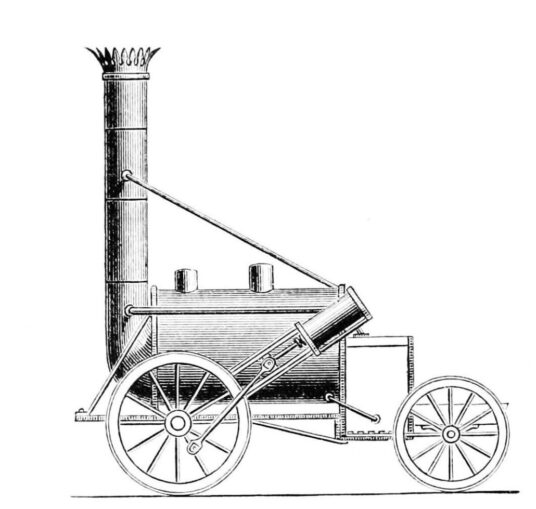
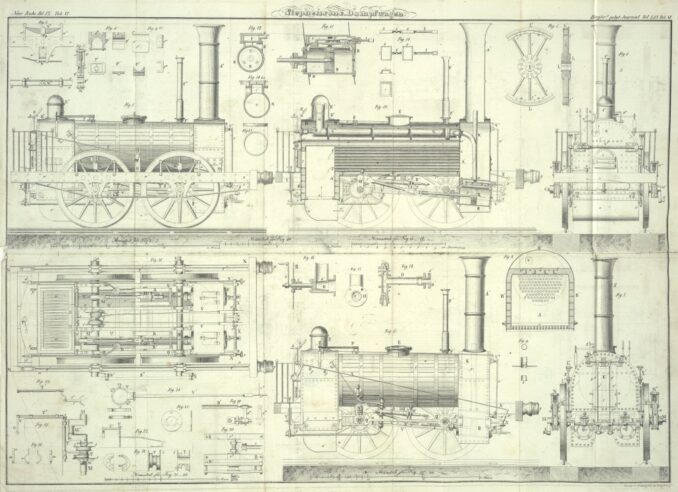
Rocket was designed by Robert Stephenson (George’s son, now 26) with input from George and Henry Booth, the railway’s treasurer. It used a multi-tube boiler, which was the key innovation: instead of one big pipe carrying hot gas through the water, it had 25 small copper tubes. More surface area = more steam = more power.
Rocket averaged 12 mph hauling 13 tons. Its top speed hit 30 mph, which in 1829 was faster than any human being had ever travelled by land. Novelty broke down. Sans Pareil was disqualified on a technicality (too heavy). Rocket won, and the Stephensons got the contract to build locomotives for the line.
The Liverpool and Manchester Railway opened on 15 September 1830. It was the first inter-city railway in the world to use steam locomotives for all traffic. It connected two major cities, carried passengers and freight on a fixed timetable, and proved that railways were commercially viable. Every railway built after it used the same basic model.
Four feet, eight and a half inches (and why it matters)
Here’s a question that sounds boring but shaped the modern world: how wide should a railway track be?
Stephenson chose 4 feet 8 inches. He picked it because that was the gauge used by the coal waggonways at Killingworth, where he’d spent his working life. Those waggonways probably inherited the width from earlier cart tracks. There was nothing scientific about it. It was just what he knew.
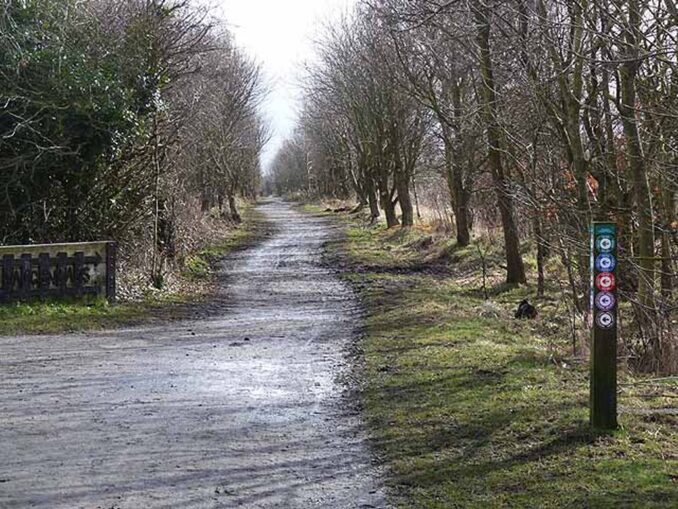
[Editorial tangent: below is a picture of the waggonway, which as chance would have it is just down the road from where my mum used to live. I have gone for many a run down this track and can confirm that it is incredibly boring and repetitive.]
© Copyright Oliver Dixon and licensed for reuse under this Creative Commons Licence.
He later added half an inch (to reduce friction on curves), making it 4 feet 8.5 inches. And because Stephenson built the first major railways, his gauge spread. New lines connected to existing ones, and connection meant using the same width.
Isambard Kingdom Brunel, building the Great Western Railway from London to Bristol, thought this was ridiculous. He chose 7 feet 0.25 inch, arguing (correctly) that wider track meant bigger locomotives, higher speeds, and smoother rides. He was right on the engineering. He was wrong on the politics.
By the time Parliament stepped in with the Gauge Act of 1846, Stephenson-gauge track outnumbered Brunel-gauge track by about 8 to 1. The maths was brutal and simple: ripping up the minority gauge was cheaper than ripping up the majority. Stephenson’s gauge became the standard. The Great Western didn’t finish converting until 1892.
Today, about 60% of the world’s railways use Stephenson gauge. The width of a railway track in Japan, Argentina, and Canada traces back to the coal waggonways of a Northumberland colliery. A man who couldn’t read at 18 set a global standard that has outlasted every other engineering decision of his era.
Pineapples, cucumbers, and competitive gardening
See page for author, Public domain, via Wikimedia Commons
Stephenson’s later years were spent at Tapton House near Chesterfield, Derbyshire. He’d made his fortune. He could have retired quietly. Instead, he declared war on Joseph Paxton.
Paxton was head gardener at Chatsworth House, about 10 miles away, and widely regarded as the finest horticulturalist in England. Stephenson, who had precisely zero formal training in botany, decided to outgrow him. He built vineries, pineries, melon houses, and forcing houses on the Tapton estate. He vowed to grow pineapples the size of pumpkins. He engineered wire gauze baskets to support melons.
And then there were the cucumbers. Stephenson could not tolerate a curved cucumber. He tried adjusting temperature, light, growing position. Nothing worked. So he did what any reasonable civil engineer would do: he had hollow glass tubes manufactured at his Newcastle steam engine factory and slipped them over the growing cucumbers, forcing them straight by industrial means.
He didn’t patent the glass tubes, despite patenting 5 other inventions between 1815 and 1846 (all railway-related). Maybe he thought cucumber straighteners lacked gravitas. Maybe he just wanted to beat Paxton.
He married three times. His first wife, Frances Henderson, died of tuberculosis in 1806, leaving him with young Robert. His second wife, Elizabeth Hindley, died in 1845. His third marriage, to Ellen Gregory in January 1848, lasted seven months before George contracted pleurisy and died on 12 August 1848, aged 67.
What he actually did
Strip away the mythology and Stephenson’s achievement is staggering in its simplicity. He took an existing technology (the steam engine), applied it to an existing infrastructure (waggonways), and created something entirely new: a connected world. Before Stephenson, the fastest way to travel overland was on a horse, the same as it had been for 3,000 years. Within 20 years of the Liverpool and Manchester Railway, you could cross England in hours.
He did this without formal education, without wealthy patrons (at least initially), without the establishment’s blessing, and while fighting a running battle with a scientific elite that considered him a provincial upstart.
The gauge he chose connects cities on 5 continents. The railway model he proved viable at Liverpool and Manchester became the template for every railway network on earth. And he did all of it starting from a position of being illiterate.
© Paranoid Android 2026