
He started working life down a pit age six, ran half the coalfield by his thirties, and built an entire harbour to spite his rivals. They called him the King of the Coal Trade, and when he died the streets of Newcastle stopped to watch him pass. So why has almost nobody heard of him?
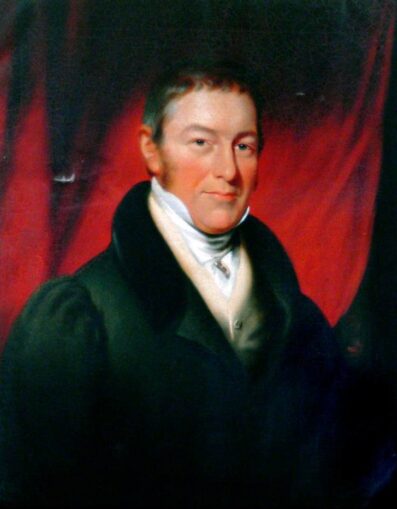
pre1840 unknown artist as per Oil Paintings in Public Ownership in Northumberland, Tees Valley & Tyne and Wear The Public Catalogue Foundation Sonia Roe Editor, London 2009 ISBN 978-1-904931-37-9, page 230., Public domain, via Wikimedia Commons
For roughly 40 years the most powerful man in the British coal trade was a stocky, unmarried Durham coal viewer who designed his own theatre heating and cut a working harbour into the County Durham cliffs. His name was John Buddle, and every colliery owner from Newcastle to Nova Scotia wanted him underground at their pit. He got there by understanding the one thing that kept killing miners: the air.
Down the pit at six
Buddle was born at West Kyo, near Stanley, in September 1773. His father, also John, was a schoolmaster turned colliery man who corresponded with serious mathematicians and decided his only son would learn the trade properly, from the ground down.
So properly, in fact, that Buddle later reckoned he’d started picking up the work at the age of six. By 19 he was underviewer to his dad. By 1801, aged 27, he was viewer of Benwell Colliery and had bought himself a thirteenth share of it for £2,700. Not bad for a man with no schooling beyond what his father taught him at the kitchen table.
A viewer, back then, was the person who actually ran a mine: the surveyor, the engineer, the manager and the safety officer rolled into one. Buddle took that rough job and dragged it toward something we’d now call a profession. In 1806 he took over Wallsend Colliery, one of the deepest and gassiest in the country, and that’s where the real story starts.
“We have at last subdued this monster”
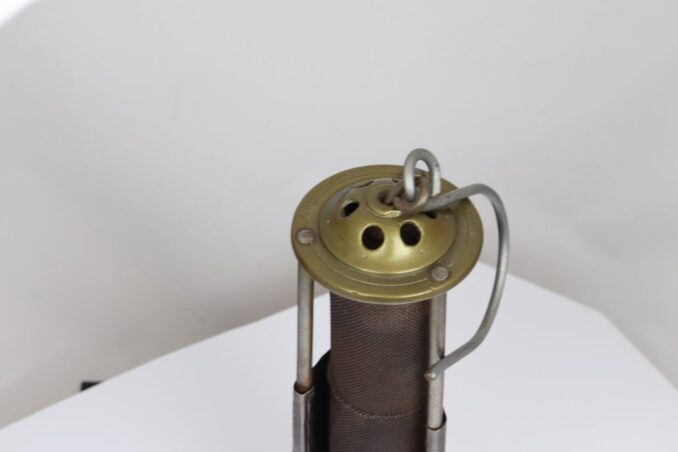
Rutin123, CC BY-SA 4.0, via Wikimedia Commons
Deep coal mines fill with firedamp, a flammable gas that’s mostly methane. Bring a naked candle near it and you get an explosion that flattens tunnels and burns men alive. In Buddle’s day this happened constantly. The Felling pit disaster of 1812 killed 92 people a few miles from where he worked.
Buddle had been wrestling with the problem for years when, in 1815, a chemist named Humphry Davy started designing a lamp that could burn safely in gas. Buddle was in it from the start: he met Davy that August, sent him bottled firedamp from his own pits for the London experiments, then ran the first genuine underground trials at Wallsend in January 1816.
His account of that first test is one of the great moments in industrial history, mostly because of how plainly he tells it. He hung the lamp in the gas, watched the gauze glow red hot without igniting the air around it, and turned to the men beside him. “We have at last subdued this monster,” he said. Coming from a man who had buried more colleagues than he could count, that line lands harder than any speech.
The lamp war
At almost the exact same time, a self-taught engine-wright on the same coalfield invented his own safety lamp. His name was George Stephenson.
Two famous men, two rival lamps, one furious argument about who got there first. Davy’s supporters thought Stephenson was a chancer who had copied the idea. Davy himself was blunter, sniffing that Stephenson had “made something like a safe lamp, except that it is not safe.” Tyneside split into two camps.
Buddle, the practical man who had tested both, came down firmly on Davy’s side and helped push the Davy lamp into the pits. He was probably right on the science. He was also, awkwardly, backing the London celebrity over the local man who’d go on to invent the railways. History kept Stephenson’s name and dropped the viewer who actually decided which lamp went down the shaft.
Editorial Tangent: For those of you who read the Stephenson article and remembers the theory that the term ‘Geordie’ comes from his lamp. The two lamps burned side by side across the North East for decades, and which one a miner carried depended on who ran his pit. Collieries in Stephenson’s orbit, Killingworth and the Grand Allies’ pits, carried the Geordie. Buddle’s pits, Wallsend and the Londonderry mines, carried the Davy. The Geordie was popular locally because the glass gave better light and because Tyneside enjoyed backing its own man; the Davy won everywhere else in Britain. So if the nickname theory is true, the miners who became Geordies potentially got their name by ignoring the most powerful coal viewer in the region.
Splitting the air
The lamp gets the headlines, but Buddle’s quieter work probably saved more lives. The trouble with old mines was that they pushed a single current of air through the entire workings in one long loop. By the time that air reached the far end it was stale, gassy and useless, and any spark was a death sentence.
Buddle’s answer, rolled out from around 1810, was a system he called splitting the air. Instead of one exhausted current crawling round the whole pit, he divided the mine into separate panels and fed each one its own fresh intake and its own return. Gas concentrations dropped. The air stayed breathable to the coal face.
Mining engineers still talk about panel ventilation today, and the basic logic is his. He also kept careful written records of airflow when most viewers worked on gut feel, which sounds dull until you remember that the alternative was guessing in the dark with a candle.
The harbour he built out of spite
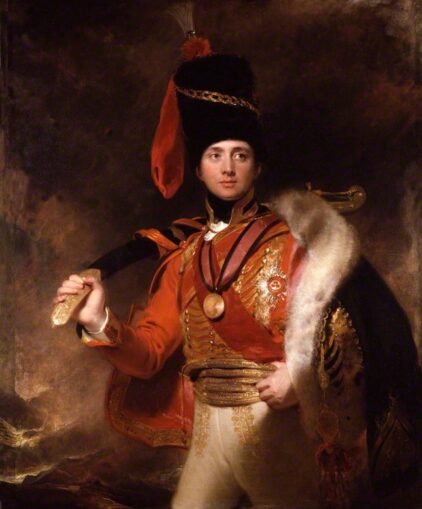
Thomas Lawrence, Public domain, via Wikimedia Commons
Buddle’s biggest patron was Charles Vane, 3rd Marquess of Londonderry, a hot-tempered aristocrat who had married the wealthiest woman in Britain and inherited a sprawl of Durham coal mines through her. Buddle became his general manager and, in effect, the brain behind the operation.
The pair had a problem. Shipping coal out through the Tyne and Wear meant paying the cartels that controlled those rivers. So in 1828 they simply decided to build their own port from nothing, at Seaham, cutting docks and piers straight into the coast to dodge the monopolies. The engineering plans came from William Chapman, an old collaborator of Buddle’s who turns up again below.
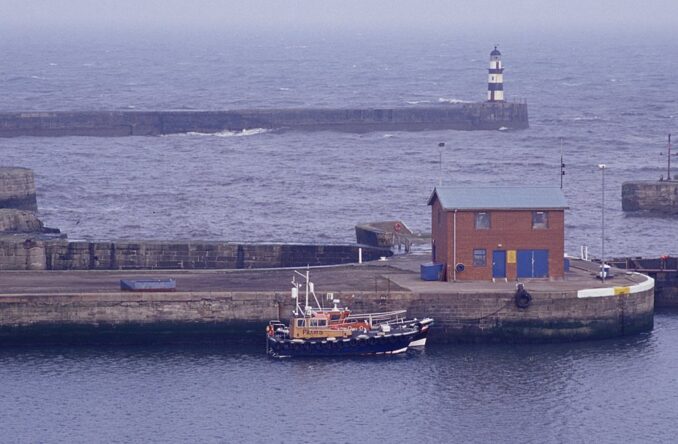
Seaham Harbour, the port Buddle and Londonderry carved into the County Durham coast from 1828
Londonderry laid the foundation stone in November 1828. On 25 July 1831 the first coals ran down the incline into a brand-new brig named the Lord Seaham, which sailed out to gun salutes, a colliery band and a crowd of 7,000. A whole town grew up around the harbour, and Buddle had a hand in shaping that too. When his sister Ann died, the local ships ran up black flags and the shops shut as a mark of respect, which tells you roughly how much of Seaham revolved around one Durham viewer and his family.
Locomotives, theatres and a very long list of jobs
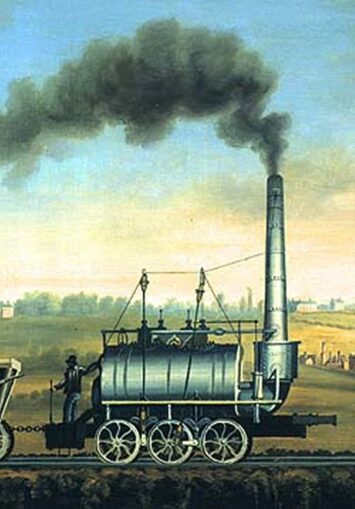
See page for author, Public domain, via Wikimedia Commons
Coal and harbours were only part of the workload. Working with William Chapman, the same engineer who drew up Seaham, Buddle helped design an early locomotive called the Steam Elephant for the Wallsend wagonways, plus a geared eight-wheeled engine for the Lambton line. The railways were being invented all around him, and he was heavily involved.
He also collected a number of titles. Vice-president of Newcastle’s Literary and Philosophical Society (that place keeps popping up in these articles as you will find). Vice-president of the North of England fine arts society. A steward at the Infirmary with the power to appoint its physicians. He chaired the committee for the new Theatre Royal and, because he couldn’t help himself, personally designed its heating system.
His advice was wanted everywhere. The records show him weighing in on mines and railways in Portugal, South America, Russia and Nova Scotia, all from a base on the banks of the Tyne. He even helped fund the Penshaw monument raised to his friend Lord Durham.
A mile-long funeral
Buddle never married. A Unitarian, he died at his Wallsend home in October 1843 after falling ill on a ride out to inspect the collieries with Londonderry, still working at 70. He left a fortune of around £150,000, a staggering sum for a man who’d started with nothing but his father’s lessons.
His send-off matched his standing. The funeral procession stretched over a mile and took three hours to travel from Wallsend to his grave at Benwell. One newspaper reckoned Newcastle had never seen such a crowd gathered for a single sad occasion.
Among the pall-bearers and principal mourners stood a wealthy corn merchant named William Armstrong, with his son, also William, a solicitor in his early 30s who was 4 years away from opening an engineering works at Elswick and becoming Lord Armstrong, the great Victorian arms magnate. The North East’s industrial story was passing, almost literally, from one giant to the next at the graveside.
So why isn’t Buddle a household name? Partly because viewers worked underground, out of sight, while the men who built bridges and engines did it where everyone could watch. Partly because he served other people’s empires, the Londonderrys and the bishops, rather than stamping his own name on the front of a company. His bust sits quietly in the old mining institute in Newcastle, next to a colleague, where hardly anyone looks.
He deserves better. The next time a film props up Stephenson as the lone genius of the coalfield, spare a thought for the unmarried Durham viewer who tested the lamp, split the air, built the harbour, and told the men around him that the monster was beaten.
© Paranoid Android 2026





Stewart,_Later_3rd_Marquess_of_Londonderry,_1812,_oil_on_canvas,_National_Portrait_Gallery,_London.jpg)
