
Everyone knows George Stephenson. The self-taught genius who invented railways. Except he didn’t, really. George was the visionary, the man who saw what steam could do. But the man who actually designed the engines, surveyed the routes, dug the tunnels and threw bridges across places that had never been bridged was George’s son. And almost nobody knows his name.
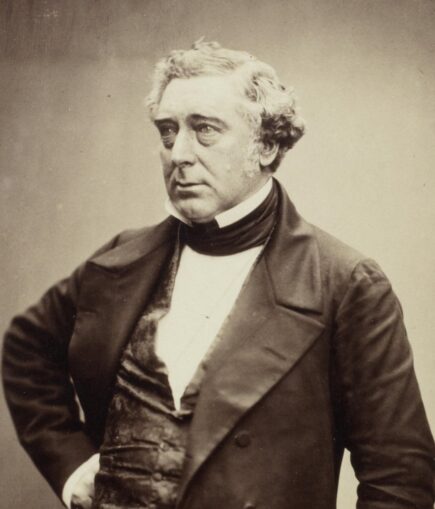
Maull & Polybank, 55 Gracechurch Street, London This was a partnership of Henry Maull (1829–1914) and an unknown partner George Henry Polyblank or Polybank.(See London Gazette, 1865 p 2059 and Maull & Polyblank at the Getty Museum), Public domain, via Wikimedia Commons
There’s a version of railway history where George Stephenson does everything. A one where he invents the locomotive, builds the Stockton and Darlington, wins the Rainhill Trials, sets the gauge and connects the world.
It’s a good story but it’s also wrong.
George was the dreamer, the self-taught pitman who willed railways into existence through sheer bloody-mindedness. But the man who actually made them work, who designed the Rocket, who built the first intercity railway from London to Birmingham, who threw tubular iron bridges across impossible gaps in Wales, Canada, and Egypt, was his son Robert. And Robert paid for it with his health, his happiness, and eventually his life.
The donkey, the education, and the debt
Robert Stephenson was born on 16 October 1803 at Willington Quay, east of Newcastle. His mother, Frances Henderson, died of tuberculosis when he was 3. George, then a colliery engineman earning pennies, was left with a small boy and no money.
So George bought a donkey.
Not for himself. For Robert. The donkey carried the boy 10 MILES each way to school in Newcastle, because George had decided that his son would have the education he’d been denied. George couldn’t read until he was 18. Robert would read from childhood, so that he would learn mathematics, science, and engineering properly. The donkey was an investment. It paid off beyond anything George could have imagined.
[Editorial tangent – I’m still wondering how a young child manages to get a donkey to go in the right direction for 10 miles… ]
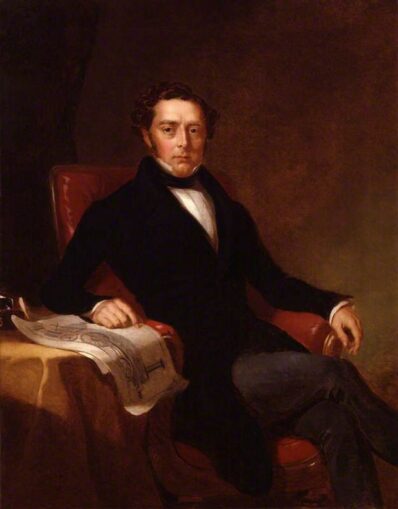
John Lucas, Public domain, via Wikimedia Commons
By his teens, Robert was helping his father survey colliery lines. At 19 he was apprenticed to Nicholas Wood at Killingworth Colliery, but he was already showing symptoms of tuberculosis (the disease that had killed his mother). He was down West Moor Pit when an underground explosion ripped through the tunnels. His master released him early.
In 1823, aged 20, Robert became managing partner of Robert Stephenson & Company in Newcastle, the world’s first locomotive factory. His father’s name was on nothing. The company was Robert’s. He was running it before he could legally drink in a modern pub.
Three years in the jungle
And then he left.
In June 1824, Robert sailed from Liverpool for South America. The Colombian Mining Association had hired him to reopen gold and silver mines in what was then Gran Colombia (modern-day Colombia and Venezuela). The country had just won independence from Spain. British investors smelled opportunity. Robert, aged 20, was their man on the ground.
He spent 3 years in tropical heat, managing mines, fighting malaria, and dealing with supply chains that made Victorian Britain look efficient. The mines were mostly played out. The venture was a failure.
In Cartagena, waiting for a ship home, Robert bumped into a man called Richard Trevithick. Trevithick had built the first steam locomotive back in 1804, decades before the Stephensons. He’d been prospecting for gold in Peru and Costa Rica, and was completely skint. Couldn’t afford passage home. Robert gave him £50. The pioneer of steam locomotion got back to England because his greatest rival’s son lent him the fare.
The Rocket (which was Robert’s, not George’s)
Robert returned to England in 1827 and walked straight back into the locomotive business. The Liverpool and Manchester Railway was being built, and its directors were holding a competition to decide whether steam locomotives or stationary engines would haul the trains. The Rainhill Trials. October 1829. £500 prize.
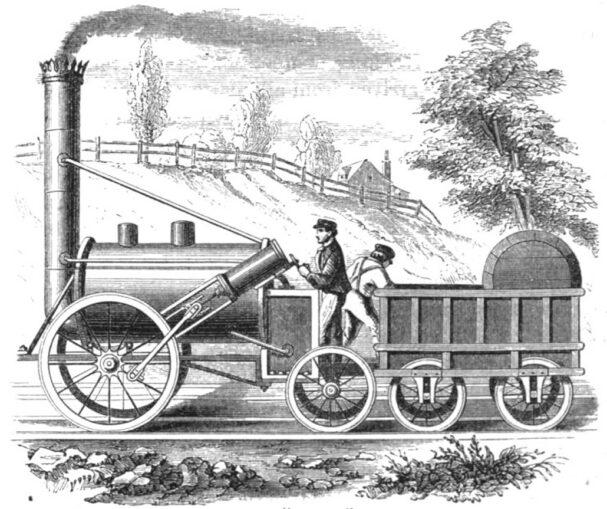
The Rocket is usually credited to George but it shouldn’t be. It was Robert who designed it. The key innovation, a multi-tube boiler with 25 small copper tubes instead of one large flue, was Robert’s. Henry Booth, the railway’s treasurer, suggested the concept; Robert engineered it into a working machine. George’s input was advisory. Robert was 26.
uncredited, Public domain, via Wikimedia Commons
Rocket averaged 12 mph hauling 13 tons. Top speed: 30 mph, faster than any human being had ever travelled on land. It won. And the multi-tube boiler went into every steam locomotive built for the next 130 years. That isn’t a typo. 130 years.
London to Birmingham (and the tunnel that nearly killed him)
In 1833, Robert was appointed chief engineer of the London and Birmingham Railway, the first major trunk line into the capital. He was 29. The project nearly broke him.
The route ran 112 miles through some of the most awkward terrain in England. Landowners fought him at every turn. The original survey had to be scrapped after opposition from Northampton interests. Robert resurveyed an alternative route to the west, which solved the political problem but created an engineering one: Kilsby Tunnel.
Kilsby was supposed to be routine. Trial borings suggested solid ground but were incorrect. Within months of digging, the second working shaft flooded. Beneath 40 feet of clay sat a layer of quicksand, waterlogged and several miles wide, 120 feet below the surface. The tunnel was filling faster than they could dig.
Robert considered abandoning it so talked to his father. George told him to pump. So Robert installed steam engines with a combined 160 horsepower over the shafts and ran them continuously for 8 months, pulling out 2,000 gallons of water per minute, around the clock. Twenty-six workers died during construction. The tunnel took 3 years and cost £320,000, triple the estimate. But it held.
The London and Birmingham Railway opened in 1838. It was the first trunk railway into London, and it changed the country overnight. Robert was 34.
The bridge builder
If Robert had stopped after the London and Birmingham, he’d still be one of the most important engineers in British history. He didn’t stop. He pivoted to bridges, and what he built in the next decade is staggering.
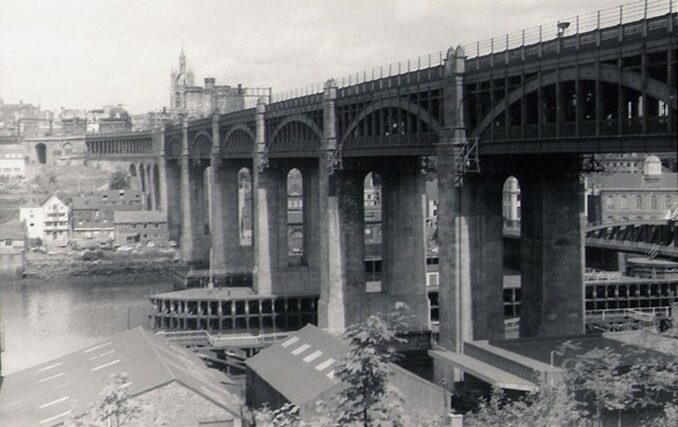
The High Level Bridge in Newcastle (1849) was a double-decker: railway on top, road underneath, carried on cast-iron arches spanning the Tyne. Opened by Queen Victoria, it still carries traffic today, 176 years later.
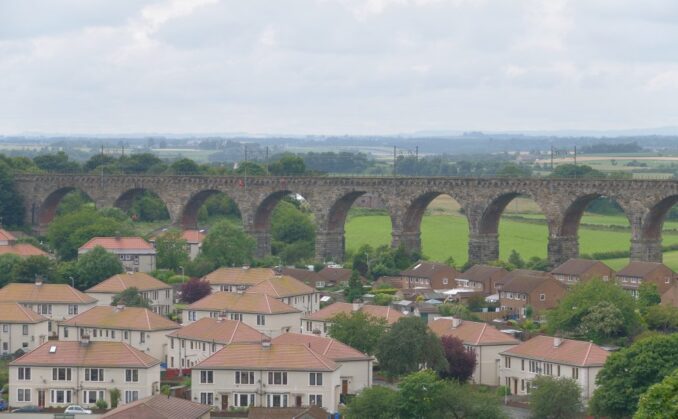
The Royal Border Bridge at Berwick-upon-Tweed (1850) is a 28-arch stone viaduct, 126 feet above the River Tweed. It’s the reason trains can cross from England into Scotland on the East Coast Main Line. Victoria opened that one too.
mattbuck (category), CC BY-SA 2.0 <https://creativecommons.org/licenses/by-sa/2.0>, via Wikimedia Commons
But the big ones were in Wales.
Not credited. It is unlikely that any artist would have still been alive in 1944., Public domain, via Wikimedia Commons
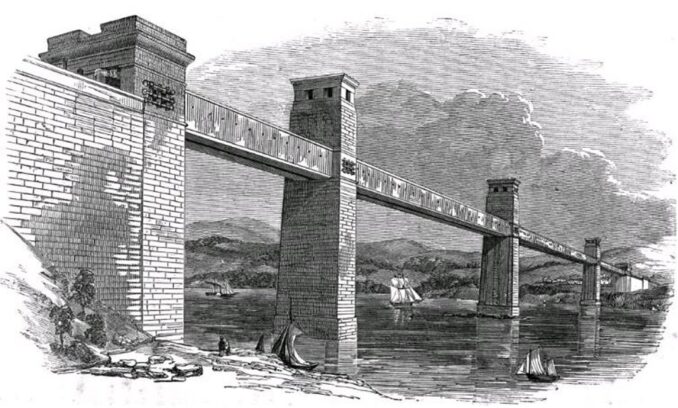
The Britannia Bridge across the Menai Strait (1850) was something engineers said couldn’t be done. Robert had to carry a railway across a tidal strait with clearance for tall ships. Suspension bridges sagged under heavy loads. Arches were out because the Admiralty refused to allow construction piers in the channel.
Robert’s solution was radical: a continuous wrought-iron tube, rectangular in cross-section, big enough for a train to run through. He developed it with Eaton Hodgkinson and William Fairbairn, testing scale models to destruction. The tubes were built on shore, floated into position on pontoons, and jacked up into place. Each main span weighed over 1,500 tons.
It carried trains for 120 years until a fire in 1970 forced a rebuild. The engineering principle, the box-girder bridge, became one of the most widely used structural forms in the world.
Roger Cornfoot / High Level bridge
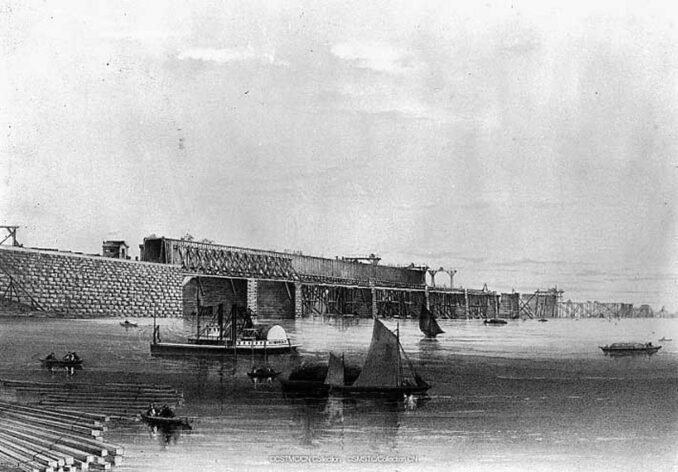
And then there was Canada. The Victoria Bridge in Montreal (1859) used the same tubular principle across the St. Lawrence River. At 2 kilometres, it was the longest bridge in the world. They called it the Eighth Wonder of the World, which for once wasn’t just Victorian hyperbole. Robert never saw it finished as sadly he died two months before the first train crossed it.
Images Canada, Public domain, via Wikimedia Commons
The Dee Bridge (and the disaster that haunted him)
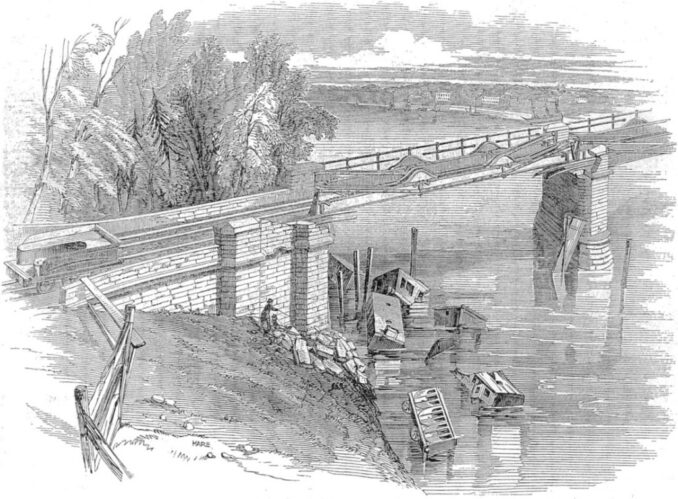
On 24 May 1847, a passenger train crossed the Dee Bridge in Chester. The bridge, designed by Robert, collapsed under the train. The carriages fell into the river, claiming the lives of five people.
uncreditedIt is unlikely that the author would have lived after 1944., Public domain, via Wikimedia Commons
The coroner’s inquest accused Robert of negligence. The Railway Inspectorate concluded that his design was fundamentally flawed: the cast-iron girders were too weak, and the wrought-iron trusses he’d added did nothing to reinforce them. Cast iron, the jury noted, was a “treacherous” material prone to sudden fracture.
Robert arrived at the inquest pale and haggard. He’d been prepared to admit liability, but was talked into presenting a defence. The jury returned a verdict of accidental death. Robert was cleared. But the disaster changed bridge engineering permanently. Cast iron fell out of favour for railway bridges. Wrought iron, and later steel, took over.
Robert never publicly discussed the Dee Bridge collapse but by most accounts, it weighed on him for the rest of his life.
The wife, the yacht, and the slow collapse
Robert married Frances Sanderson (known as Fanny) on 17 June 1829, the same year as the Rainhill Trials. They had no children. In 1840, Fanny was diagnosed with cancer. Robert stopped work for 5 days to be with her before she died on 4 October 1842.
His diary entry that day: “My dear Fanny died this morning at five o’clock. God grant that I might close my life as she has done, in true faith and in charity with all men. Her last moments were perfect calmness.”
Fanny had asked him to remarry and have children. He never did. He went back to work within days of the funeral, and he never really stopped again.
By the late 1840s, Robert was working on an absurd number of projects simultaneously. He eventually took on 160 commissions from 60 different companies. Railways in Belgium, Norway, Denmark, Switzerland, Egypt, India. Bridges across rivers that had never been bridged. He was consulting engineer to half of Europe.
In 1847, he was elected Conservative MP for Whitby, because apparently he didn’t have enough to do. He rarely spoke in Parliament but when he did, it was about engineering.
He bought a yacht, the Titania, and sailed it obsessively. It was the closest thing he had to rest. His friends noticed he was drinking more. His health was deteriorating. He was exhausted, grieving, and carrying the weight of every bridge, tunnel, and railway that bore his name.
He was offered a knighthood. He turned it down, just as his father had.
Westminster Abbey
Robert Stephenson died on 12 October 1859, aged 55. He’d been ill for months. The cause was listed as congestion of the liver, likely compounded by years of overwork, stress, and alcohol.
His funeral was extraordinary. Queen Victoria gave permission for the cortege to pass through Hyde Park, an honour previously reserved for royalty. Three thousand mourners crammed into Westminster Abbey. He was buried in the nave, next to Thomas Telford, the great canal and road engineer. A stained-glass window was later installed nearby, designed by William Wailes.
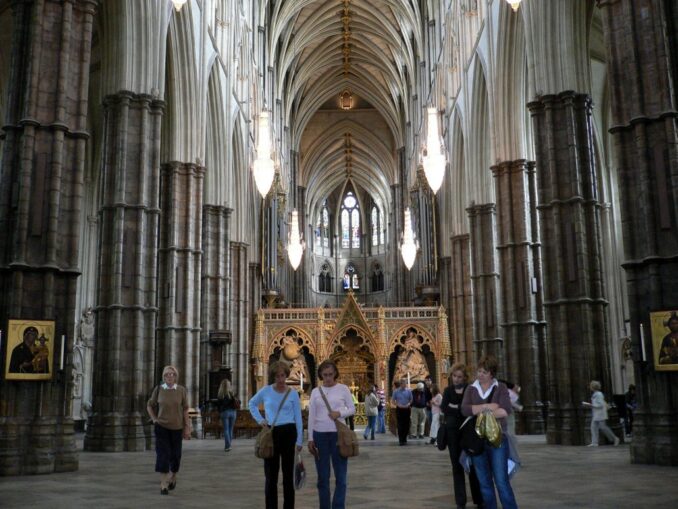
Herry Lawford from London, UK, CC BY 2.0, via Wikimedia Commons
George Stephenson got a statue outside Newcastle Central Station. Robert got Westminster Abbey.
The numbers
So in Robert’s career spanning roughly 30 years he built:
- The Rocket, and the locomotives that followed it.
- The London and Birmingham Railway.
- The High Level Bridge.
- The Royal Border Bridge.
- The Britannia Bridge.
- The Conway Bridge.
- The Victoria Bridge in Montreal, the longest bridge in the world.
- Railways across 6 countries. 160 commissions.
- The world’s first locomotive factory.
The Institution of Civil Engineers called him the greatest engineer of the 19th century. He served as president of both the Institution of Civil Engineers and the Institution of Mechanical Engineers. Fellow of the Royal Society. Commissioner for the Great Exhibition of 1851, alongside Brunel.
I leave it to the readers to debate whether he was a greater engineer than Brunel.
And yet. Ask someone who built the Rocket, and they’ll say George. Ask who built the first railway, and they’ll say George. Ask who Stephenson was, and they’ll mean George. Robert did the harder work, solved the harder problems, and built the things that actually carried the trains.
He died at 55, exhausted, childless, and largely overshadowed by his own father. He’s buried among kings, poets, and scientists in Westminster Abbey, and most people walk right past without knowing his name.
[Editorial tangent – BUT… and there is a but… it’s one thing to build something and quite another to keep it working regularly. His article will be next…]
© Paranoid Android 2026


_-_Robert_Stephenson_-_NPG_5792_-_National_Portrait_Gallery.jpg)
.jpg)

.jpg)
