
Born in the same village as George Stephenson, 5 years earlier. The man who saved the Stockton and Darlington when the engines kept breaking down. The man who built Russia’s first locomotive… and then vanished from history.
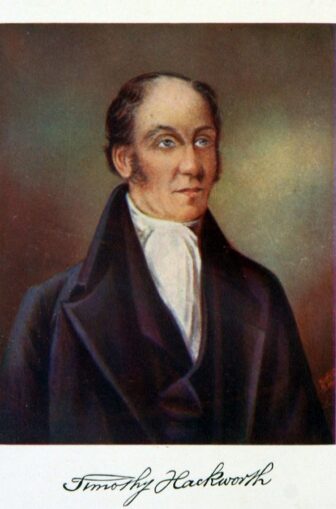
Public domain, via Grace’s Guide.
The story of the railways has a beginning, a middle, and an ending that everyone agrees on. George Stephenson built the Stockton and Darlington. Robert Stephenson designed the Rocket. Brunel did the Great Western. Between them they account for roughly 100% of the credit and about 60% of the actual work.
A large part of the missing 40% can be attributed to a man called Timothy Hackworth. He was the first Locomotive Superintendent of the world’s first public railway. He built one of Canada’s first locomotives. And he entered a competition with a machine built in a shed, using cylinders cast by his rival’s factory, and nearly won.
Then Samuel Smiles wrote a book about the Stephensons, and Hackworth more or less vanished from history.
The blacksmith’s son from Wylam
Timothy Hackworth was born on 22 December 1786 in Wylam, Northumberland in literally the same village and the same row of cottages where George Stephenson was born in 1781. They grew up within spitting distance of each other, and both ended up shaping the railway age.
One got the glory. The other got a museum in Shildon that most people drive past without noticing.
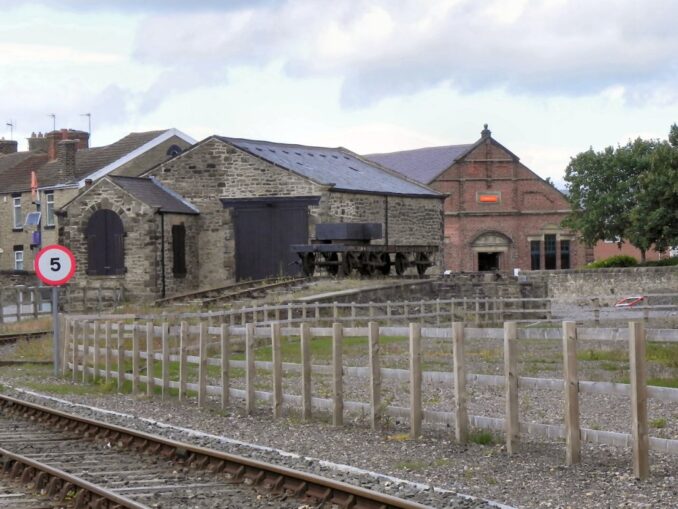
David Dixon / Locomotion Railway Museum, Shildon
His father, John Hackworth, was the foreman blacksmith at Wylam Colliery. Timothy was apprenticed to him as a boy and took over the position when John died in 1804. He was 17. Running the colliery forge, maintaining winding engines, keeping the mine infrastructure from falling apart. It was a good trade and a steady life.
He was also a committed Methodist, which in early 19th-century Northumberland was a bit like being vegan at a hog roast. It defined everything about him: his work ethic, his integrity, his stubbornness, and eventually his career.
“Lose or not lose, I shall not break the Sabbath”
At Wylam, Hackworth worked alongside William Hedley on some of the earliest steam locomotives ever built, including the famous Puffing Billy (1813). He was there at the very beginning of locomotive engineering, hands on the metal, solving the problems that everyone else was still theorising about.
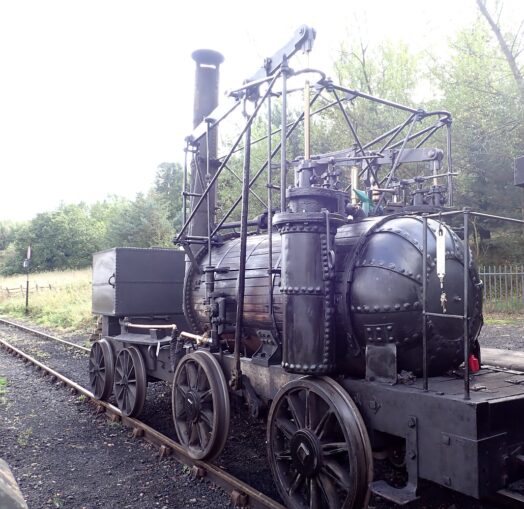
Beamish – Replica of ‘Puffing Billy’ by Rob Farrow, CC BY-SA 2.0, via Wikimedia Commons
But in 1816, the colliery asked Hackworth to work on a Sunday. He refused. His Methodist faith was absolute on this point. When his employers pushed, he pushed back with those words: “Lose or not lose, I shall not break the Sabbath.”
He lost his job. He packed up and moved to Walbottle Colliery, and then to Forth Street in Newcastle, where he worked under George Stephenson at Robert Stephenson & Company. In 1824, when Robert Stephenson left for South America and George was busy surveying new lines, Hackworth effectively ran the factory. He was apparently offered the job of manager and a share in the company. He turned it down.
Why? Nobody knows for certain. Maybe he wanted his own operation. Maybe he saw how the Stephensons worked and decided he’d rather answer to himself. Either way, he walked away from what would become the most important locomotive factory on Earth.
The man who saved the Stockton and Darlington
In May 1825, Hackworth was appointed the first Locomotive Superintendent of the Stockton and Darlington Railway. This is the job that should have made him famous.
The Stockton and Darlington, opened in September 1825, was the world’s first public railway to use steam locomotives. It was also, in its early months, a disaster. The locomotives kept breaking down. George Stephenson’s Locomotion No. 1, which hauled the first train, was unreliable. The other engines were worse. The railway’s directors were seriously discussing scrapping steam power altogether and going back to horses.
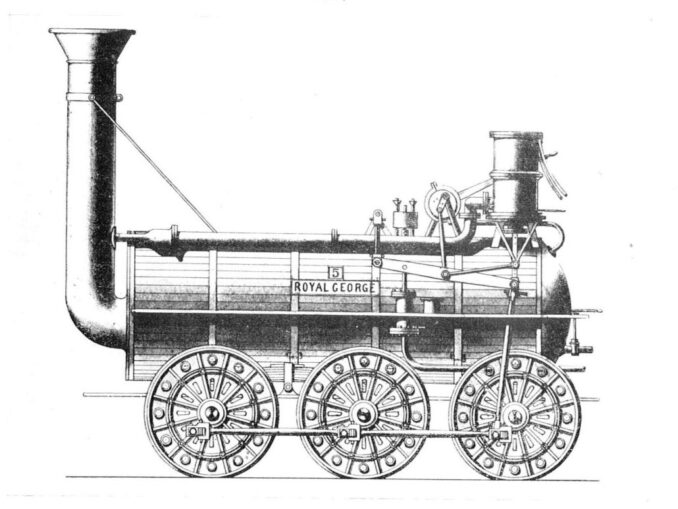
1829 author unknown, Public domain, via Wikimedia Commons
Hackworth’s job was to stop that from happening. He redesigned the machines from the wheels up. In 1827 he built the Royal George, which was a proper working locomotive: reliable, powerful enough to haul coal trains at commercial speeds, and maintainable. It used a return-flue boiler and a blastpipe arrangement that Hackworth had been refining for years.
The Royal George proved that steam traction could work commercially, day after day, mile after mile. Without it, the directors would have pulled the plug on locomotives. The entire railway age might have stalled before it started. Hackworth kept the lights on while the Stephensons collected the medals.
The Rainhill Conspiracy
This would not be a good GP article without the obligatory conspiracy theory, so here we go…
In October 1829, the Rainhill Trials were held to determine what motive power the Liverpool and Manchester Railway would use. Hackworth entered Sans Pareil. The Stephensons entered the Rocket.
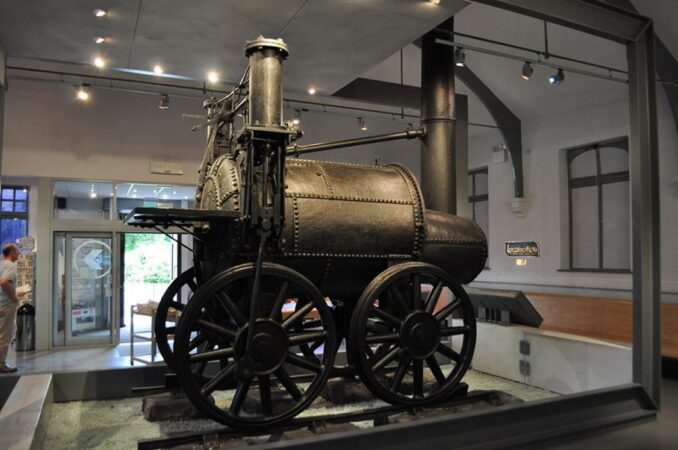
Ashley Dace / Sans Pareil
Hackworth had none of the Stephensons’ resources. Robert Stephenson & Company was by now a proper factory with skilled workers and capital. Hackworth built Sans Pareil in a shed at Shildon, at his own expense, while also doing his full-time job running the Stockton and Darlington’s locomotive fleet. He had to contract out the casting of individual parts to various workshops.
Including the cylinders. Which were cast by Robert Stephenson & Company.
Sans Pareil ran well. It completed 8 trips and hit 16 mph. Then a cylinder cracked and it had to withdraw. Here’s the detail that stings: the cracked cylinder came from the Stephensons’ foundry. Hackworth believed, for the rest of his life, that the Stephensons had deliberately given him a defective casting. Most historians think this is unlikely (Hackworth was given a choice of 20 cylinders). But it didn’t look good and Hackworth, needless to say, was extremely bitter.
The Rocket won. Sans Pareil was bought by the Liverpool and Manchester Railway anyway and ran in service until 1831. It still exists. You can see it at the National Railway Museum in Shildon.
Russia, Canada, and everywhere else
After the Rainhill disappointment, Hackworth went back to Shildon and kept building. In 1836, he built the first locomotive to run in Russia for the Tsarskoye Selo Railway. His son, John Wesley Hackworth, was sent out to deliver it and run the preliminary trials.
The line’s purpose was to prove to Tsar Nicholas I that Russia could build and maintain its own railways, even through a Russian winter. A locomotive built by a Methodist blacksmith from County Durham chugged across the snow outside St Petersburg, and the Tsar was convinced. Russian railways began.
No photograph of the locomotive survives, but a drawing from the Hackworth family archive appears on the cover of Robert Young’s Timothy Hackworth and the Locomotive (1923). For further detail on why it was not the Stephensons who brought railways to Russia, see the extremely geeky footnote at the end of this article.
In 1838, Hackworth built the Samson for the Albion Mines Railway in Nova Scotia. It arrived in Canada in 1839 and became one of the first locomotives to operate in the country. The Samson survived. It’s now in the Nova Scotia Museum of Industry, one of the oldest surviving locomotives in the Americas.
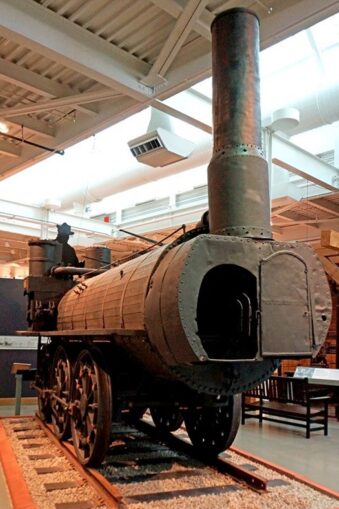
Dennis G. Jarvis, CC BY-SA 2.0, via Wikimedia Commons
Between Russia and Canada, Hackworth was also building engines for collieries across the North East, for the Clarence Railway, and for anyone else who needed a reliable machine. His reputation among the people who actually used locomotives was enormous. His reputation in the history books was about to be erased.
The Soho Works and the final locomotive
In May 1840, Hackworth resigned from the Stockton and Darlington Railway to concentrate on his private business full-time. He’d been superintendent for 15 years. He set up the Soho Engine Works in Shildon, eventually growing it to 6 acres, and built locomotives, stationary engines, and boilers.
His last locomotive was the Sanspareil No. 2, a callback to the name of his Rainhill entry. He kept refining his designs right to the end. One of his 1833 apprentices, Daniel Adamson, would go on to further develop Hackworth’s boiler designs and become a successful manufacturer in his own right.
On 7 July 1850, Timothy Hackworth died of typhus at Soho Works, Shildon. He was 63. A typhus outbreak had swept through the area, and Hackworth, who had worked himself ragged for decades, didn’t have the reserves to fight it off. He left behind his wife Jane, six daughters, and three sons.
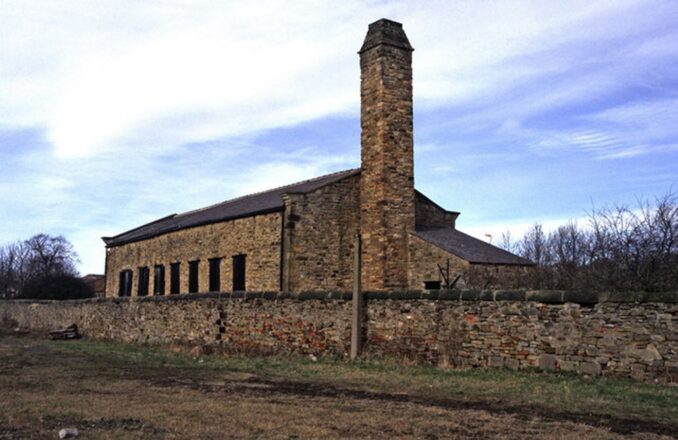
Timothy Hackworth Victorian Railway Museum, Shildon by Chris Allen, CC BY-SA 2.0, via Wikimedia Commons
The family who fought for his name
After Hackworth died, his contribution to railway history was steadily erased. Samuel Smiles published Lives of the Engineers in 1857, and the Stephensons got the starring roles. Hackworth was mentioned. Barely. The book sold enormously and became the default version of railway history for a century.
His family fought back. His eldest son, John Wesley Hackworth, spent years gathering evidence and promoting his father’s legacy. He wrote letters, gave talks, and pestered historians. It made very little difference. The Stephenson narrative was set in stone.
In 2021, Historic England upgraded the listing of Hackworth’s house at Soho, Shildon, acknowledging him as an “unsung hero of the railway revolution.” That phrase, 171 years after his death, is about as close to an official apology as history gets.
But ask anyone who invented the railways, and they’ll say Stephenson. Ask who made the Rocket, and they’ll say Stephenson. Ask who kept the first railway running when the engines kept breaking down, and you’ll get a blank look.
What he actually did
Strip it back and Hackworth’s contribution is this: George Stephenson built the Stockton and Darlington Railway. Robert Stephenson designed the Rocket. Timothy Hackworth kept the Stockton and Darlington alive when George’s locomotives were failing, and without that, there would have been no railway for the Rocket to prove itself on.
He built Russia’s first locomotive. He built one of Canada’s first locomotives. He ran a 6-acre engineering works. He entered a competition with a machine built in a shed, and the cylinder that broke came from his competitor’s factory.
And he lost his first job because he wouldn’t work on a Sunday.
George Stephenson is the father of railways. Robert Stephenson is arguably the greatest engineer of the Victorian age. Neither of them would have likely made it into the annals of history without Hackworth.
A footnote for the locomotive pedants
Go looking for Hackworth’s Russian engine online and you’ll find plenty of images labelled Provorny (‘Agile’ in Russian): a handsome museum model with ПРОВОРНЫЙ painted on the tender, a full-size replica at St Petersburg’s Vitebsky station, and the famous watercolour of the opening train steaming past the crowds. Every one of them shows a Robert Stephenson & Company engine.
The Tsarskoye Selo Railway bought engines from several English builders. Hackworth’s arrived first, in late 1836, and ran the winter trials that convinced the Tsar. Provorny, built by the Stephensons, hauled the official opening train on 30 October 1837. Russia commemorates the opening, so Provorny got the replicas, the models, and the watercolour. The Stephensons upstaged Hackworth even in St Petersburg.
The only known picture of Hackworth’s actual machine is the drawing from the family archive on the cover of Robert Young’s Timothy Hackworth and the Locomotive (1923). If the image you’ve found looks shinier than a 1923 book cover, it’s probably the wrong engine.
© Paranoid Android 2026


.jpg)
.jpg)
