
George Stephenson gets the statues. But a plain-dressing Quaker wool merchant from Darlington put up the money, drove the Act through Parliament, and hired Stephenson in the first place. He helped found the world’s first locomotive works too. Then he missed the opening day, because his son had died the night before.
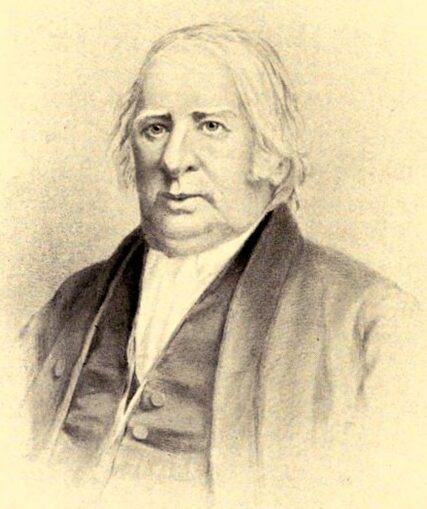
See page for author, Public domain, via Wikimedia Commons
There is a long-running argument about who should be called the father of the railways. George Stephenson is the usual answer, and he has the statues and the banknote to prove it. But whilst Stephenson (and subsequently his son) built the railway, he did not pay for it, did not think of it, and did not hire himself. The man who did all three was a retired wool merchant from Darlington who wore plain Quaker grey and felt guilty about every penny he made.
His name was Edward Pease and he is perhaps the Grandfather of the railways.
A wool merchant with an idea
Pease was born in Darlington on 31 May 1767 into a Quaker family in the wool trade, and he spent his working life buying and selling fleeces across the North of England. Quakers were barred from the universities and the professions, so they went into business and banking. Pease did very well from this trade.
On his travels he kept noticing the same bottleneck. The coalfields of west Durham were full of coal, the port of Stockton was crying out for it, and between the two lay miles of bad road and slow carts. There ought, he thought, to be a railway: a horse-drawn waggonway to haul the coal cheaply to the sea (yes, horse-drawn, but I promise the trains come shortly). When he reached his fifties he retired from the wool business to make it happen.
Plenty of people had wanted to move that coal more cheaply, and for decades the favoured answer had been a canal. Pease argued instead for a railway, cheaper to build across the Durham hills and far better suited to coal. It was not an obvious bet in 1818, when railways meant horses dragging chaldron waggons along colliery lines, but Pease saw further than the canal men did.
The Act, and the walk
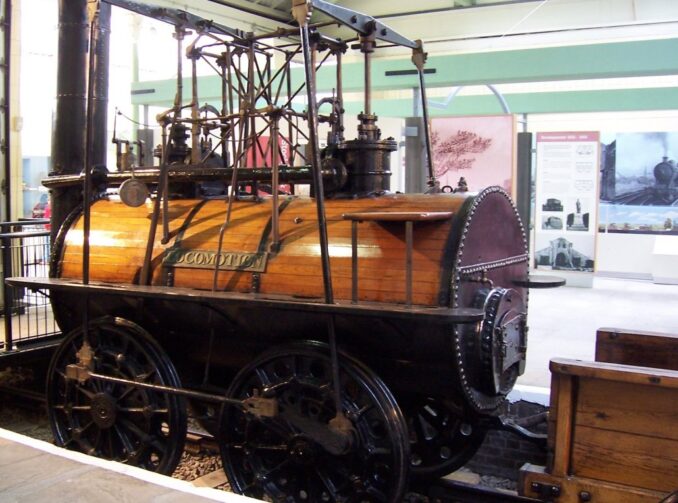
Chris55, CC BY-SA 3.0, via Wikimedia Commons
In 1821 Pease gathered a group of local businessmen, mostly fellow Quakers, and formed the Stockton and Darlington Railway company. On 19 April 1821 their Act of Parliament passed, authorising a horse-drawn railway between the two towns. As far as Pease was then concerned, the engines would have four legs.
Getting there took stubbornness. An earlier bill had been thrown out in 1819, defeated in part because the proposed line ran straight through the fox coverts of the Duke of Cleveland, who had no intention of letting a coal railway spoil his hunting. The route was redrawn to keep the Duke’s foxes happy, and Pease and his allies came back and tried again until Parliament gave way.
Then a man walked into his life, literally. George Stephenson, the enginewright at Killingworth Colliery, came to Darlington with the colliery manager Nicholas Wood to make a case: forget horses, use steam locomotives. By one well-worn account Stephenson had walked a good part of the way, and arrived on the very day the Act passed. Pease listened, then went up to Killingworth to watch Stephenson’s engine Blucher hauling coal for himself. He came home convinced, and offered Stephenson the job of chief engineer.
It was the single most important hiring decision in the history of transport, and a Darlington Quaker made it on the strength of his own eyes.
Pease warmed to Stephenson personally as well as professionally. He noted the engineer’s plain, honest, unpretending manner, the look of a man who knew his trade and would not bluff, which to a plain-dealing Quaker counted for a great deal. The pitman’s son and the wool merchant trusted each other on sight.
The first locomotive works
Pease did not stop at funding the line. In 1823 he put up money, alongside George and Robert Stephenson and a fellow Quaker financier, Thomas Richardson, to set up Robert Stephenson and Company in Newcastle, the first business anywhere in the world established specifically to build railway locomotives. Nearly every early engine of the railway age, including the Rocket, came out of a works that Edward Pease helped bankroll.
He was, in effect, the venture capitalist of the railway revolution, except that he was a pacifist Quaker who agonised over spending money rather than chasing it.
27 September 1825
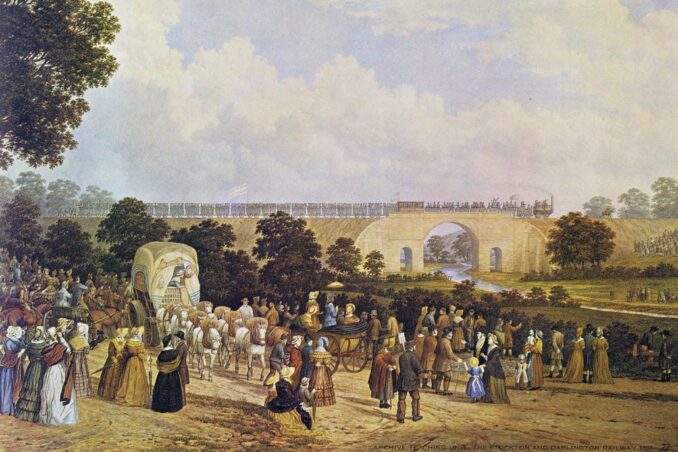
John Dobbin, Public domain, via Wikimedia Commons
On 27 September 1825 the Stockton and Darlington Railway opened, the first public railway in the world to run steam locomotives, with Locomotion No. 1 hauling a train of coal and passengers while crowds lined the route. It was the day Edward Pease had worked towards for a decade, the proof that his idea and his money had built something the world had never seen.
He was not there. His son Isaac had died the night before, and Pease stayed at home with his grief while the railway he had created made history a few miles away.
The reluctant capitalist
Pease never wore his success comfortably. He was a strict, plain Quaker who dressed simply and distrusted display, and his private diaries are full of self-reproach about his worldly riches and anxiety about his sons’ ever-bolder business ventures. He had helped unleash the most transformative industry of the century, and part of him worried it was all a bit too much for the world.
The family he founded had no such doubts. His son Joseph Pease became the first Quaker to sit in Parliament, and the Pease dynasty grew into a coal, iron and railway empire that dominated the North East for generations. Edward sat at the head of it, in plain grey, fretting.
He died at his house in Darlington on 31 July 1858, rich, respected and uneasy about both. George Stephenson got the title, the statues and the fame, and earned them. But the railway age needed someone to believe in it with an open chequebook before a single rail was laid, and that someone was a wool merchant from Darlington.
He had lived long enough, dying at 91, to watch the thing he doubted reshape the entire planet. “Let the country make the railroads,” Pease is supposed to have said, “and the railroads will make the country.”
He spent his life dreading fame, and history, for once, obliged. Nobody remembers Edward Pease, and he is perhaps the only man in this whole railway series who would have been pleased about it.
© Paranoid Android 2026


