
Before George Stephenson’s name ended up on everything, a colliery manager from Newburn settled the one argument that decided whether railways would ever work. He won it with a hand-cranked cart, two iron engines, and a refusal to believe the experts. Then history moved on without him.
Editorial Note: A word before we begin. I never planned a railway sub-series, but the North East and Northumberland produced so many people who built the railways that one article led to the next, and, well, here we are.
One caveat while we are at it. Plenty of famous names are tied to the story of the railways whom I won’t be covering, Isambard Kingdom Brunel chief among them, because they fall outside the geographic focus of this series. That being said, I might change my mind one day.
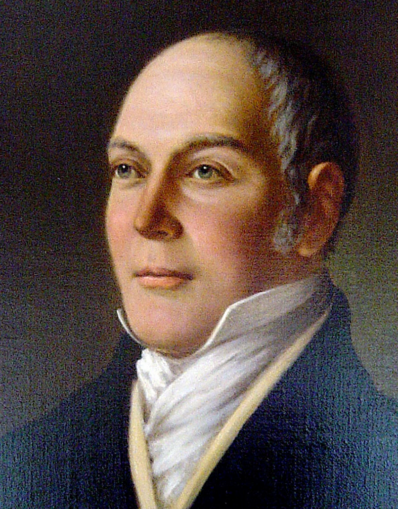
William Hedley (1808 painting), public domain; high-resolution scan via Grace’s Guide, CC BY-SA 4.0
The argument that held everything up
In the 1810s the great unanswered question in the coal trade was simple yet most people today would find it incredulous. Specifically – if you put a heavy iron engine on smooth iron rails, would the wheels actually grip and pull, or would they just spin on the spot like a dog scrabbling on a kitchen floor?
Most of the clever men of the day were certain they would spin. The accepted wisdom said a smooth wheel on a smooth rail could never get enough purchase to drag a real load. Richard Trevithick had already built a working steam locomotive back in 1804, and it ran well enough to win its owner a bet, but it was so heavy it cracked the cast-iron rails to bits. Everyone took the wrong lesson from that: steam on rails was a dead end.
So engineers built increasingly crazy workarounds. John Blenkinsop and Matthew Murray cut teeth into one rail and ran a cog along it, like a zip fastener made of iron. William Brunton built a contraption with mechanical legs that physically pushed itself along the ground from behind. His machine later blew up and killed several bystanders, which tells you roughly how settled the science was.
Hedley thought the whole thing was nonsense. And he set out to prove it with the least glamorous piece of equipment in railway history.
The cart that settled it
Hedley was the viewer at Wylam Colliery, which is the old word for the man who ran the pit. He had been there since 1805. In 1812 the mine’s owner, Christopher Blackett, relaid his waggonway with iron and wanted to know if a steam engine could ever earn its keep on it.
So Hedley built a test carriage. No engine, no boiler, just a wagon frame fitted with gears and a crank that men turned by hand. He piled different weights onto it, measured how much each load could haul before the wheels slipped, and worked out the precise relationship between the weight pressing down on the wheels and the grip they got back from the rail.
It was dull, methodical, and completely decisive. The numbers proved that a heavy enough engine, with its weight spread across coupled wheels, would grip the rail and pull many times its own weight. The exact thing the experts had ruled out was sitting there, working, on a hand-cranked cart in Northumberland.
That single result is why most trains on Earth today run on plain smooth rails instead of clawing its way along a giant cog.
Building Puffing Billy
Knowing a thing is possible and building it are two different jobs. Hedley’s first powered attempt, a single-cylinder engine made to Trevithick’s pattern and nicknamed Grasshopper, was a letdown. It wheezed, stalled on the gentlest slope, and could not keep up steam.
So he went again. For the second attempt he brought in two men whose names would outlast the machine. One was his engine-wright, Jonathan Forster. The other was his foreman blacksmith, a young Wesleyan with firm opinions and firmer forearms named Timothy Hackworth, who did of course feature in the previous article.
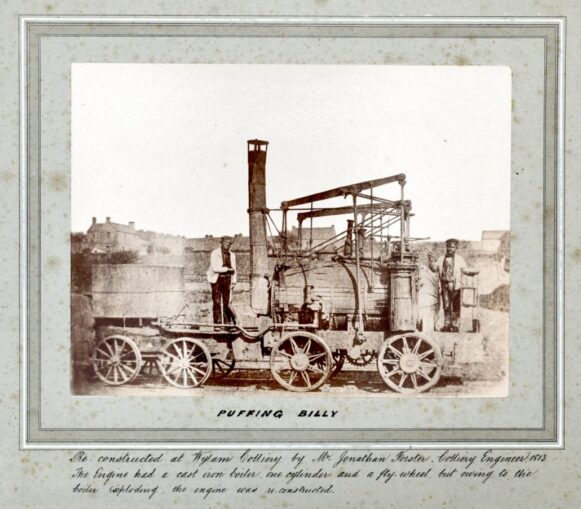
Unknown photographer, Public domain, via Wikimedia Commons
Around 1813 and 1814 the three of them built Puffing Billy. Two vertical cylinders, one on each side of the boiler, drove a crankshaft slung underneath that geared the wheels together so they all turned as one. It hauled coal wagons from Wylam down to the staithes at Lemington at a giddy 5 miles per hour. It leaked steam from every joint but it worked. Hedley patented the wheel-coupling arrangement the same year.
They liked it enough to build a near-identical sister called Wylam Dilly. Two engines, doing the work of dozens of horses, on rails, by grip alone. The argument was over, even if the rest of the country took years to notice.
A small problem with the rails
Puffing Billy had one embarrassing habit. It weighed about 8 tons, and the brittle cast-iron plates of the early track kept snapping under it. The opponents of steam pointed and laughed.
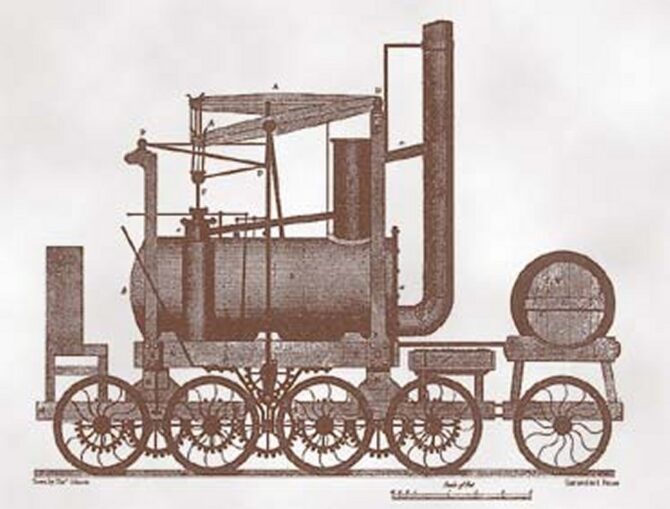
See page for author, Public domain, via Wikimedia Commons
Hedley’s fix was wonderfully blunt. If an engine on four wheels broke the rails, he would spread its weight across more of them. Both locomotives were rebuilt on eight wheels so the load sat lighter on each plate. When the line was relaid with stronger edge rails around 1830, he simply put them back on four. The engines stayed in service until 1862, by which point they had been at it for roughly half a century.
The day a locomotive went to sea
Here is the detail that ought to be in every children’s book and somehow never is.
In 1822 the keelmen of the Tyne went on strike. These were the men who carried coal downriver in flat-bottomed boats called keels, and when they downed tools the coal piled up on the bank and Blackett’s money stopped moving.
Train Photos, CC BY-SA 2.0, via Wikimedia Commons
Hedley’s answer was to take Wylam Dilly off its wheels. He had the locomotive lifted onto a keel, bolted paddle wheels to its sides, and turned his railway engine into a paddle steamer. The improvised tug churned up and down the river hauling the coal the strikers refused to move, and it broke the strike.
As far as anyone can tell, it is the only time in history a steam locomotive has been converted into a boat to win an industrial dispute. Make of that what you will about Hedley as an employer. As an engineer, the man plainly did not believe in problems, only in machines he had not yet bolted together.
Hedley and his links to the other railway greats
Timothy Hackworth was Wylam born and Wylam bred. His father John had been the colliery’s foreman smith until he died in 1804, and in 1810 Timothy took over the same job. So when the pit’s owner, Christopher Blackett, put together the little team that would build Puffing Billy, it came to four men: Blackett, Hedley as the viewer who ran the pit, Jonathan Forster as enginewright, and Hackworth at the forge. Hedley worked out what the engine had to be. Hackworth hammered it into existence. Every iron part that held Puffing Billy together came off his anvil.
That spell in Hedley’s workshop set Hackworth up for everything that followed. In 1825 he became the first locomotive superintendent of the Stockton and Darlington Railway, the world’s first public steam railway, whose engineer was none other than George Stephenson. The blacksmith out of Hedley’s shed was now keeping George Stephenson’s railway running, and he would go on to build engines that ran the length of Britain and even sent the first steam locomotive to Russia.
Then came the famous falling-out. At the Rainhill trials of 1829, the contest to pick the engines for the Liverpool and Manchester Railway, Hackworth entered a locomotive of his own, Sans Pareil, against Robert Stephenson’s Rocket. Sans Pareil ran hard and fast until one of its cylinders cracked, and it lost. The galling detail: that cylinder had been cast at Robert Stephenson’s own works in Newcastle. Hackworth believed to his dying day that the Stephensons had handed him a dud on purpose. Most historians doubt it, since he had been free to choose from a score of castings, but the suspicion never left him. The man Hedley trained at Wylam spent his career orbiting the Stephensons, working under the father and beaten in public by the son.
George Stephenson came to Wylam to learn. When Hedley’s engines began running in 1813, Stephenson, working a few miles off at Killingworth, is documented visiting the colliery more than once to study how Puffing Billy actually did it. A year later he built his own first engine, Blucher. It dragged 30 tons up a gradient at 4 miles an hour, and it gripped the rail through its wheels exactly as Hedley’s did, rather than crawling along a toothed rack like John Blenkinsop’s. Stephenson built on Hedley as openly as Hedley had built on Trevithick.
What Hedley got for going first was the sight of another Wylam man taking the credit. By the 1830s George Stephenson was the Father of Railways, and in 1836, when the writer Dionysius Lardner crowned him father of the locomotive as well, Hedley had had enough. He fired off letters to the Newcastle papers setting out his own prior claim, with dates attached. He was right on the engineering and right on the chronology. It changed nothing. Stephenson was a national institution by then, and Hedley was a wealthy colliery viewer history had already filed under footnote.
The irony runs through three generations. The adhesion principle Hedley pinned down on a hand-cranked cart was the thing George Stephenson scaled up into a railway, and the thing his son Robert then sold to the world, in the locomotives and bridges that carried British engineering onto every continent. The Stephensons got the planet. Hedley got Burnhopeside Hall and a tidy paragraph in the reference books.
Where the engines ended up
There is a strange justice in what survived.
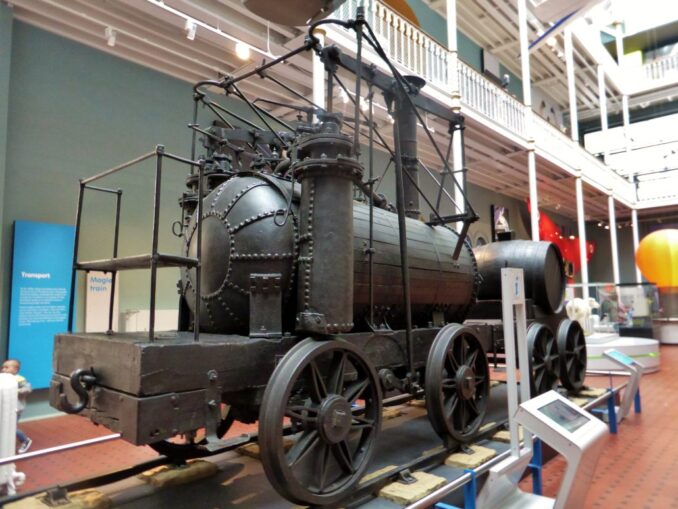
Slashme, CC BY-SA 4.0, via Wikimedia Commons
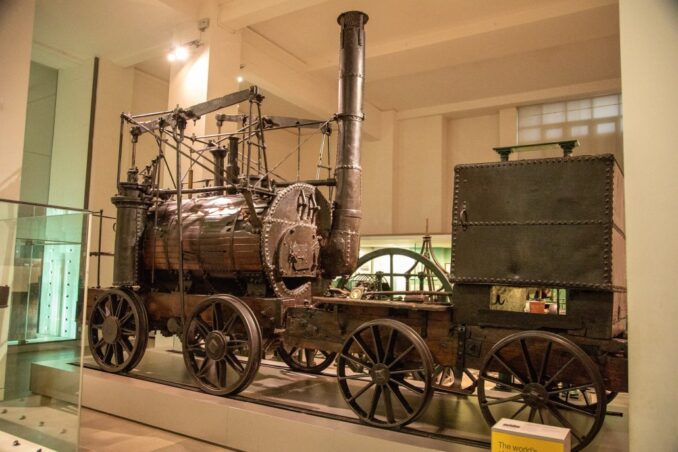
Puffing Billy is now the oldest surviving steam locomotive in the world, sitting in the Science Museum in London, where it has lived since the 1860s. Wylam Dilly, the engine that once went sailing, is in the National Museum of Scotland in Edinburgh. Two of the oldest locomotives anywhere on the planet, both Hedley’s, both still standing. And at Beamish, the open-air museum in County Durham, a full working replica of Puffing Billy, built in 2006 and part-funded by a foundation Hedley’s own descendants endowed, steams up and down the Pockerley Waggonway, so you can still watch his engine do the very thing the experts swore it could never do.
Editorial Note: I’ve noticed quite a few references to Beamish appearing in my articles now so may have to do something about that….
Some people even reckon his engine left a mark on the language. When you do something “like billy-o”, flat out and full pelt, one of the suggested origins is Puffing Billy thundering along at its terrifying 5 miles per hour.
Hedley’s descendants stayed in the coal trade for over a century, right up to nationalisation in the 1940s, and a charitable foundation still carries his name. He never got the column or the cult. What he got was the thing itself: two iron machines, still here two centuries on, proof that the experts were wrong and the cart-pushing colliery manager from Newburn was right.
Hedley proved that the wheels would stick; his name, sadly, has not.
© Paranoid Android 2026




.jpg)
