
He taught Robert Stephenson his trade, judged the Rainhill Trials, and wrote the first proper book on railways, the one that engineers across the world actually used.
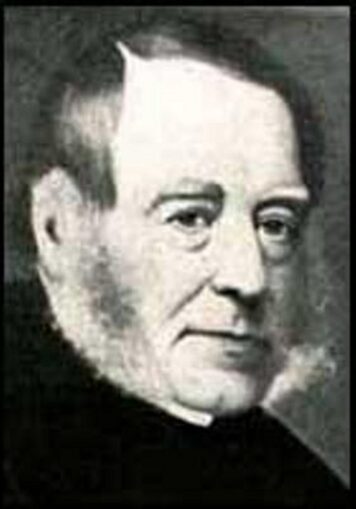
See page for author, Public domain, via Wikimedia Commons
Not all of us can be gallivanting around tinkering with boilers all the time. Every revolution needs someone to write it all down, and the railways were no exception.
The railways had dozens of brilliant mechanics building engines that worked (or blew up), but somebody had to stand back, decide what actually worked, and explain it to the rest of the world. That somebody was a colliery viewer from the Tyne Valley called Nicholas Wood, and he quite literally wrote THE book on railways.
The Killingworth Set
Wood was born at Ryton, west of Newcastle, on 24 April 1795, and as a young man was sent to Killingworth Colliery to train as a viewer, the engineer who ran a pit.
[Editorial Note: you may be starting to notice a theme here…. ]
Killingworth in those years was the centre of the world for anyone interested in steam, because its engine wright was George Stephenson. Wood and Stephenson became close friends, and Wood found himself at the very heart of the group that was inventing the railway.
He was there for the dramas, too. When Stephenson designed his miners’ safety lamp, the “Geordie” (see this article for more details), and was accused of having stolen the idea from the famous chemist Humphry Davy (covered in this article), it was Nicholas Wood who stood up and testified that he had watched Stephenson develop the lamp independently; he was the reliable witness.
The teacher of Robert Stephenson
Nicholas Wood, Public domain, via Wikimedia Commons
Here is a fact that ought to be better known. Robert Stephenson, George’s son and the man who would build the Rocket and span the world with railway bridges (and yes there was an article on this as well), served his apprenticeship under Nicholas Wood at Killingworth between 1819 and 1821. Wood trained him.
Killingworth was, in effect, the world’s first school of railway engineering: a single pit with the best engines, the famous safety lamp, and a circle of self-taught men all solving the same problems. Wood was its star pupil and, soon enough, its teacher.
The Book
[Editorial Note – For extra Geordie effect, please ensure you stress the double ‘o’ as much as possible when saying the word ‘Book’]
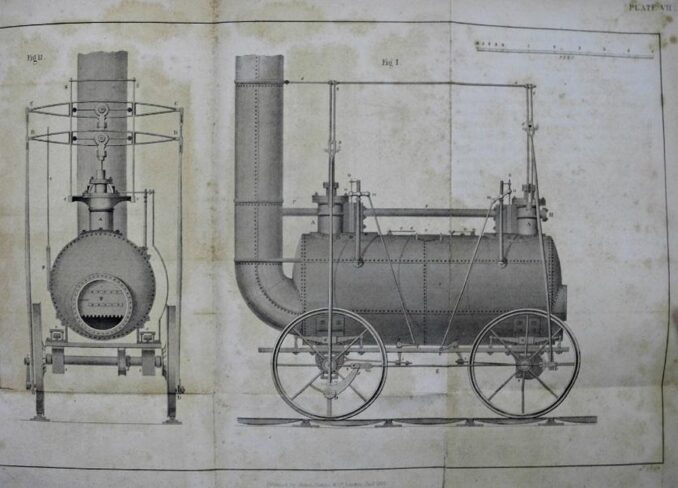
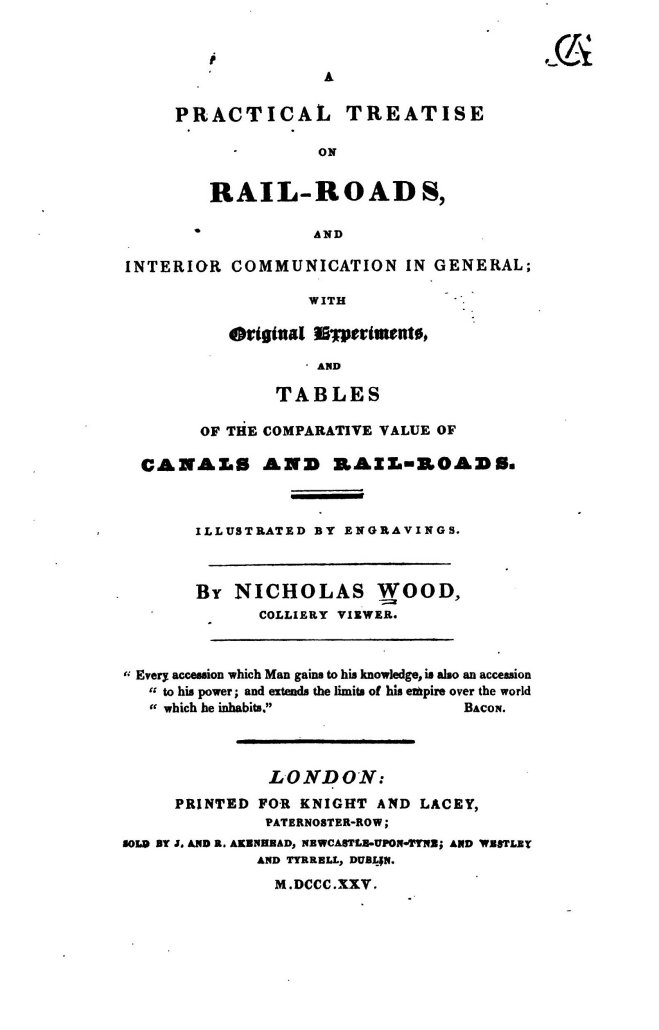
In 1825 Wood published A Practical Treatise on Rail-Roads, and Interior Communication in General. It was the first serious, comprehensive book on the subject, and it was published just as the Stockton and Darlington was about to open and the whole country was suddenly wondering what on Earth a railway actually was. He signed it “Nicholas Wood, Colliery Viewer”, in typical understatement. It was printed for Knight and Lacey of Paternoster Row, London, but sold, of course, by the Akenheads of Newcastle-upon-Tyne.
Public Domain
Wood weighed up the competing ways of moving things along a railway: fixed steam engines hauling waggons by rope, self-acting inclines worked by gravity, horses, and the new locomotive engines. He was cautious and fair, not a locomotive zealot, which is precisely why engineers trusted him. For a generation, anyone anywhere who wanted to build a railway started by reading Nicholas Wood.
The book did not date quickly. It ran through several editions over the next decade, was pored over by engineers from America to the Continent, and stayed the standard reference as railways spread out of the North East and across the world. Its sober tables comparing the cost of canals and railways did as much to win the argument for rail as any single locomotive ever did.
The Umpire at Rainhill
See page for author, Public domain, via Wikimedia Commons
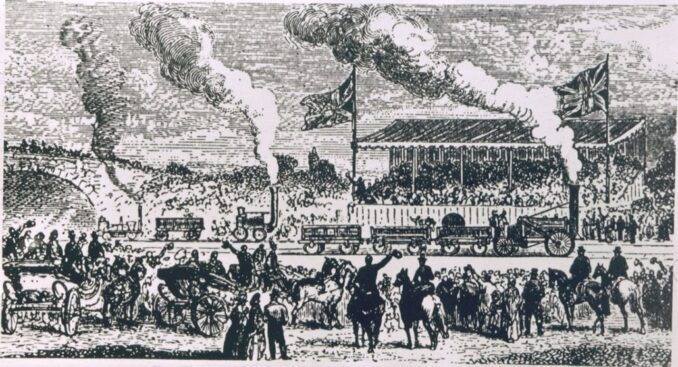
When the Liverpool and Manchester Railway held the Rainhill trials in 1829 to decide what kind of engine should haul its trains, the company needed judges who knew enough to tell a good locomotive from a exploding deathtrap. Nicholas Wood was chosen as one of the three.
The contest was won, famously, by Robert Stephenson’s Rocket, the work of Wood’s old friend George and his former apprentice Robert. Wood was about as close to the winning side as a judge could be, but nobody questioned the verdict, because nobody in England was better placed to deliver it. The expert who had written the book now approved the machine that proved its central argument right.
It had been a real contest. Five machines were entered, including one powered by a horse trotting on a treadmill (I don’t think they quite got the brief), and only the Rocket finished the trials without breaking down (or exploding… or neighing). Wood and his fellow judges measured speed, loads and fuel consumption and judged Rocket to be the winner.
The Institute
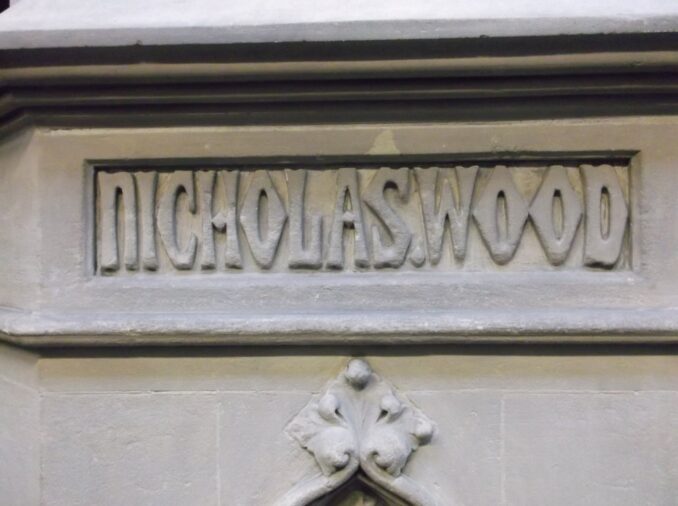
Harry Mitchell, CC BY-SA 3.0, via Wikimedia Commons
Wood spent the rest of his career as one of the most respected mining engineers in the country, becoming a partner in Hetton Colliery in 1844 and a tireless campaigner for safety underground in an industry that killed men by the hundred. His lasting institution was the North of England Institute of Mining and Mechanical Engineers, which he helped found in Newcastle and led as its first president from its creation until his death in 1865.
The Institute he built was not a gentlemen’s club. It was founded to address the explosions and floods that killed pitmen by the dozen across North Eastern coalfields, and it became a driving force behind Victorian mining safety. When the Hartley Colliery disaster of 1862 trapped and killed more than 200 men behind a single blocked shaft, it was the engineering world Wood’s Institute represented that helped force through the law requiring every mine to have two.
The Institute still stands, in Neville Hall in Newcastle, and the hall built in his memory holds his statue. A library and a learned society suit him rather better than an engine would, because what Wood gave the railways was understanding: he measured what worked, wrote it down, judged it fairly, and taught the next man how to do it.
And then, sadly, the world quietly forgot him. George Stephenson made it onto the five pound note, and Robert is buried in Westminster Abbey. Their friend, teacher and umpire got a statue in a hall that most people walk straight past.
The world learned about railways from his book but it did not remember his name.
© Paranoid Android 2026


.jpg)

.JPG)