See page for author, Public domain, via Wikimedia Commons
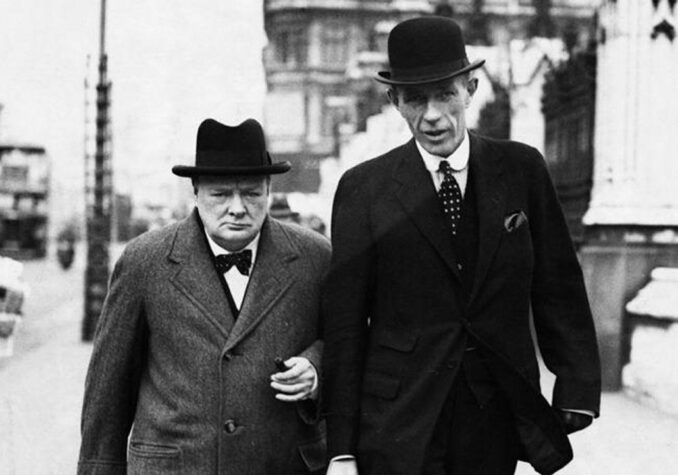
It was all going to be so easy. He was a drunken reactionary monster who turned the cannon on the strikers. Trouble is it didn’t quite turn out that way. This writing game is seldom straightforward. The he in question was Winston Churchill, one of the giants of the 20th century. He was born in Blenheim Palace and was a descendant of John Churchill, the 1st Duke of Marlborough.
Born in 1874, 27 years before Queen Victoria’s demise, he was not a very academic child and ended up joining the cavalry in 1893. By 1895 he was commissioned in the Queen’s Own Hussars where he saw action in India, Sudan and the Boer War. He famously took part in one of the last cavalry charges in British history at the Battle of Omdurman.
After military service Churchill took to writing both articles and books and became the Conservative MP for Oldham in 1900. He also switched parties a couple of times, crossing the floor to the Liberals in 1904 where he remained for 20 years after which he rejoined the Conservatives. 1924 was the year the Liberal vote collapsed where it has stayed ever since.
In 1908 Churchill was appointed President of the Board of Trade but in 1910 quickly moved on to become Home Secretary until 1911. Here he faced the Tonypandy riots, the 1911 Siege of Sydney Street and introduced the coal mines bill and the shops bill. During the Tonypandy riots Churchill blocked the deployment of troops as requested by the Chief Constable. Soldiers were eventually deployed but the protestors were offered a chat with a government arbitrator. Winston’s point of view was that both sides were very unreasonable.
There is an oft repeated claim that Churchill turned the artillery and tanks on strikers. He never did. There were times when troops were placed on standby and in 1919 in Glasgow six tanks were sent but that was three days after the rioting finished. The Scots however continue to insist he set the heavy stuff on the strikers. A myth that continues to this day.
He introduced a Coal Mines Bill that imposed stricter safety standards and his Shops Bill was designed to improve the working conditions of shop workers to the great displeasure of the shop owners. He was also present at the siege of Sydney Street and told the fire brigade to stay away when the house containing the burglars burnt down. A wise move I would suggest.
Also in 1911 he sent troops to Liverpool because the dockers were protesting. It looks like his initial reluctance to use troops was on the way out with the mounting number of protests.
That same year he was appointed First Lord of the Admiralty. The Agadir crisis had persuaded him that we need to bolster the Royal Navy. ’Twas he who responded to Germany’s plans to increase warship production with the promise to build two for their every one. Some Liberals were unhappy with his increased expenditure on the Navy, some things never change, but he threatened to resign and also, with the changeover to oil powered ships, authorised the purchase of 51% of the Anglo-Persian Oil Company.
It was in his capacity of First Lord of the Admiralty that Churchill came up with the disastrous Gallipoli plan. The aftermath resulted in a coalition between Conservatives and Liberal, the Tory demand was that Churchill be removed from the Admiralty. This was the first of several strategic blunders or potential blunders we could lay at the door of Winston Churchill. The others happened in the second war.
After the Gallipoli fiasco Churchill re-enlisted in the army and was attached to the Grenadier Guards. In 1916 he was promoted to Lieutenant Colonel and was given command of the Royal Scots Fusiliers. He asked to leave the army in May 1916 and was demoted to Major at which point he returned to the House of Shame.
From 1917 to 1919 he was Minister of Munitions where he had to contend with more strikes by munitions workers. He ended the second one by threatening to conscript the strikers. Oddly enough considering his opinion of women he voted in favour of the bill to give women the vote.
From 1919 to 1921 he was Secretary of State for War and Air and was in favour of the creation of the League of Nations. It was here that Winston was in charge of demobilising the army though he managed to retain a British Army of the Rhine. He also opposed the harsh measures against Germany. In the Irish War of Independence he was fully supportive of the paramilitary Black and Tans to fight the Irish revolutionaries.
From 1921 to 1922 he was Secretary of State for the Colonies. Just like today, the Middle East was a powder keg of trouble. With a £55,000 inheritance he could afford to buy Chartwell in Kent as a country home. In 1922 he lost his Dundee seat to a Tory and was not an MP until 1924 when he turned his back on the Liberals and rejoined the Tories becoming MP for Epping and was appointed Chancellor of the Exchequer notwithstanding his total lack of experience and allegedly massive debts.
In 1925 he restored the gold standard against the advice of John Maynard Keynes. Many said this caused deflation and subsequent unemployment. In his five budgets he reduced the state pension age from 70 to 65, provided widows’ pensions, reduced military expenditure and reduced income tax. In 1926 he acted as an intermediary between the striking miners and the mine owners and called for a legally binding minimum wage. He also said that Ireland should be united but also united to the British Empire. Quite radical for those days.
In 1927 he met Il Duce, old Mussolini himself, in Rome and praised him for his stand against Leninism. This differs somewhat with his opinion of the Austrian painter who got no praise at all for his similar views.
From 1932 to 1939 Winston was still an MP but not in government, he fought his depression by concentrating on his writing. This period is known as his wilderness years, Mr T Stokes insists that due to his initials, WC, and his opinions Winston was known as “the shithouse” in parliament. I am not sure how true this is, oooh errrr, who else has the initials WC? It was during his wilderness years that he railed time and time again against the Germans and especially the little chap with the moustache. It should be remembered that most people had no wish for another war, we hadn’t recovered from the first one and probably still haven’t.
In 1939 he was appointed First Lord of the Admiralty again, I fear that was not the wisest move in retrospect. We are all familiar with his record in WW2 so I do not intend to delve too deeply into it other than to point out where I think he went wrong on the odd occasion.
I suppose the nub of this article is why he lost the 1945 election. This has been put down to war weariness, especially of the troops coming home and also his reactionary reputation when it came to the workers. I am sure the weariness part has legs to it but as for being a reactionary, is this an early example of the left tarring their opponents with half truths.
The turning the cannon on the workers reputation was a lie but it was a potent one. When faced with strikers and rioters Winston’s initial reaction was to refuse the Chief Constable’s request for troops. He did send extra police but no troops were deployed. As riots happened after that he was not so reluctant to use more force but the cannon story was a fabrication.
Before WW1 and after he seemed to be a bit to the left wanting a minimum wage and trying to improve workers; rights against the wishes of business owners. Was he an early example of a LibDem masquerading as a Conservative, there is a case to be made.
In terms of being a warmonger we are on firmer ground. I have read somewhere that only 3 men wanted to join what became WW1. The King who hated the Kaiser, Lord Grey the Foreign Secretary and Winston Churchill. Much has been made of Winston’s spending, especially on puffins’ favourite, booze. It has been said that he was influenced by people who paid off his considerable debts and this may be true. He did not earn enough from his writing to keep himself in the style to which he became accustomed.
His position in the 1930s was that we should have a war with Germany and this was not popular at the time. Having been a prime instigator in declaring war on Germany, he became PM after the Norway fiasco, ’twas Norway that dun for Chamberlain. Having got us into a war, he did see the job through with a magnificent display of oratory and inspiration. It has been alleged that Winston was paid £150,000 to get us into the war and to drag in the Americans later. I have seen no proof and this seems like not enough to get us into a war. On the other hand he was rather keen to join in defending the poles from Germany while turning a blind eye to the soviet invasion from the east a couple of weeks later.
He should have left it at that but even with the Gallipoli lesson from 1916, he kept poking his nose into strategy. He took us into Greece just before the Germans kicked us out losing much in the way of tanks and supplies. They would have better been used to continue in North Africa from where they were withdrawn. He was not totally in favour of D-Day and afterwards wanted to attack Germany via the Balkans, what he called the soft underbelly of Europe, instead of the South of France. Luckily the American view prevailed. We were already bogged down in Italy, the Balkans would have been even more difficult.
In conclusion I believe he was a warmonger, possibly influenced by those who paid his debts, but as for treading down the workers I feel that was not his position. Quite a few of his ministerial actions were on the side of the workers. The left have long been guilty of the misrepresentation of those politicians who are on the other side, a trait that continues to this day. Lies are the left’s stock in trade.
© well_chuffed 2026