
Tyson Fury talking to fans ringside,
Mike DiDomizio – Licence CC BY-SA 4.0
At Home with the Furys is a Netflix reality documentary series following the life of Morecambe-based heavyweight boxer Tyson Fury and his family. The show offers a behind-the-scenes look at Fury’s life outside the ring, particularly during periods when he has stepped away from boxing, and focuses on his relationship with his wife, Paris, and their children. Hmm.
It blends chaotic and humorous family moments with more serious reflections on fame, mental health, and the challenges of adjusting to life beyond professional sport, making it as much about personality and family dynamics as it is about boxing. Hmmm.
And therein lies the opportunity to sell stuff, or rather ‘influence’ as it’s called these days. Just as we’re no longer allowed to say gyppo, tink or pikey, likewise plugging tatt to morons on the telly must now be referred to as ‘influencing’.
One might wonder why he resides in Morecambe. Possibly to spend the money he saves by living in the Lancashire resort on private jets to places well-covered on G-P, such as Lake Como and Monaco. Is the self-styled Gypsy King trying too hard to be a Puffin?
However, when decamped to the principality for a private event by a musician apparently called ’50 Cents’, one wonders if Fury’s paying or if this is some kind of influncing linked promotional work? Whilst over there, Paris and Tyson don’t stay in the principality but at a villa on the French side which sits along a windy twisty road. A driver takes the couple to the coast.
Pausing at a vantage point, rather than gaze upon an azure coast at sunset, viewers see a car-sick 36-year-old Doncaster-born gypsy mum of seven chucking up. The personalities are more important than the landscape, and as a forceful, independent and glamorous mum – with a vulnerable side – Paris sells and sells and sells to an important demographic.
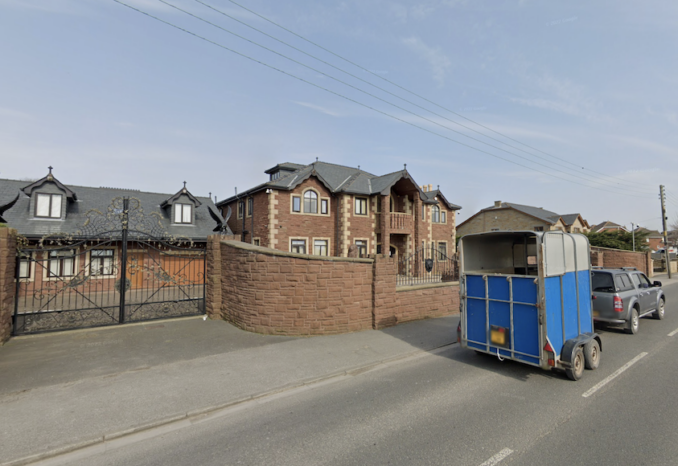
Meanwhile, 15-year-old daughter Venezuela is back in the £1.7 million Morecambe mansion looking after her four brothers and two sisters – with hilarious results. Or is she? Read on.
Paris fares better in Como, where the couple’s accommodation is on the lake. We know not where, as their host’s product placement is nonexistent. Not so back shopping in Morecambe. ASDA appears in big letters at every opportunity. In the aisles. On the carrier bags. The gypsymobile even passes an ASDA van.
Later, however, Mottram Hall has an attack of heebie-jeebies worthy of an upmarket Como lakeside hostelry ordinarily appealing to a different demographic. Although an introductory outside shot of the Cheshire venue makes it instantly recognisable to those who’ve played golf in its grounds or been a best man in the function room, the words ‘Mottram’ and ‘Hall’ evade the cameras.
Roles reverse.
Of course, you can disrupt the supermarket all day for two minutes of footage. Media relations will be in touch to let you know how many mentions we expect.
Elsewhere:
Can we book your function room for our gypsy family event and film it for a reality TV show?
No.
Then we’ll spend our and Netflix’s money somewhere else.
Oh, alright then, but don’t mention us.
That’s how it works. Therefore, is At Home With the Furies a big gypsy fake? That takes us back to Venezuela looking after the kids and, in a later episode, Tyson looking after the boys when the girls decamp for a queue-free Alton Towers weekend that, as with every visit to the theme park, includes champagne, a lodge and a tranquil lake.
During the babysitting, cooks, nannies, cleaners and drivers dive out of shot. Empowered Paris arranges the Mottram Hall surprise 60th birthday party for her father-in-law all by herself – via one phone call to a party organiser.
So, yes, it’s set up, but it’s fun. Puffins shall suspend disbelief and enjoy themselves. Unlike Guardian readers.
As if a waiter at a 1750 Flemish bond and sandstone ultimate Cheshire staycation location, or an upmarket concierge part way between Menaggio and Tremezzo, journalist Jack Seale gave the documentary only a two-star rating, stating in his article’s foreword, “this sluggish celebrity family show is like Keeping Up With the Kardashians – but set in Morecambe. You can’t blame Tyson for wanting to get back in the ring”.
Give him a good, hard smack on the jaw, Venezuela.
© Google Street View 2026, Google.com
The father-in-law is John Fury, Tyson’s dad. John himself had a short professional boxing career in the late 1980s and early 1990s. Competing in the heavyweight division, he fought 13 professional bouts, consisting of 8 wins (1 by knockout), 4 losses, and 1 draw.
Known more for his toughness and durability than technical skill, the journeyman’s most high-profile bout came in 1989, when he was knocked out by Henry Akinwande, a future world heavyweight champion.
In the Netflix series, John gives the man-to-man and intergenerational advice beloved of writers, producers and brands. The psychological warfare department informs us that moments such as sitting around the campfire in Knutsford (for Tyson decamps to a family field with the boys during the Alton Towers trip) are a shortcut to character depth and emotional weight.
A brief conversation between an older and younger man can quickly establish values, backstory, and stakes without needing long exposition. It also naturally creates a sense of authenticity and intimacy, because audiences tend to recognise it as a real-life social ritual: passing on advice, identity, or “life lessons” across generations.
I see.
The propaganda wallahs continue: They’re also useful because they often sit at key points in a story—before a decision, after a setback, or at a turning point—so they help structure the drama. A well-placed “heart-to-heart” can signal that a character is about to change or grow, which is very valuable in storytelling.
For advertisers, the appeal is slightly different but related. These scenes evoke trust, stability, and emotional sincerity, which are powerful associations for brands. If a product appears in or around or is associated with a person involved in that kind of moment, it can inherit some of those feelings—family values, reliability, wisdom, or tradition.
Even when a brand isn’t directly present, advertising often borrows the same tone because it resonates with viewers on a deeper, more emotional level than purely factual messaging. Likewise, three generations around a campfire can add to the brand of a family of budding influencers.
And so it goes. When Tyson is pondering a return to the ring, it is John, despite drooling from both sides of his mouth, and with dollar signs in his bulging eyes, who unconvincingly cautions against.
That Cheshire field fireside brings us to another point of contention. Regular readers will recall this humble author being catapulted to gypsydom via a DNA test and long-kept family secret. The Fury’s suffer no such embarrassment. Although he was born in a trailer in Withenshaw, South Manchester, in 1988, Fury is an Irish name and should be more properly labelled to Irish traveller.
Or even an Irish non-travelling traveller – there is such a box that can be ticked on the ethnicity page – as the family properties include land at Knutsford, a Cheshire home for brother Tommy (also an influencer), as well as the Morecambe mansion and some neighbouring properties in the same style next to a caravan park.
Also, an £8 million pile on the Isle of Man where the Furys actually live (and avoid UK taxes), with the Morecambe compound being used for TV’s addiction to humble-place-up-the-north lolz.
Thinks he’s the king of the gypsies does he?! We’ll see about that. Venezuela, hold my jacket!
© Always Worth Saying 2026