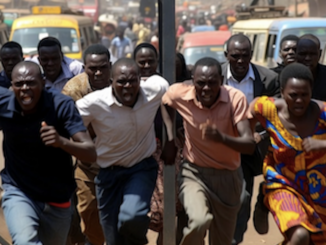
The separation of the June 2024 protests from the long history of organising within Social Justice Centres erases the intellectual labour of movement building and organising, and the infrastructure that these centres have built over time.
April 30, 2026
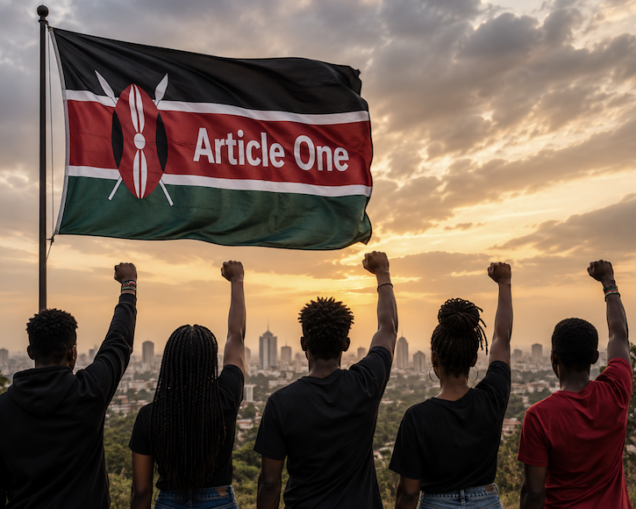
Image generated using GROK AI
The June 2024 Finance Bill Protests rightfully earned their place in Kenya’s history for overturning the punitive Finance Bill and successfully exposing the state’s excesses and the government’s tone-deafness. However, public debate and engagement about this historic moment, specifically about state violence, seem to have erased the history of state violence and organising in informal settlements. Reflections on this moment have inadvertently negated the foundational role that social justice centres (SJCs) in informal settlements have played in sustaining agitation against police violence for over a decade prior to 2024.
For anyone that has been following community organising in informal settlements, the 2024 protests – including the organising tactics, the symbols used (including flags, chants, songs, posters), the class and gender solidarity, and the predictable violent response from the state – were all too similar to past protests to ignore. Despite the obvious link and clear solidarity between protesters that included SJC members in June 2024 (and in subsequent protests), the Finance Bill protests have wrongly been cast as exceptional, a purely Gen Z affair and, more insidiously, as if they sprung from a vacuum. In this way, the protests have unintentionally been dislodged from their foundational place within informal settlements and SJCs, which risks erasing the role of SJCs from this historic moment while also cementing the simplistic class divides that have historically pushed any politics of the urban underclass to the background.
I locate the success of the June 2024 Finance Bill protests within SJCs’ long-refined art of collaborative organising that had been nurtured for nearly a decade prior. I also explore the inner workings of SJCs and draw a link between its mechanics of organising and the cumulative knowledge it has imprinted on social movements over time. Indeed, the methods of organising that made June 2024 work were arguably borrowed from the organising practices of SJCs. I argue that for us to make protests count as a viable tool for political change in Kenya, we must view them in a continuum, and we must link the struggles that each of the protests have pushed for. Only then can we understand the real possibility of protests to elevate our politics beyond the divides we have normalised as the template for political mobilisation in Kenya.
In other words, what do the similarities in the unfolding of the June 2024 protests and SJCs-led Saba Saba protests teach us about the possibilities that protests present for transformative change in Kenyan politics?
2020 Saba Saba protests
For three consecutive years between 2018 and 2020, Saba Saba protests in Kenya were reclaimed by residents of informal settlements. And while the day is historically remembered as an opposition mainstay, these protests are increasingly solely organised by the youth, with few politicians in attendance. While all Saba Saba protests have been successful, the 2020 protest stood out as – unlike the previous two that were organised at Kamukunji grounds – it was held in the Central Business District (CBD). The decision to take the protests to the CBD was not accidental. For at least a decade in contemporary Kenyan politics, and longer if we consider colonial and immediate post-independence regimes, naked state violence was reserved for residents of informal settlements and SJCs protests did not seem to go beyond the confines of those communities. Unlike in 2018 and 2019, the July 2020 Saba Saba March for Our Lives was unique in forcing into the mainstream this ugly truth about the extent of state violence. In effect, in the lead-up to the event, the conversations during the community meetings had centred around bringing the protests to the CBD in an effort to mainstream the state violence that was taking place in the shadow of Kenyans’ lives. The highlight of the day was the powerful iconic utterance by protester and MSJC convener Wanjira Wanjiru who, having narrowly escaped arrest by a police officer, shouted, her fist pumping the air, “When we lose our fear, they lose their power!” before escaping to safety while the officers scattered, aware of the negative attention they were drawing to themselves with their actions.
That Wanjira’s powerful words resurfaced in 2024 is no coincidence and supports the position that the foundation and history of protests in Kenya rests with the residents of informal settlements, groups often excluded from Kenyan mainstream politics. The possibility for us to understand protests as an avenue for political change lies in our ability to draw those connections and expose the false divides we have unwittingly instituted by talking about protests as sporadic, singular, standalone events. To understand the centrality of protests in redefining our current politics, we must tap into this continuity.
How to build a social movement
The success of the Saba Saba protests and indeed of the June 2024 Finance Bill protests was not accidental. Rather, it signals that protests are a core feature and principle of SJCs as will become clear below. Today’s protests follow from a growing ritualisation of the memory of organising within SJCs that started around 2013. While all SJCs are context-specific entities, they all share some key features and are aimed at the same overarching objective of advancing social justice in their respective communities.
Gacheke Gachihi best captures the infrastructure of SJCs that reflect the principles that frame their work generally in what he calls the “four wheels of social movement building”. Encompassing seven steps, the first of these wheels can be interpreted as “finding your tribe” in the community by making friends and building and activating citizen responsibility within it. This is activated among other activities through debate, building shared community-specific action plans and building the movement by recruiting more people. The second involves “organising, demonstrating and petitioning”; the third, establishing social justice centres as the constellation of all these activities; and finally, mainstreaming the push for social justice and linking it to national politics, specifically through “participation in bourgeois elections”.
It is these very principles and sustained collective thinking on social movement building that gave rise to the renewed ritualisation of the memory of Saba Saba that had long been abandoned by the veteran politicians that now hold power. And it was within this context that Saba Saba 2020 was organised. Moreover, the chants, the anthem (Wimbo wa Mapambano), the articulation of demands by explicitly linking the struggle to Article 43 of the Kenyan Constitution to ground those demands in constitutional rights, the identification of which symbols to use in organising, these were all first used during the weekly community organising within SJCs; they didn’t just spring up at the broadcasted protests in June 2024.
For instance, in the days leading up to Saba Saba 2020, there was agile informal organization and a pooling of resources within the SJC network that included a tentative “protest information pack” detailing the expected conduct (which emphasized peace); emergency contacts; a tentative communication plan – specifically who would be tweeting, what hashtags to use; and a tentative plan for legal support where pro bono services would be offered for protesters that may end up getting arrested. The planning also tapped into other movements outside SJCs, specifically the residual energy of student movements between 2017 and 2020. Indeed, among the youth that showed up for the 2020 Saba Saba protests were university students and student leaders that directly or indirectly brought their organising experience and expertise to the protest.
There was also a clear effort to ensure that the face of the protest remained ambiguous, with all attempted press conferences (these were very quickly scattered by the police as soon as protesters gathered) being led by a balanced mix of regular SJC conveners like Wanjira and other – often middle-class – youth that do not live in informal settlements but have consistently supported the cause. The multilayered solidarity in pulling off the Saba Saba 2020 protest was unmistakable. While few understood how the June 2024 mobilisation happened so organically, for those within SJCs, this was a natural progression and a sign of the maturation of their long-nursed efforts toward movement building.
June 2024 Finance Bill protests
If Saba Saba 2020 sounds similar to some of what we witnessed in June 2024, it is because SJCs’ social movement building, and their built-in protests are partly the blueprint that the Finance Bill protests were built upon. Being adept in dealing with the repressive and trigger-happy anti-riot police, running battles were not new for protesters that came from SJCs while for many others, they were protesting for the first time. Those that had protested before had over time figured out the best parts of the CBD in which to take cover long enough for the police to retreat and helped first-time protesters. The information pack and agile informal organisation seen on the eve of the protests also drew from this canon of organising, and this explains why the June 2024 protests bore so much resemblance to the Saba Saba 2020 protests. The tactics and rapid mobilisation on social media adapted and scaled what had been done in previous protests and was therefore not new.
By June 2024, the cumulative memory and infrastructure of historical protests, especially the protests that took place between 2017 and 2023, were sitting waiting to be activated. This would explain the easy camaraderie witnessed between protesters that clearly transcended the ethnic, religious, racial, gender, class and other divides that we have become accustomed to when thinking about our politics.
Erasing the memory and labour of social movement building
Yet, reflections on this historical moment seem to inadvertently dislodge the protests from the history of organising as led from informal settlements and to isolate and limit the demands of the June 2024 protests to only the Finance Bill and to Gen Z as a social group. This is because in the decade of their incubation, the SJC movement building remained confined to the so-called periphery and violent repression by the state was equally relatively contained in these locations. For a while, the containment succeeded, primarily because it played into our limiting divisive politics that isolate the realities, interests, and grievances of “informal peoples” as unique to them and their communities. This was made worse by the misplaced fear and mystery with which informal settlements and their inhabitants are socially portrayed, misrepresenting those communities as inherently dangerous, thuggish and their politics and protests destructive and chaotic.
All of this has acted to myopically tarnish protests that stem from informal settlements and to suggest that protests led by people from informal settlements are not legitimate and, importantly, that they are not representative of the collective national struggle and hence cannot chart the path forward for “real” national political transformation. However, like the 2020 Saba Saba protests, the June 2024 protests not only challenged this association of protests with chaos and destruction; importantly, they also humanised the residents of informal settlements and showed that their struggle reflected a national struggle.
This geographical dislocation of protests is neither new nor is it accidental. African protests more broadly have long been discounted as mere riots and looting escapades. This, as Branch and Mampilly show, is in part based on the wrongheaded Western assumption of “Africa as too rural, too traditional and too bound by ethnicity for modern political protests to arise”. In a related pattern, protests led by people from informal settlements are often discounted as too sub-local (and perhaps too crude) both in interest and their modalities of organising for them to represent broader national politics, exposing the elitism that undergirds our reflections on protests.
Within Kenya, the separation of the June 2024 protests (and other more recent ones) from the long history of organising within SJCs creates deeper damage. For one, it erases the intellectual labour of movement building and organising, and the infrastructure that SJCs have built over the past decade. We also lose out on the possibilities these movements have to offer for forging a national identity. Indeed, the work of SJCs has recently expanded to other counties – with SJCs in Mombasa, Kisumu and Kakamega – and the movement continues to grow, with active attempts to link their causes to those of other social justice movements in the broader East African Community and as far as Southern and West Africa.
The possibility for protests to lead to transformative political change, therefore, is as much about individual protests as it is about linking those protests to historical protests and the grievances they sought to address. It also lies in our ability to relate the different struggles represented by the diversity of those protests.
The June 2024 Finance Bill protests mainstreamed the place of protests in Kenya’s democratic process; they did not set them in motion. They activated the memory of protests and underscored their centrality as viable avenues for political engagement. They forced, even if only for a fleeting moment, a shift in politics away from the myriad divides that elites have previously weaponised for political mobilisation, and this alone is reason for us to root their foundation in SJCs if the change they brought about is to be sustained.
© Rachel Sittoni 2026
Rachel (researcher, reader of African politics, Gen Z) is happy and grateful to share article with AW Kamau (and supportive others) to widen awareness.