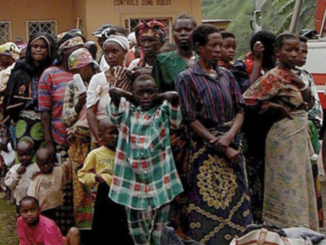
For the second time, Kenya has pressed its palms against the cold marble of the IMF and the World Bank, asking the same architects of global austerity to diagnose wounds we have spent time inflicting on ourselves.
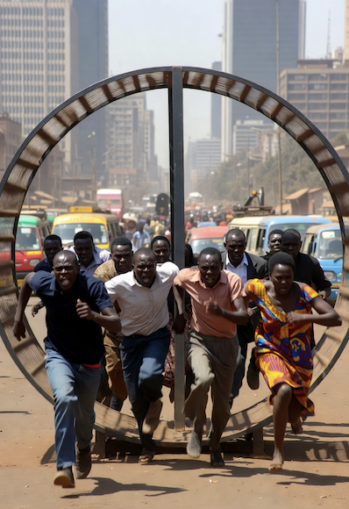
Image generated using GROK AI
Sometime last year, just after the June protests, when the city still carried the aftertaste of the deaths that occurred, I ran into a friend in a dim-lit joint in Westlands that I tend to drift into often. We had been in university together in Thika. Back then, he moved through rooms with a voltage, one of those brilliant computer science students who carried the belief that his skill alone could bend the world towards him.
But standing across from him that day, that belief seemed to have been carefully, methodically removed. He was not the vibrant tech whiz I remembered. The spark hadn’t disappeared so much as it had been buried, tamped down under something. His shoulders were set in a permanent brace as though anticipating impact. When he laughed, it didn’t land like before, but it broke midway, dissolving into a dry cough that lingered just long enough to unsettle. There was a slight tremor in his hand, rhythmic, that betrayed a deeper exhaustion.
He looked like a man who had been running a marathon for a decade and had only just realised there was no finish line.
“Now?” he asked when I asked what he was doing.
He shrugged with the weight of someone who has exhausted the available explanations.
“I spend my days applying for remote data entry jobs that pay in peanuts. Sometimes I do ‘assignments’ for rich kids abroad – code, essays, whatever they need – just to keep the landlord away.” He paused, then added, almost as an afterthought, “You study computer science in this country, thinking you will take over the world. In the end, you’re just trying not to become another statistic in the 67%.”
The 67% he was talking about was the youth unemployment rate for those of us aged between 15 and 34.
Outside, a sleek SUV slid past, its surface catching the streetlights just enough to announce itself without effort. For a moment, this country’s contrast felt too clean, or too perfectly staged. He did not follow the car with his eyes. Neither did I.
And somewhere between the hum of the neon and the quiet clatter of pool balls, it became clear that what I was looking at wasn’t just a friend down on his luck, but a country’s diagnosis.
***
We agreed to meet again. About a week later, we kept the date – July 7th. Saba Saba. The coincidence of a date that sits differently in Kenyan history. By then, I had figured out what I wanted to tell him as consolation. The anomaly of two exhausted young Kenyans in a bar. This is the inheritance handed to a generation, an inheritance that sits beside the memories I grew up with, stories of the brutal decade we narrowly escaped, only to watch its scars return as reality.
I wanted to tell him that this precarity was similar to a much older rupture, one that reshaped lives long before ours had even begun. This nightmare had first come as the Structural Adjustment Programmes – the SAPs – that arrived in Kenya as a slow reordering of national life. Initiated by the IMF and the World Bank in 1988 and accelerated after 1991, these reforms altered the country’s economic DNA. Middle-class suburbs, once confident markers of aspiration, began to fray. What had passed for stability in the 1980s slowly dissolved in the 1990s into neighbourhoods marked by downward mobility. To explain this, I had to return to my family story.
In my family album, there is a photograph of my mother’s family taken sometime between 1988 and 1989. She is standing outside the gates of her high school, her face bright with the audacity of hope. My late grandfather, a civil servant and devoted KANU man, is beside her. He stands at the centre of the frame, his posture straight, his eyes fixed on the camera with the certainty of a man who believes his children will go further than he did. My mother has her hand resting lightly on the gate, unaware that this moment of arrival was also a threshold she would soon be pushed back across.
At some point in the preceding year or so, a violence arrived at their doorstep. My grandfather’s salary, already meagre for a family of so many children, was frozen, and he would go on to lose his employment. Decades later I would discern this was part of the government’s “cost-cutting” measures imposed by the IMF. The civil service, once the backbone of Kenya’s aspiring middle class, was being slimmed down. The harambee contributions that neighbours and relatives once pooled for school fees dried up as everyone began to feel the pinch. At the time, he didn’t know that a year later his daughter would become a dropout, working at my grandmother’s restaurant in Kiambu, and subsequent pictures would carry a mark on my mother’s hand. Small, almost forgettable if you don’t know to look for it. But it holds the time. 1990. The year when the world came to collect its debts.
Those in the city tried to fight this deterioration of life. News from town was of the Saba Saba demonstrations – men from the city clashing with police, the whiff of tear gas drifting upcountry. My mother would tell me how, in the ’90s, grandfather would stand at the gate in the evenings, listening to the radio, his jaw tight. He never spoke of what he heard. Perhaps because he never discerned that what he was trying to reconcile with was that the Kenya he had served was now being reshaped by men in Washington, D.C., who had never set foot in Kiambu.
Two days after July 7, 1990, the violence would arrive at the doorstep of my grandmother’s restaurant. And the permanent mark would be born.
My mother does not speak of that day in detail. What I know is this: there was shouting, a scuffle near the entrance of the restaurant. Someone had come from the demonstrations in Nairobi, bearing stories of blood and bullets.
Someone else said the government was right now sending policemen into the villages to punish even those who had stayed home while the city burned. And, sure enough, the policemen came. In the ensuing chaos, a table was overturned, a glass shattered, and my mother’s hand caught the edge of it all.
The wound was deep. The hospital in Kiambu, already buckling under the weight of health sector cuts, was out of disinfectant that day. The nurse used salt water and old gauze. When the wound healed, it left the mark.
The subsequent months and years would be blurry for her and for those who came after. In 1992, her firstborn would arrive – a daughter. But she would have to leave the toddler behind.
In the mid-90s, the journey from Kiambu to somewhere in Kitui, Ukambani, was her economic migration. Leaving a toddler at home in the cool, green highlands of Kiambu to work in the semi-arid stretch of Ukambani meant she was chasing a private-sector opportunity. Recruitment into the government jobs that her former civil servant father might have once secured for her was frozen under SAP mandates. Any connections he had built over a lifetime of service were no longer viable. The state had retreated, and with it, the ladder that had once allowed families like ours to climb.
So she went where the work was. And every Sunday evening or Monday morning, she would board a matatu from Kiambu, likely connecting through Machakos Country Bus Station in Nairobi. The fare was a moving target. Because SAPs had liberalised fuel prices, a hike in global oil prices hit her pocket immediately. One week the fare was fifty shillings. The next, it was eighty. The week after that, a hundred. She learned to leave the house with extra notes folded somewhere, never knowing what the conductor would demand when she reached the stage.
There were no mobile phones. To check in on her daughter during the week, she would have had to find a Posta or a private “Bureau” in Kitui town to make a trunk call. Those calls were expensive, another “luxury” taxed by the era’s economic shifts. She made them only when she could, standing in a small booth with the receiver pressed to her ear, shouting to be heard over the crackle of the line.
When my mother eventually returned to Kiambu, she was fleeing the isolation of the Eastern Province to be present for my grandfather’s final years. And his eventual passing would mark the end of an era, and of one of a generation that saw the promise of independence give way to the harsh “market realities” of the Moi years. When he died, he left behind a family that had been scattered by the economic winds of the 1990s – children in different Kenyan towns, all of them chasing the private-sector opportunities that the retreating state had left in its wake.
My mother would meet my father shortly thereafter, a young man from Nyandarua caught in the crossroads of the mid-90s. His story mirrored hers, the same economic architecture pressing down from above. The government had withdrawn most subsidies for higher education, killing his university dreams, and he had left home, escaping a rural economy that had already begun to stagnate around him. In Nyandarua, with the liberalisation of the dairy and grain sectors under the SAPs, small-scale farming was no longer a path to upward mobility. So he left. Like my mother, and like so many young people of that generation, he walked away from the farm and the life that was supposed to be his inheritance. He came to Kiambu, the doorstep to Nairobi, because it offered the only “hustle” left. I was born in 1999 of two survivors of a decade that had tried to price them out of their dreams and into a Kiambu that was becoming a bedroom community for Nairobi’s “informal” workers, the formal jobs gone, retrenched by the IMF’s “A-Team” reforms.
***
If there was something I know my parents were grateful for, it was the fact that I arrived at childhood consciousness just as the country was stepping out of the long shadow of Moi’s twenty-four-year rule and the SAPs sermons. The 2002 transition was cast as Kenya’s democratic rediscovery, and a national exhale after years of constriction. The air had changed, and the horizon, once sealed shut, had cracked open.
Some may insist that Kibaki’s rise, even as it broke the Moi pattern, only exchanged one elite orbit for another, replacing the old guard with a “Kitchen Cabinet” or the so-called Mount Kenya Mafia. But for many of us who grew up on the lower rungs, the shift was more than a matter of political architecture; it rearranged the texture of our lives.
It seemed possible that the country was rising in tandem with us, that our ambitions as kids were an inheritance from a newly opened era. Suddenly, we found ourselves in sun-bleached classrooms reciting in unison the futures we believed were ours for the taking. We wanted to eventually be policy thinkers who would one day stroll into ministries in crisp suits and speak the language of national renewal. Nairobi, for us growing up far away (my dad had relocated the family first to Nyandarua, and then to Naivasha in 2001), shimmered like a faraway republic of possibility, a place where we boys and girls from dilapidated rural schools might ascend into the ranks of the people we admired – the late Raila Odinga, Uhuru Kenyatta – figures whose complexities we were too young to perceive, and whose faults our young minds had not discerned.
But as we grew, so did the contradictions. The very many leaders we once recited like catechism would later become architects, both by action, and by neglect, of a system defined by entrenched corruption. An elite, nestled close to the state, grew wealthier as the rest of us sat through our teenage years in the 2010s watching the gulf widen, our textbooks still heavy with promise that the country itself was increasingly showing it might not eventually honour.
And so we came of age in the 2020s, a generation that marched out of FPE classrooms believing history was tilting our way. We graduated, polished our CVs, and reached for the fading promise we believed was just beyond the gates of our universities. But the country we stepped into was one that had reordered itself in the years since we first wrote doctor or lawyer in the margins of our books.
***
June 7, 2025, my friend and I, two graduates discerning the inheritance handed to a generation raised on the rhetoric of opportunity, an inheritance that sits beside the memories we grew up with, stories of what we narrowly escaped, only to watch its scars return as reality. Broken promises don’t just disappoint, they distort a life, especially when they have been drilled into a mind in childhood. And so, instead of reunions with our former schoolmates celebrating admissions to the bar or the rise of young policy thinkers – the very future Free Primary Education promised – our generation now gathers in such bars, drug dens, pool-table joints, taking turns on Chinese-made betting machines. A generation is buckling under the weight of coping with disappointment, while a generation of parents watches an old nightmare reappear in a new form.
It is a heavy realisation when you sit across from a friend and see that even their small habits, like grabbing a drink, have been sacrificed at the altar of “survival math”. In recent years, that silence between friends has become a common language in Nairobi.
The symptoms of “hustler’s fatigue” hit the Kenyan tech community particularly hard. His decision to cut his drinking, he explained, was also likely a pragmatic retreat.
When 40% of employers are slashing roles and the Finance Act layers taxes on every digital transaction, the margin for error disappears. He has redirected every spare shilling from socialising towards keeping his laptop connected and his phone topped up with data, which itself has become a luxury under the new excise duties.
Fresh out of university, he had secured a six-month internship that felt like a safety net, just as IMF-backed austerity, reminiscent of the 1990s SAPs, began to bite. He still had a startup dream on the side, but that too was suffocating under the new tax regime. As the government pushed austerity to manage debt that was swallowing up 75 per cent of tax revenues, the cost of doing business skyrocketed. Between the new levies on data and a 24 per cent devaluation of the shilling, cloud-hosting fees doubled. When the Kenyan shilling hit the 150+ mark against the dollar at one point, he told me it didn’t just double his Google Cloud bills, it effectively halved his purchasing power overnight. For a computer science graduate, seeing your code become “too expensive to run” because of macroeconomics is a unique kind of heartbreak. The “lean” startup he had planned was now a luxury he couldn’t afford.
But the real heartbreak came four months into his internship. The firm, hammered by 7.7% inflation and soaring energy costs, held a silent “restructuring”. He became one of the 70,000 formal private-sector workers who lost their positions between late 2022 and late 2023. Even the “internship bridge” simply collapsed under him. Since then, he has been surviving on the peanut jobs he had told me about.
Our generation stands today in the very place where our parents stood as they faced losing their futures. The fear is that history is looping back. We are becoming the reincarnation of the relatives who struggled under the economic downturn of the 1990s. Three decades later, with new adjustment programmes threading their way back in, the symmetry to the ’90s is haunting. Youth navigating a future shortened by policy has returned with a familiar weight. Introduce the same pressures, and you inherit the same consequences; every generation that comes of age under those conditions arrives at the same crossroads, carrying burdens they never chose. When the same forces return, so do their shadows. A generation raised under them will always find itself walking a path already worn by those who came before.
For the second time, Kenya has pressed its palms against the cold marble of the IMF and the World Bank, asking the same architects of global austerity to diagnose wounds we have spent time inflicting on ourselves. A nation submitting to triage and with it, a generation falling into a loop that has been there before. Kenyans have been here before. But right now, it’s Kenyans from a generation raised on promises of upward mobility who are watching policies that feel like the unfolding of an inherited script whose ending we know.
We are in a country that today feels like one caught between its promises and its practices. The rhetoric of opportunity that raised us, the anthem of possibility ringing out in classrooms, public campaigns, and political seasons, now meets a landscape where the moral economy tilts unevenly, and rules are negotiable. And the betrayal of that rhetoric has become its own kind of pressure point, a ticking reminder of expectations deferred. You see it most vividly in the protests of June 25th, 2024, and again in 2025, when young Kenyans flooded the streets in recognition that the gap between promise and reality had grown intolerable.
I have not seen my friend again since that Saba Saba Day. I still remember my parting shot to him. I showed him where, during one of the protests, I had nicked my thumb on scaffolding. Not as scarring as my mother’s, but nonetheless, it had left a mark. I told him that the next time I visit her, we will hold our hands out under the light.
We may not say it loudly, but it will be obvious: this is the loop of Kenyan Austerity, written there in scar tissue.
© Frank Njugi 2026
Njugi is a Kenyan writer, journalist and critic who has written for platforms such as Debunk Media, The Republic, Culture Africa, Sinema Focus, Wakilisha Africa, The Moveee, Africa in Dialogue, Afrocritik and many others. Shared with author’s full approval.