
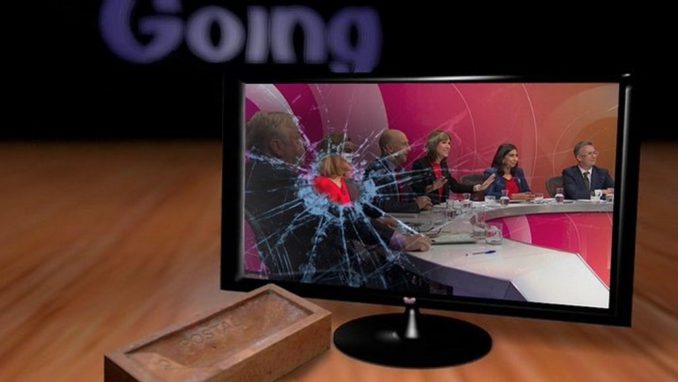
Question Time AI Special 28th May 2026
The Panel:
Darren Jones (Labour)
Julia Lopez (Conservative)
Laura Gilbert (Tony Blair Institute)
Mo Gadwat (AI Pioneer)
Victor Riparbelli (CEO, Synthesia)
Venue: Dulwich
Penned in 2022, a G-P exclusive showed that the then most recent accounts (up to December 2020) showed annual donations to the Tony Blair Institute exceeding those to the Conservative Party, Liberal Democrat Party and Scottish National Party combined. Since then, donations to Sir Tony have totalled another $130 million, with a further $218 million promised in future pledges.
Where does the money come from? The institute claims it is under no obligation to reveal its donors but does provide a selective list in the Strategic Statement section of its September 2021 accounts. Donors include – and these are the ones Blair isn’t too embarrassed to mention – African kleptocrats, assets strippers of the old USSR, the Gates Foundation and the interesting Larry Ellison Foundation.
Ellison’s connection to AI stems from his role as the co-founder and CTO of Oracle, which he has transformed into a massive infrastructure provider for AI companies.
Make no mistake, when Blair recently criticised Mr Milliband’s net zero policy, saying the climate change debate had become ‘irrational’ and people in rich countries no longer wanted to make financial sacrifices ‘when they know that their impact on global emissions is minimal’, and that limiting fossil fuels was bound to fail, he was not speaking for the benefit of the environment or the domestic consumer, but was whoreing for one of his energy hungry data centre-owning donors.
As for Blair’s representative on tonight’s panel, Laura Gilbert (not her real name, Dr Laura Catherine Gilbert CBE, DPhil Oxon, MA/Bsc Cantab, FInstP, CPhys, FIoA), Puffins are reminded never to trust a gal with more letters after her name than in it.
With an undergraduate degree from Cambridge University and a postgraduate degree from Oxford, Ms Gilbert is a Visiting Professor in Practice at the School of Public Policy, and Senior Director of AI and Head of the AI for Government programme at the Tony Blair Institute.
Her previous positions have included Director of the Incubator for Artificial Intelligence at 10 Downing Street and Associate Director and Quantitative Analyst at Eldian Partners. Who they? ‘A global multi-asset class trading firm built on cutting-edge technology, combined with sophisticated quantitative trading strategies.’
In other words, applicators of AI to the stock market in much the same way a travelling English gentleman of a certain generation might understand the worn gears on a Monte Carlo roulette wheel, or a holidaying Secret Intelligence Service quartermaster might jiggle the Las Vegas slots with an outsized wrist watch concealing a powerful magnet.
Not quite his real name, Mohammed ‘Mo’ Gawdat is an Egyptian-born 58-year-old engineering graduate of a Cairo public university. Upon completing his education, and depending upon which chatbot one relies, Mohammed either became a systems engineer or sales rep with IBM. Moving to the United Arab Emirates, he joined NCR and progressed to Bill Gates’ Microsoft, where he held various roles across seven-and-a-half years. He joined Google in 2007, eventually rising to the position of chief business officer at Google X. In between time, he completed an MBA at the Maastricht School of Management.
Since getting the heave from Google eight years ago, Mohammed appears to have done not a lot other than self-promotion. Via his LinkedIn profile a self-proclaimed ‘international best-selling author’, his mighty work ‘Alive: A Human’s guide to living in the world of AI’ sits at a number crunching 827,325th on the Amazon best sellers list, a full 793,984 places behind the Marquis de Sade’s more worldly ‘120 days of Sodom.’
Victor Riparbelli, absolutely not his real name – Victor Riparbelli Rasmussen – is Co-Founder & CEO at Synthesia.io. If a gentleman Puffin is tiring of reviewing panel shows and stacking shelves, Mr Rasmussen is hiring at Synthesia.io/careers. If, while filling in the online form, you wonder where dot io is, it is in the central Indian Ocean, roughly halfway between East Africa and Indonesia, consists of the Chagos Archipelago and Diego Garcia, and is properly monikered the British Indian Ocean Territory.
Hold on a minute, why would anybody want to …? Let’s ask the AI.
‘The British Indian Ocean Territory (BIOT) is a very unusual place to base a business — especially an IT company — because it has no permanent civilian population and is mostly a restricted military area (centred on Diego Garcia). So in practice, nobody is running a typical “global IT business” from there in the normal sense.’
Oh.
AI continues:
‘If someone claims to have set up a global IT business in BIOT, the reasons are usually legal or financial on paper rather than practical or operational. One possible motivation is tax or regulatory arbitrage, where entities are structured to minimise corporate taxes or reduce reporting requirements, similar to what is commonly done in places like the Cayman Islands or the British Virgin Islands, although BIOT itself is not a major offshore hub and lacks the infrastructure to support such activity widely.
‘A more plausible explanation is that the company is a “paper” or shell entity, registered in name only while its real operations take place elsewhere, allowing owners to obscure control or shift profits across jurisdictions.
‘Overall, a company claiming to be a global IT operation based in BIOT is not normal and is far more likely to be a legal construct or potentially a misleading claim rather than a genuine operational headquarters.’
Ho hum.
Sure enough, at Companies House in the UK, Synthesia registers a series of tax-avoiding annual losses among endless re-statements of share capital allotments replacing original submissions that ‘contained an error’. Likewise, their UK-registered address is an anonymous-looking north west London building used as a convenience address by dozens (hundreds?) of other companies.
Avoid.
Am I the only Puffin who is beginning to suspect AI, like global warming, is a home for chancers, grifters and desperate politicians looking for an easy rhetorical fix to insurmountable problems in the real world?
Let’s find out.
***
A sombre-looking La Bruce introduced a sombre-looking panel consisting of Churchill, troublemaker Mahatma Gandhi, a plastic Mrs Pankhurst, and somebody else, the statuary female from the Third World I’d never heard of. Of course, they were AI-generated – and looked it.
Question One: Another Third World female wondered if 80% of the population are right to be frightened they’ll lose their jobs to AI.
Oh yes, began Mo, but it’s the fault of the capitalists who cut wages and labour numbers to increase profits, but in doing so, they reduce demand by impoverishing their former employees.
Mr Ramundsen disagreed. The AI will change products, students will choose to study different things. If you told people 50 years ago that most would be sitting in front of a screen at work, they wouldn’t have believed you. There will be new jobs, perhaps based on the value of human interaction.
A recent computer science graduate spoke of his struggles to get a post. Software engineering is not safe at all.
Laura, whose publicity shot belongs to the modern ‘hey, Grok, knock a few years off’ school of portraiture, began by reminding us that research suggests that researchers are worse at predicting the future than non-researchers. Can readers see the problem with that conclusion? She spoke in percentages and hundreds of millions, and concluded AI is a reasonable thing to be worried about.
The audience was largely tinged, and even the non-tinged had foreign accents. How many new opportunities are there at the moment? one of them asked. It’s costing more than it saves because of the experimentational learning curve required.
Darren Jones (Labour) spoke in chatbot-type catchphrases, including: The many, not the few. Working with providers. Better outcomes. The big message. He outlined a danger to service industry jobs to be cured with training and skills support. The director found a black woman nodding in the audience.
Julia Lopez (Conservative) wasn’t as keen on AI and said organisations aren’t getting the productivity improvements they expected. She blamed the government for making it more expensive to employ people and for high energy prices.
La Bruce saw a juggernaut heading towards us. Lots of people are going to lose their jobs. In the meantime, Julia is going to build a strong ecosystem where businesses have the tools to succeed.
Mo pointed out that previously we invented tools that helped, whereas the AI is an entire system that will replace.
Question Two came from Adam Zabanzi: Do AI friends solve loneliness or normalise isolation? La Bruce claimed one in three of us relies on a virtual friend.
Laura wanted evidence and research.
A black woman with curly white hair found traditional therapists to be blank and bland, but the chatbot understood her emotions.
Plus, therapy costs money, added Laura.
And Chatbot’s available 24/7, interjected the audience member.
Loneliness and therapy are two different things, number one in therapy impact is compatibility between the therapist and the client, said Mo. You have to be careful that ChatTherapist isn’t just telling you what you want to hear.
At which point, myself and Laura were thinking the same thing. I was thinking, but these are just search engine links put into continuous text, while Laura was pointing out that there isn’t a caring individual at the other end of this type of communication. Rather, it’s ad revenue that motivates service providers to keep people’s eyeballs on the screen. This isn’t reality, it’s a machine.
Victor said we can’t imagine the future, it’s easy to be negative, people are more honest with a chatbot, there is no shame, and people aren’t afraid to ask stupid questions. Focus on harmful outcomes and take action. As for the existential questions – nobody knows. Let’s focus on solving problems in front of us.
A gentleman in the audience claimed big foreign corporations driving this are a malign force to begin with. I’m not British, but welcome to the Third World, replied Mo, if you import all the technology … Why is there not a British ChatGPT? It’s not that complex.
Why not indeed. Only one way to find out:
‘Keeping a single system updated is much more practical than maintaining dozens of country-specific versions. But it’s trained on international data, including plenty from the UK. If you want, I can behave like a very British version — formal, slangy, regional (Scottish, London, etc.). Just tell me the vibe 👍’
Hmm. Write me a slangy English regional sign-off to a 1,500-word topical panel show review.
‘Anyway, that’s your lot. Panel telly’s still knocking about somewhere between sharp as a tack and utterly on the blink — depends who’s at the desk and how many pints deep the writers’ room was. This week’s effort? Not a total bin fire, but you wouldn’t rush home for it either. Still, we’ll keep watching, won’t we? Gluttons for punishment and all that. Right then, I’m off — stick kettle on, feet up, and we go again next week. Cheers, duck.’
Dear God.
© Always Worth Saying 2026
The Goodnight Vienna Audio file
