
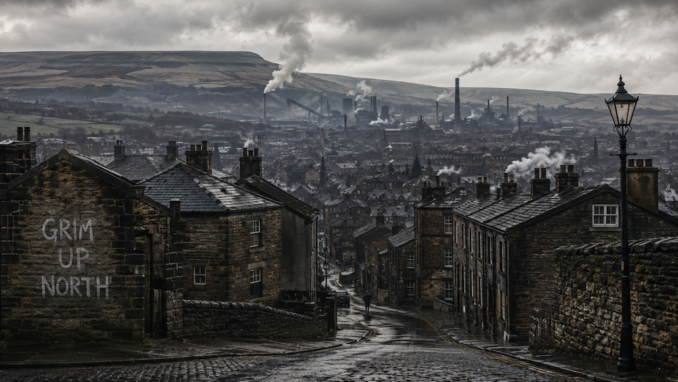
Image generated using ChatGTP AI
The ‘Grim up north’ trope reminds of Northern England’s story of endless decline. In reality, the region produced immense wealth through the likes of textiles, steel, coal and shipbuilding. Influential industrialists’ fortunes rivalled those in the South. But what happened to the giant money-making machine and the wealth it created?
Myself and Mrs AWS are on the case, while embarked on a Cook’s tour of northern cities. In keeping with the industrial age, we travel by train, and as the term ‘plutocrat’ springs to mind, we feel obliged to stretch out in first class while being fed and watered.
As if a well-respected South coast diaryist and thriller writer aboard a superior cruise liner, one feels obliged to share the menu. As if an Instagram influencer, one feels moved to smirk (through bad teeth) while surrounded by things marked ‘first’.

© Always Worth Saying 2026, Going Postal

© Always Worth Saying 2026, Going Postal
Heading south from Lancaster – where last time we broke bread with the legacy of linoleum magnet Lord Ashton – the West Coast Main Line skirts Clougha Pike, the other side of which lies the Forest of Bowland. Often referred to as the Trough of Bowland, this is a remote and scenic upland landscape of moorland, valleys, and quiet rural roads.
Beneath its natural beauty lies the Bowland Shale, one of the largest fracking gas reserves in the country. A source of secure and cheap energy, thus far opponents have successfully kiboshed its development through concerns about environmental impact, landscape preservation and global warming. Our Victorian northern forebears thought differently.
The Mill Towns
At Preston, 21 miles south of Lancaster, we arrive in a mill town proper. A palethera of such places in the North West of England and Yorkshire reminds us to settlements built around the textile mills of the Industrial Revolution.
Why here? Because several advantages came together in the right place at the right time. First, the climate mattered. The region’s cool, damp air helped prevent cotton threads from snapping during spinning, making production more efficient.
Second, there was easy access to water and power. Fast-flowing rivers from the Pennines initially powered mills, and later the region adopted steam engines fueled by nearby coalfields, ensuring reliable, cheap energy for large-scale production.
Transport links were another key factor. Canals, and later railways, connected inland mill towns to ports like Liverpool, allowing raw cotton to arrive cheaply and finished goods to be exported worldwide. There was also a ready workforce. Rapid population growth and migration from rural areas provided abundant labour, including women and children, who were often employed in mills.
Finally, capital and innovation drove expansion. Entrepreneurs invested heavily in machinery like spinning mules and power looms, turning the region into the global centre of cotton manufacturing during the Industrial Revolution. Together, these factors made the North West and Yorkshire ideal for a booming cotton industry.
Britain didn’t grow cotton, so the industry depended on imports, mainly from the American South and the Empire. The North West’s proximity to the port of Liverpool (more of which in a future episode) meant that raw cotton could be unloaded there and quickly transported to nearby mill towns like Manchester and Oldham via canals and railways, keeping supply steady and costs low.
All these things came together in Preston, which grew exponentially during the Industrial Revolution, its skyline defined by tall chimneys, crowded weaving sheds, and tightly packed terraced housing. The River Ribble supported industry while canals and railways connected Preston to wider markets, fueling trade and production.
Life was often harsh, with long hours, noise, and pollution shaping daily existence, yet strong communities formed among mill workers. Over time, industrial decline changed the town’s character, but echoes of its textile heritage remain visible in architecture, culture, and collective memory today, alongside some impressive public buildings.
The Harris

© Always Worth Saying 2026, Going Postal
This industrial prosperity created a wealthy professional class—lawyers, merchants, and manufacturers—like Edmund Robert Harris. Although not a mill owner himself, Harris’s fortune was indirectly supported by this thriving economy, enabling a large philanthropic donation.
A bequest reflects how cotton wealth didn’t just enrich industrialists but also funded civic institutions, shaping Preston’s cultural and social landscape in the Victorian era, with The Harris Museum, Art Gallery & Library being named after the Preston lawyer who donated £300,000 in 1877 to fund a public library, museum, and gallery, in memory of his father, a local clergyman.
Construction began in 1882, and the building officially opened in 1893. Close to the opening, the Lancashire Evening Post gushed about an unusually large collection of examples of the art of Greece and Rome. Greek specimens illustrated the 5th century BC and were arranged around a hall. Admirably lighted, these Greek divinities made ‘a splendid show in the famed Carrara marble’. Better times.
The old Post Office and War Memorial

© Always Worth Saying 2026, Going Postal
The building positioned directly behind the Preston War Memorial, and sharing Market Square with the Harris, is the former Head Post Office. Constructed in 1903, this prominent Edwardian building served as the city’s main postal hub for over a century until its closure in 2005. In recent years, the vacant site has undergone extensive redevelopment to convert the historic structure.
The Post Office was designed by the prominent architect Sir Henry Tanner. At the time, Tanner served as the Chief Architect for Her Majesty’s Office of Works, a government department responsible for designing major public infrastructure across the country.
Preston’s war memorial was unveiled in 1926, and commemorates local soldiers who died in the World Wars and subsequent conflicts. Designed by Sir Giles Gilbert Scott, it replaced an earlier Boer War monument and is the central site for local remembrance ceremonies. It stands approximately 70 feet high, forming a tall, slightly tapering obelisk. Made of Portland stone. It is built on a 40 foot widfe stepped cruciform plinth.
Sculptures by Henry Alfred Pegram depict a carved representation of ‘victory’, with arms raised and holding laurel wreaths with small figures at the base representing those who died pleading for acceptance of their sacrifice.
There are no names on this memorial, rather an inscription reading:
Be ever mindful of the men of Preston
Who fell in the Great Wars
1914-1918 1939-1945
This land inviolate your monument
The outer face of the west wall reads:
Be ever proud of the people of Preston who
Have given their lives in conflicts since 1945
As for the actual unveiling, it was on this very day exactly 100 years ago – 13th June 1926. The Lancashire Evening Post of Monday 14th reported:
It is doubtful if a larger crowd has ever assembled on Preston Market Square, even during the Guild celebrations, four years ago, or on the occasion of the visits of the King and Queen in 1913, than was seen yesterday afternoon when Admiral the Fleet, Earl Jellicoe of Scapa, G.C.B, 0.M., G.C.V.O., unveiled Preston’s war memorial.
Every yard of space available for the public on the square itself was occupied, and dense masses of people thronged the abutting streets for a depth, down Friargate of several hundred yards and down Market-street as far as the end of the Post Office building, whilst Jacson-street and Harris-street were also packed.
In conclusion, our plutocrats’ tour stop off at Lancaster reminded myself and Mrs AWS of the destructive nature of the unions and the Labour Party and the tendency for wealth and influence to pass from manufacturing towards the land and the gentry. Likewise, our day in Preston allowed us to conclude the wealth-sapping influence of:
- A drift from manufacturing to the professions and civic life
- Our finest being lost to war
Next time: Besides the railway station, Harris, Post Office and War Memorial, Mrs AWS and myself took in Preston Jail and B&M. During our perusal, we couldn’t help but notice we were surrounded by Pakistanis. How come? And might this have something to do with the region’s decline?
Find out next time on ‘A Plutocrats’ Tour of the North’!
© Always Worth Saying 2026

