
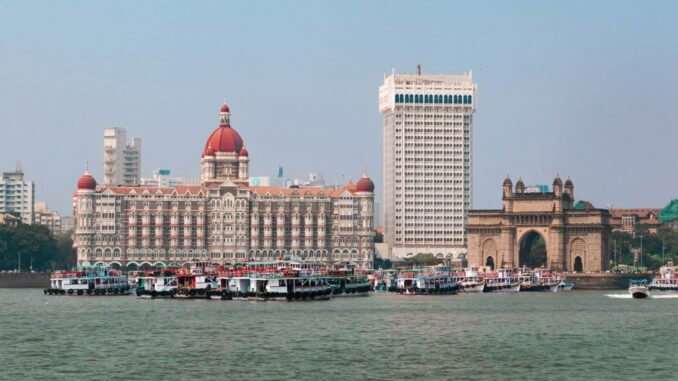
iMahesh, CC BY-SA 4.0 <https://creativecommons.org/licenses/by-sa/4.0>, via Wikimedia Commons
After a long, hot site visit in Panoli, a small industrial town in Gujarat, the traffic on the main Ahmedabad to Mumbai highway was even more hideous than usual. It was the last day of the trip, Wednesday 27th November 2008, with my flight leaving Mumbai the following day.
I was due to meet my friend, our local agent from Mumbai, at the Taj Mahal hotel bar at 9 o’clock for a cocktail and a quick debrief, but due to the traffic, we were behind schedule. His assistant called him from the car, and we decided that I would be arriving too late, as they had a big family and friends meal arranged in one of the Taj’s Restaurants at 9.30.
As my usual hotels, the Taj itself and the Oberoi were fully booked, I was staying at the Marriott near the airport, so we changed the plan and diverted there. Just before dropping me off, at about 9.30, phones started ringing, and there was news of an incident happening at the main Mumbai railway station. The locals in the car seemed not too bothered as this was apparently a regular occurrence.
[Ten Pakistani Islamic terrorists hijack a fishing boat, kill the crew and approach Mumbai in 4 rubber dinghies. The first two open fire and throw grenades inside the CST railway station at 9.30 pm, killing over 50 people.]
With travel home booked for the next day, an early night was called for, but I was soon woken at 11.00 by the hotel phone ringing. Bleary eyed, I answered to hear a distraught Mrs P on the line, back home from collecting the girls from school, and extremely relieved to hear me pick up. She urged me to switch on the TV.
[Two separate terrorist teams infiltrate the Taj Mahal and the Oberoi Trident hotels, open fire on staff and guests, and take western hostages. Another team attacks the Leopold Café tourist spot.]
The unfolding horrors were all over the rolling international news, and all thoughts of sleep vanished. I tried my friend’s phone but there was no connection. My god, they were in the Taj! It seemed to be escalating into chaos as reports of more incidents came in from around the city.
[A bomb explodes in a taxi in the Mumbai suburb of Vile Parle. A local hospital is attacked with several police officers killed, including the Mumbai anti-terrorist chief.]
I could hear something in the hotel corridor: people running, doors opening and closing. Cautiously I looked out of the spy hole and saw a man in dark clothing run past, carrying an automatic weapon. I could hardly breathe.
[One terrorist team takes hostages inside Nariman House, a Jewish centre. The Taj hotel is set on fire and more bombs explode.]
Something was pushed under the door. With much relief, it was a note to all residents that the hotel had arranged a private armed security detail to check out the hotel and grounds and to guard us in case there were attacks heading our way. Terrifying and reassuring at the same time.
[Local Indian army troops arrive at the Taj Mahal Hotel, cordon off the area and engage in firefights with the terrorists in the building. More explosions are heard inside.]
The BBC world service was full of concern for many UK business people and tourists caught up in the carnage. With my head swirling, I fell into a few hours of fitful sleep, worried about my friend and his family.
[National Security Guard commandos arrive from Delhi early Thursday morning and start the operation to liberate the Taj and Oberoi hotels. Heavy gunfire and explosions are heard all day as commandos fight room-to-room with the Islamists.]
The Marriott staff were amazing during the Thursday morning, as they told everyone that we could stay as long as necessary at the hotel and provided free food and drinks for all. This was also very reassuring for my family back home. My friend’s assistant phoned to say that he and his family were still inside the Taj, and no-one knew if they were dead or alive. It was a horrible day watching the life feed of the battle for the Taj unfolding on the screen, not knowing what was happening on the inside.
[Friday morning, the siege of the Oberoi ends with two terrorists killed and dozens of hostages released. Security forces kill the terrorists at Narima House but find 5 Jewish hostages killed.]
All the flights from Mumbai had been cancelled, but KLM messaged me on Friday morning to say that flights were resuming and that I was booked on the Sunday flight home via Amsterdam.
[The remaining terrorists are cornered in the Taj Mahal hotel and a fierce shootout is continuing into Saturday. NSG commandos execute Operation Black Tornado, a final aggressive assault inside the hotel using stun grenades and smoke bombs. The hotel is declared fully secure and the last three terrorists are killed, bringing an end to the 60 hour siege.]
At last I got news of my Indian friend: he his family members had been rescued unharmed after being barricaded for hours in a private area together with kitchen staff and other guests. Sadly, before the weekend was over, he had to go to many funerals of his friends and colleagues that were with him in the hotel that night and were not so fortunate.
[Over 150 guests and staff are locked inside the Chambers corporate lounge for all of Thursday night. Local police and soldiers attempt a rescue down a back stairwell, but the terrorists are alerted from the upper floors. As the guests descend to the exit corridor, the Islamists begin shooting and throwing grenades down from above. Many guests and staff are slaughtered before the terrorists are fought off and survivors are pushed into other locked areas or escape through the exit to safety.]
Saturday for me was an almost surreal day waiting for the Sunday flight home. Free food, cocktails and snacks by the pool, sunbathing and reading from the stack of books that the hotel had found to keep us all entertained. The flight was almost silent on the way home, with most passengers shell-shocked by what had unfolded. I have never been so relieved to step off a plane in Manchester, but it took several months for the enormity of the horror to sink in with me, and how close I had actually been to disaster.
[During the 2008 Mumbai attacks, 166 innocent victims were slaughtered: 140 Indian nationals were killed including hotel staff, railway commuters and 20 Indian security personnel. One British man was killed, along with a further 25 foreign nationals. Nine out of the 10 terrorists were killed by Indian security forces, and the other, Ajmal Amir Kasab, was captured and later executed. The Islamic terrorists were funded, trained and equipped by ISI, the Pakistani intelligence service.]
© Richard Puller 2026