John Chapman, CC BY-SA 2.0 <https://creativecommons.org/licenses/by-sa/2.0>, via Wikimedia Commons
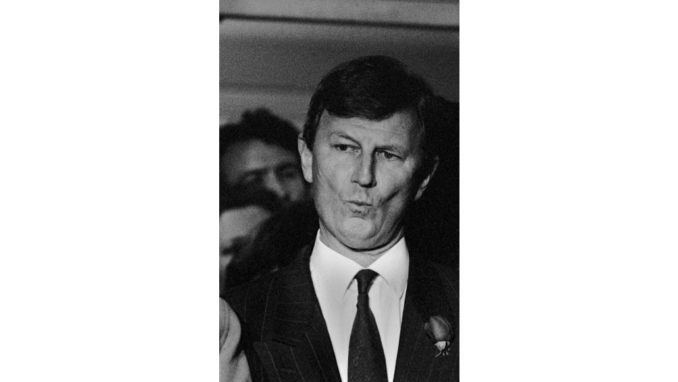
Perhaps the one aspiration all parties bar the Greens hold is to try to engineer some growth into the economy. Most of the blame attaches to the Treasury but the country seems unable to accomplish the simplest project without being weighed down with competing policies, the non compliance with which leads to the interference by the courts and extraordinary delays. HS2 , Heathrow expansion, nuclear power stations are but examples of the way that public projects come in years, even decades, late at several times the original budget after enquiries and appeals lasting years, if they come in at all, whilst other countries simply get on with construction. Rule by activist judges (as opposed to the Rule of Law) is something that has sneaked up incrementally on the public encouraged by all branches of the uniparty. Did anyone years ago foresee the terrible damage that it would inflict on the country and argue against it ? I think that one politician may have had an inkling about forty years ago. He was a distinguished academic who was able to articulate the intellectual case against the then way ahead which has subsequently poisoned us. Perhaps surprisingly, he was a Labour politician and even within its ranks, was regarded as a Man of the Left. He was suspicious of the EU long before Brexit became a serious topic. Who was this anti Blair, anti Starmer, anti Hermer ? His name was Bryan Gould.
I am referring to Gould in the past tense as he left British public life to return to his native New Zealand over thirty years ago. However, he is still alive there at the age of eighty-seven, having retired as the Vice-Chancellor of the University of Waikato in 2004. It is his time in the UK and the insight he developed here of which I write. By way of background, Gould was born and brought up in New Zealand and arrived at Oxford as a post graduate Rhodes Scholar, much as happened to Bill Clinton a few years later. He stayed here, entering the Diplomatic service and then became a Law tutor at Oxford. He was Labour MP for Southampton Test from the second 1974 election until 1979 and for Dagenham from 1983 until he resigned his seat to return to New Zealand in 1994. He served on the Labour Front Bench in Opposition and unsuccessfully challenged John Smith for the leadership after Neil Kinnock resigned following the 1992 election.
Judicial review of government decisions had for long been a fairly uncontroversial process. Briefly, the Courts could stop an administrative action if the law or procedure had not been properly followed or if the decision was so patently wrong that no reasonable body ought to have reached it (often referred to as the Wednesbury test after an early case). However, judicial activism moved in to quash decisions that had the faintest flaw in procedure (such as no reference on the face of it to some long-forgotten policy which might have slightly impinged on it) or widening Wednesbury unreasonableness almost to something similar to the judge simply not agreeing with it. Gould’s view was that these were matters for the High Court of Parliament in Westminster and not the Royal Courts of Justice in the Strand.
Gould argued that moving major policy decisions into the Courtroom damaged public faith in governance. Politicians can be removed- judges cannot and therefore it alienates the common citizen from democratic decision making. He criticised a “rules based” order where everything was decided on a rigid mechanistic approach without thought of the policies that needed to be implemented from the wishes of the democratically elected representatives of the people. Starmer is a golden example of someone with such a mindset. Rules are a substitute for action. Activist judges stretch statutory language to match changing moral or political views whereas Gould believed that the judges should simply interpret the legislature’s intention.
For policy decisions, by ruling on complex policies such as public spending, energy security including climate change and border security, Gould was insistent that the Courts needed to exercise strict restraint-the final decisions needed to be made by elected officials. All in all, he feared for the traditional doctrine of separation of powers between the courts, the government and Parliament. Democratic accountability needed to be preserved and judicial overreach prevented.
Three years after Gould returned to New Zealand, Tony Blair arrived at No 10 with almost the entirely opposite view. I dare say that Gould would support the Human Rights legislation in theory, but I equally suspect that he would be horrified on how it has been used to thwart so many actions of government which both the majority of MPs and the general public support. Every interest group can delay projects, whether energy, infrastructure, building or any other developments or otherwise propound their own interests to the detriment of the majority using them. We are said to be living in a Rules based order but, in practice we are living in a judicial dictatorship and with judges being selected, not by the abolished and historic office of Lord Chancellor sitting in the cabinet, but by the Common Purpose infested Judicial Appointments Commission.
Gould wrote several forthright articles following the Brexit referendum, appalled at the actions of the Remainers to attempt to thwart the result of a democratic vote and gave an interesting perspective from the Left on why it was good for Britain. I think the best way to regard him is that of an outsider to the uniparty and the miserable unpatriotic “consensus” that afflicts us. His return to New Zealand was a sad loss to British public life. He had sound views which need to be heard now more than ever in our current plight.
© Bergen 2026