
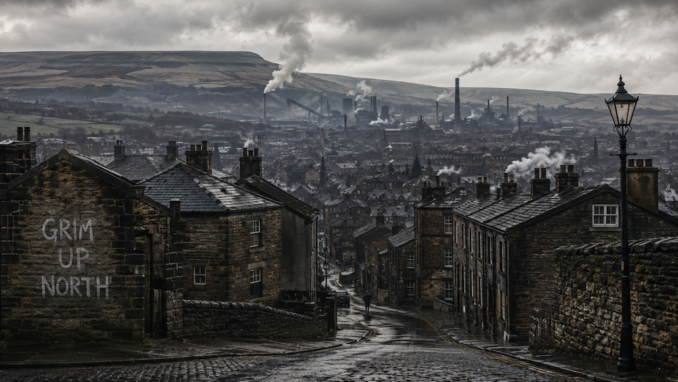
Image generated using ChatGTP AI
“Grim up north” reflects how Northern England is seen today —neglected after decades of decline. Previously, the region produced immense wealth through the likes of textiles, steel, coal, shipbuilding. Influential industrialists’ fortunes rivalled those elsewhere in the developed world. What happened to the giant money-making machine and the wealth it created?
Myself and Mrs AWS are on the case, while embarked on a Cook’s tour of northern cities. In keeping with the industrial age, we travel by train, and as the term ‘plutocrat’ springs to mind, we feel obliged to stretch out in first class while being fed and watered.
As if a gentleman reviewer of Caribbean cruises, we shall share the menu and, as if an influencer earning commission on upmarket pale ale sales, we shall post pictures of lots of tins and seats with first class printed on them.

© Always Worth Saying 2026, Going Postal
Deserted Preston
On this leg of the journey, while the great seeker after truth heads for the Fishergate exit of mill town Preston’s railway station (and his wife follows ten paces behind, taking photos), we must begin by answering the observant Puffin’s unspoken question: Where is everybody?

© Always Worth Saying 2026, Going Postal
Regular readers will be aware that we’ve had a few unsuccessful attempts at travelling the Settle to Carlisle and Ribble Valley lines on a proper train. i.e., on a diverted service during main line engineering works. Our trip at Christmas was kiboshed at the last minute because of frozen pipes and the inability of the Avanti Class 805 to pull alongside anything at Carlisle Citadel other than platform three.
We had better luck at Easter when our diversion ran. A tale for another day, other than to observe that when we alighted in Preston the engineering works meant the station was pleasantly empty.
On the subject of walking ten paces behind your husband, upon exploring the township, my lady wife and I couldn’t help but notice the place is full of Pakistanis. Why so? An explanation will follow, but first, another war memorial — this one to complement that in Market Square featured in last week’s article, published on the exact centenary of its unveiling.
The other war memorial
Four years earlier, Colonel Shute DSO unveiled a memorial at the nearby Roman Catholic Church of St Ignatius. Two hundred and twenty-eight names appear on the elaborate memorial, which, according to our friends at War Memorials Online consists of:
‘a stone calvary on a plinth with a figure of a soldier and sailor, with heads bowed, on each side. These stand on a substantial three part stone base with gothic window like alcoves with brass plaques. The central window shows dedication, and the outer panels depict St Ignatius & St George cast in relief.’
Myself and Mrs AWS paid a visit and couldn’t help but notice a change of name and ownership. For St Ignatius is now, deep breath, the ‘St Alphonsa of the Immaculate Conception Cathedral of the Catholic Syro-Malabar Eparchy of Great Britain.’ As every Puffin knows, St Alphonsa (not her real name, Anna Muttathupadathu) was an early-20th-century Indian Franciscan nun to whom hundreds of miraculous cures are attributed.

© Always Worth Saying 2026, Going Postal
As for the Syro-Malabar Catholic Church, this is an Eastern Catholic Church based in India that follows the East Syriac liturgical tradition. Centred in Kerala, it traces its origins to Saint Thomas, the Apostle of Jesus believed to have brought Christianity to India. Puffins will be relieved to read that the war memorial remains in situ and in good order.

© Google Street View 2026, Google.com
Islam in Preston
All of which is a reminder that Preston and the other mill towns in the north of England have been overwhelmed by mass, uncontrolled, unlimited immigration, with, in some places, Muslims from Pakistan outnumbering not only Indian Christians, but even the native British population. How come? First, a newspaper archive timeline.
The oldest known Muslim headstone in Lancashire is that of Achmed Ben Ibrahim, a Moroccan acrobat from Marrakech. Part of a touring theatrical troupe, he died in Preston on 24th January 1906 at the age of 60 and is interred in the Preston Cemetery on the city’s New Hall Lane.
By the mid-20th century, newspapers began reflecting a visible, organised Muslim presence in Preston. In the late 1950s, reports and retrospective articles describe small Pakistani Muslim communities forming in areas such as Avenham and Frenchwood.
By the early 1960s, this presence became more structured, with the formation of the Preston Muslim Society in 1962 and the establishment of the first mosque in a converted building in 1964. Newspapers of the time generally framed these developments within the context of commonwealth labour immigration, housing, the development of community life, and early prayer spaces set up in houses or rented rooms.
Newspapers in the 1960s and 1970s often reported Muslims in Preston in terms of textile work, as well as “new communities” settling in inner-city areas, occasionally showing cultural curiosity about festivals, mosques, and dress. From the 1980s onward, reporting shifts toward mosque construction — such as the Jamea Masjid in 1984 — alongside themes of education, integration issues, and community events.
More recently reporting has shifted from mainstream to alernative and social media, given the uncomfortable realities of racial and religious segregation, crime, rape gangs, and two a tier justice system and public services.
A case study in decline
As a case study in this country-changing ‘commonwealth labour immigration’, we shall look at a big one-time local textile employer, Horrockses, Crewdson & Co Ltd.
Incidentally, the aforementioned Colonel Shute, Sir John Joseph Shute CMG DSO TD DL JP, also made his money in the cotton trade. His business career saw him become a partner in various Liverpool-based firms of cotton brokers. He was also Chairman of Combined Egyptian Mills Ltd, based near Wigan. When unveiling the war memorial, he did so in his capacity as Deputy Lieutenant for the County Palatine of Lancaster.
As for Horrockses, Crewdson & Co Ltd, they began in 1791 when John Horrocks founded a small cotton spinning business that rapidly expanded into multiple mills, helping pioneer the factory system in Lancashire. It became Horrocks, Miller & Co in 1815, then merged with Crewdson interests in 1887 to form the final company. The firm grew internationally, later producing popular ready-to-wear fashions.
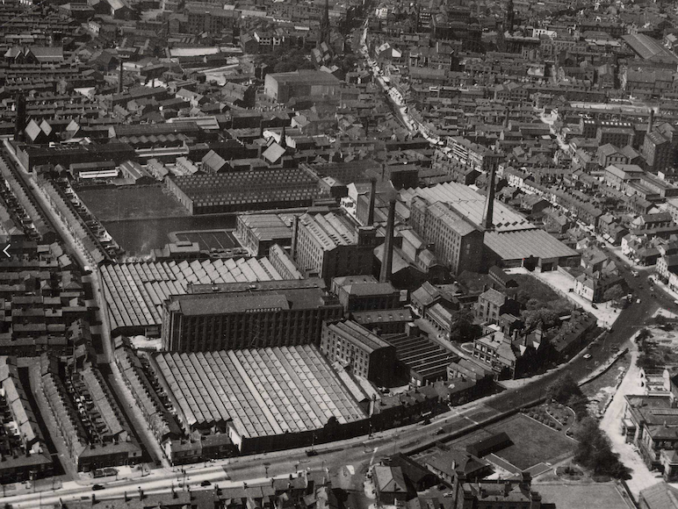
Horrockses Yard Works, Preston, 1940s,
Lancashire Archives, Preston, Lancashire – Public Domain
After having a good war – all those uniforms – the company declined in the late twentieth century as cheaper imports from countries with lower labour costs undercut British cotton manufacturers. At the same time, demand shifted away from traditional cotton goods, while that for synthetic fibres rose. Ageing mills, high operating costs, and limited modernisation reduced competitiveness. The wider collapse of Lancashire’s textile sector ultimately led to the company’s loss of markets and closure.
A foretaste from Newry
As a foretaste of what was to come, in 1961 the Northern Ireland newspapers reported the closure of a Horrockses factory in the province’s Newry. That works employed 280 workers, 250 of whom were women. In some cases, as many as four women from the same family were made unemployed by the closure. Having been open for only ten years, the company blamed foreign competition which was only expected to increase, rather than slacken, in future.
Local Stormont MP Joseph Connellan noted a tendency for firms with their main factories in England to compensate for any losses in England by shifting more and more capital to that country, with the result that Irish branches suffered.
Elsewhere in the coverage, there are passing references to a neighbouring factory being taken over by Seenozip. This was to become a notorious 1960s financial scandal in Northern Ireland involving a zip manufacturing company. Founded in Newry in 1960, the firm collapsed in 1964 amidst allegations of fraud, with directors Leslie Williams and Richard Robinson subsequently being jailed for defrauding the Northern Ireland Government of development funds.
Conservative/Unionist MP for Belfast West, Patricia McLaughlin, served as a director of the firm and although she was not found guilty of fraud herself, her association with the company led to the end of her parliamentary career, as she chose not to contest the 1964 general election.
Ownership and control
Also in 1964, Horrockses, Crewdson Ltd was sold to Steinberg & Sons, a family-run clothing business established by Alexander Steinberg, of ‘Russian emigre’ stock. Before also having a ‘good war’ Steinbergs had opened government-assisted factories in depressed regions such as South Wales and the North East of England.
According to the London Museum, ‘Jewish businesses played a vital role in making London a centre for fashion manufacturing in the 19th century. [But], the UK government had also started to provide incentives for businesses to relocate to areas that had been designated as economically deprived, such as South Wales, Cumberland and Tyneside. It was these reasons that prompted Steinberg & Sons to move much of their production from London’s East End to South Wales in 1939.’
What MP Connellan noted for Newry and the Irish, was repeated to Preston and the northern English as ownership and control moved away from the mill towns. Sites were closed and sold for alternative development. Machinery was scrapped or sold – often to foreign competitors. In what remained of the industry, a trend in replacing local people with cheap immigrant labour from the new commonwealth became a tidal wave.
Conclusion
What causes of decline in the north of England can Mrs AWS and I conclude from our latest plutocrats’ day trip?
- Cack-handed regional development programmes dogged by corruption and political, rather than market, considerations
- Asset stripping newer (taxpayer subsidised) capital goods to foreign competitors
- Sweating ageing capital goods with a tidal wave of imported cheap labour
- A post-empire form of globalisation that moves ownership and control to foreigners
Might there be a better way for the northern working man to make a living? And might observing the wear and tear on the cogs and wheels of a mill in Bradford point such an artisan towards exotic opportunities?
Find out next time on Plutcrats’ Tour!
© Always Worth Saying 2026


