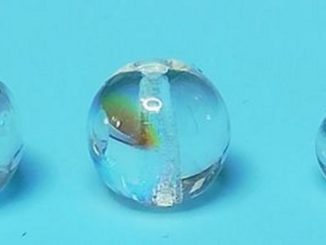

Earle Neil Kinder, licensed under CC BY 2.0
After a rather extended respite hiatus, welcome back, my friends, to the show that never ends… wending our way through the elements and the Groups of the Periodic Table (a.k.a. the Periodic Table of the Elements).
It’s been a while so, as a reminder, the general idea behind this series is that we take a detailed look into at least one element from each of the groups. To date, we’ve considered elements from twelve of the Table’s groups. Today we are going to take a look at another one:
- Group 1: Hydrogen, and Sodium
- Group 2: Calcium
- Group 4: Titanium
- Group 8: Iron
- Group 9: Cobalt
- Group 10: Platinum
- Group 11: Copper
- Group 12: Mercury
- Group 13: Boron
- Group 14: Carbon
- Group 16: Oxygen, and Sulphur
- Group 17: Bromine
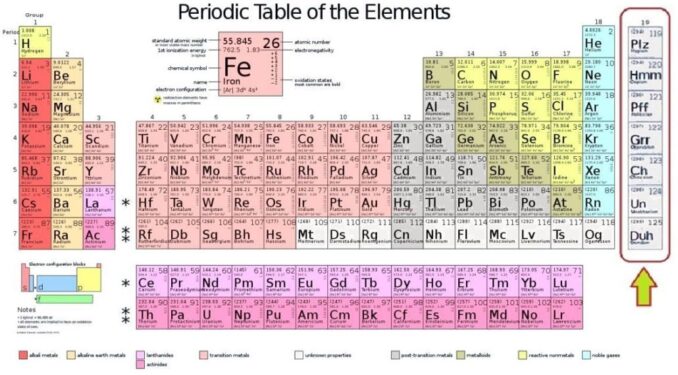
This time, we’re going not just to consider a single element, but a Group of elements within the Periodic Table in its entirety. This is a supplementary group, Group 19, one which is not generally included on the pictorial depictions of the Table we see in most textbooks. However, its presence, and the elements it contains is, I believe, as important to modern science as the preceding eighteen groups.
Think of it as being a bit like the nineteenth hole on a golf course…
adapted from 2012rc, licensed under CC BY 3.0
OK, you’ve seen where the elements that make up this group sit on the Table (above). Now let’s take a look at the elements themselves.
Hopium (Plz), Atomic Number 119
The first of the elements we’re going to explore today sits right at the top of Group 19. It’s the lightest of the seven elements found in this Group. Though it’s extremely common worldwide, hopium, a gaseous element, is like many of the gases in that it is not visible to the naked eye.
This element’s pedigree is ancient. Although it wasn’t acknowledged by this name until the 19th century, the idea of hopium is well-established, indeed first brought to prominence by Greek tragedian Euripides over 2500 years ago.
Hopium’s alchemical symbol has changed in form, transmuting over centuries through many adjustments and modifications. At times, this was the subject of considerable contention. However, its symbol was finally standardised to that which you see below.

SharpieType301, 2026
This element is interesting in the way it bonds chemically. Despite typically bonding covalently* (as we’ve seen with other non-metal, or should that be non-mettle elements), under certain conditions it can actually form ions. These are produced by the loss (or eviction) of one or more electrons from its value set.
[*bonding is explained in the article on Carbon. A covalent bond is ‘Mr Nice Guy’ when it comes to use being made of an element’s electrons. It’s an egalitarian, consensual pact, whereas ionic bonding is an altogether less altruistic arrangement]
Hopium is a peculiarly pervasive gas, one which is recognised to possess powerfully narcotic properties. In chemical reactions, hopium is frequently exploited (somewhat ineffectively, I might add) to try to modify toxic or unpalatable properties.
Interestingly, Hopium was the appellation chosen for a French start-up firm, founded in 2019 by young racing driver Olivier Lombard to build a clean, green driving machine, much vaunted as the “French hydrogen Tesla-killer”.
Lombard’s aspiration was to develop a 500-horsepower luxury sedan, rapid to refuel, with the potential for up to 620-miles driving range. This was the Hopium Māchina Vision.
The Māchina was conceived as an FCEV, an electric vehicle propelled by a hydrogen fuel cell (if you want to know more the US Department of Energy will be happy to explain). This car was not going to be a cheap option, originally advertised with an expected price tag of €120,000 once in production.

WikiGenesis, licensed under CC BY-SA 2.0
Lombard’s firm announced their plan to open a production centre in Vernon, Normandy in 2025. The site would employ c.1500 staff, with a projected target production of around 20,000 cars per year.
Ambitious, eh? Well, one might say overly so as, a tad awkwardly, despite their machinations the firm quite spectacularly failed to navigate tricky financial waters.
Although in 2022 the French government had stumped up land (a c. 85-acre site) plus, allegedly, provided loans at low or zero interest to help develop the necessary infrastructure, this was not enough. The firm fell into negative equity to the tune of some 31.9 million euros (c. £28 million) and faced bankruptcy by June 2023. By the close of 2025, not a single car out of the 1,000 pre-ordered had been delivered.
Copium (Hmm), Atomic Number 120
The next Group 19 element for us to consider is not to be confused with the twelve species of lace bugs comprising the Copium genus in the family Tingidae.
Copium is an analogous element to the one which we have just explored. Once again, it is relatively abundant, with substantial accumulations being found across the globe.
This too is gaseous in elemental form, and it is typically observed to exhibit a markedly depressing deep blue-grey tinge and is slightly hazy in appearance.
Although the name for this element was only confirmed in 2019, the substance is thought to have been recognised for almost for as long as hopium, the element to which it is most closely related.
The alchemical symbol for copium has, like its sister element hopium, been subject to similar metamorphoses. However, the universally agreed representation can be seen below. Though the derivation of this symbol is unclear, it bears a striking resemblance to a raised fist with thumb extended.

SharpieType301, 2026
This element has not hugely reactive, but has been reported to react with oxygen and nitrogen to form copium nitrate. In its elemental form it may exhibit narcotic properties, offering analgesic and sedative benefits to dull pain post-injury. However, it remains an oddly mysterious substance with no noteworthy real-world practical applications.
Politician (Pff), Atomic Number 121
This substance naturally occurs in elemental form, although it is frequently associated with ores, from which it can be difficult to separate.
Politician is rarely seen as a solid. It is more commonly encountered as a gas, often escaping from subaerial fumarole-type vents. This characteristic is believed to be how its symbol, Pff, came into being.
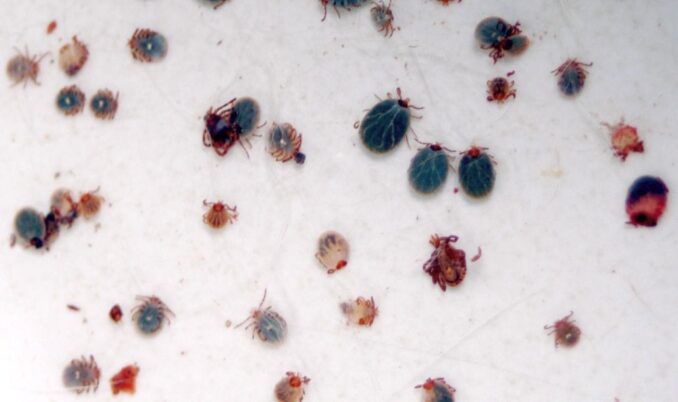
It’s an abnormal element, atypical in that its visual appearance fluctuates. Sometimes politician will exhibit a reddish hue, whereas at other times it appears to display a conspicuously bluer shade. These are most common, though there are occasional flashes of other colours.
Indeed, this element’s name tips a hat to this variation in colour, as it stems from a collection of small creatures, parasitic arachnids of the order Ixodida (you’ll be familiar with these wee beasties as ticks), which are encountered in a similarly distinguishing variety of colours.
Waldo Jaquith, licensed under CC BY-SA 2.0
Politician’s elemental name is made up of the terms poly– = meaning many, tick = small creatures of the order Ixodida, and -ian = meaning relating to or like.
This element’s properties vary depending on the environment. Politician is markedly affected by the atmosphere (especially prevailing winds) which can cause a complete turnaround in properties.
It’s an element which has been proven to have a particularly strong affinity for gold and other precious metals. It’s an excellent conductor, not of electricity, but of intense heat (Ref TTK), so can act as an extraordinarily effective deflector.
Unfortunately, beneficial applications for this element are acknowledged to be pretty limited.
Opprobrium (Grr), Atomic Number 122
Sitting next to politician on the Table, and at times found naturally in close association with it, opprobrium is an ill-famed element.
It is a dense yellowy-grey gas with a higher density than that of air at ambient temperatures. This leads to it sinking to form unsightly roiling ‘pools’ in low-lying areas.
The earliest known use of opprobrium stems from the mid-1600s. Sometimes used as a form of cleansing agent, it is highly corrosive and can cause significant deterioration of other materials through its reactions with them. It is further characterised by its bitter taste.
However, it is an element which has only a few advantageous applications. In truth it is an element whose wholly repellent properties are, perhaps, best not detailed in a public forum.
Chinesium (Ch), Atomic Number 123
Our next element is found in substantial quantities in certain regions of East Asia, but with rising amounts now identifiable worldwide.
Chinesium is a metallic element which was only properly recognised and named shortly after the Millennium. It is a solid, with an appealing lustre and a distinct yellowish hue, somewhat reminiscent of gold (Au).
However, despite its relatively recent ratification, there exists an ancient alchemical symbol for this element. It does, after all, hail from locales with a long history of manufacturing, well predating the foundation of the People’s Republic of China in 1949.

SharpieType301, 2026
Though not, technically, classed as radioactive, chinesium is not entirely stable. Its half-life (which indicates how long it would take for half of a sample to transform into a different material) cannot be accurately quantified.
Being comparatively unstable, chinesium has the capacity to transform into something quite different over time. This means that assessing its key properties as a metal can pose quite a challenge.
SharpieType301, 2026
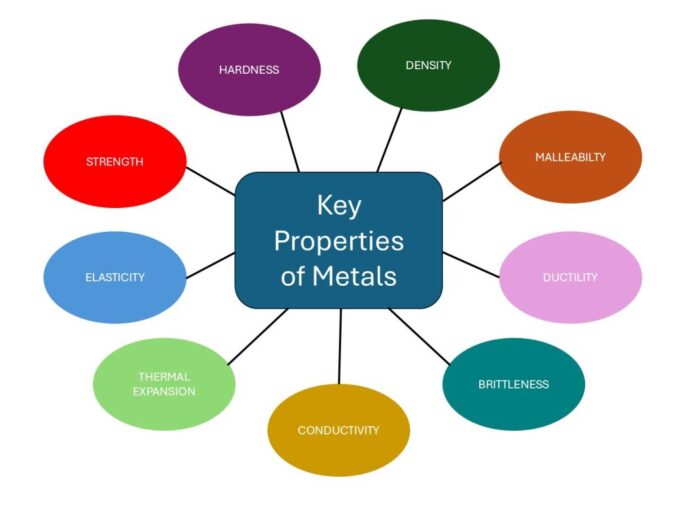
Although more are listed in the graphic above, some of the more important properties of a metal (especially in terms of production and end-user satisfaction) include:
- Hardness: how easily does the metal scratch or dent?
- Malleability: can it be bent or shaped without cracking?
- Ductility: how far does it stretch before it snaps?
- Brittleness: does it fracture suddenly when subjected to stress?
- Elasticity: will it return to its original shape once any stress is removed?
- Strength: How much force can it withstand before breakage?
That such properties are not reliably measurable, the element’s properties cannot be guaranteed. This can make chinesium a somewhat less than ideal choice for manufacturing since the quality of the end product can be severely compromised.
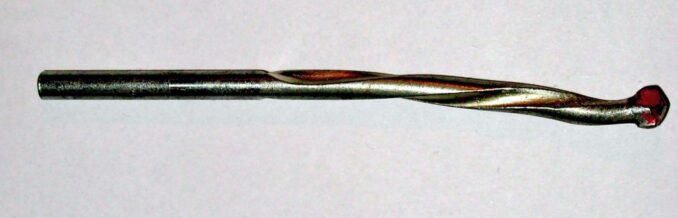
Despite these concerns, it being an abundant and easily processed material, thus leading to low production costs, this element has found uses in a remarkable array of marketable products. Perhaps inevitably, this has led to a number of observed glitches and malfunctions in real-world applications.
Dirgela, licensed under CC BY-SA 3.0
In its favour, however, chinesium is a satisfactorily dense metal and is considered by some to hold potential for important military applications, e.g. it could be used in the tips of anti-tank shells to destroy, er… oh wait, perhaps not.
Unobtainium (Un), Atomic Number 124
In stark contrast to its next-door-neighbour on the Table, this metallic element is a materials scientist’s wet dream, the Holy Grail of elements.
Its properties, unlike chinesium, are not only reliably measurable, but remain dependably stable. It is so strong and resistant to corrosion and damage that it’s regarded as being virtually indestructible.
This element was first named in 1957 by James R. Hansen at the Langley Aeronautical Laboratory, as an unknown but predicted element, well before it had been formally identified.
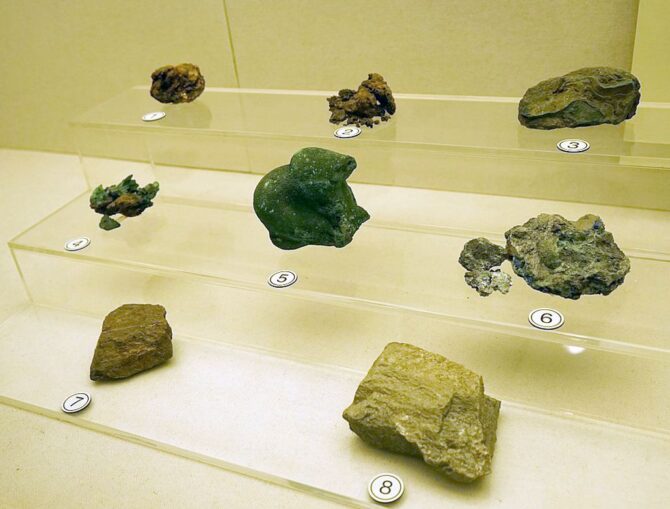
Unobtanium is a gleaming, lustrous, silvery-grey metal. Interestingly, for all its stability, it is not found in its pure metallic form in nature, typically occurring in the form of oxide, sulphate and carbonate ores, along with some silicate ores.
Amarespeco, licensed under CC BY-SA 4.0
These ores are never discovered in great abundance, only found in limited seams and pockets in some of the most remote locations on the planet, making it economically challenging to both mine and transport.
As the pure metal is metal is extremely stable so, generally, are the ores from which it is processed. This, and the fact that its ores are rarely found in significant quantities, makes unobtanium more difficult and expensive to process than large numbers of other metals.
This, along with its high temperature resistance, also means that developing alloys (for specific applications where its properties are required to be modified, or simply to reduce costs) is in no way straightforward.
However, unobtanium has an exceptionally high strength-to-weight ratio and is able to perform unfailingly in extreme environmental conditions, e.g. across a broad temperature range from severe cold to intense heat. It is also able to withstand tremendous pressures and high stresses. This gives unobtanium (and its alloys) the potential to be near perfect for many high-tech aerospace or military applications.
These properties, and others, make it a highly prized element. Both the Critical Metals Research Group within the Department of Earth Sciences at the University of Cambridge and the Critical Materials Innovation Hub (part of the U.S. Department of Energy’s Ames National Laboratory) are expected to announce that this element will soon be included amongst the ‘metals of interest’ essential to expanding their research programmes.
Dumdum (Duh), Atomic Number 125
Whilst dumdum has only recently been ratified, it has been known to mankind since the early days of human existence. Dumdum is surprisingly widespread on Earth, with sizeable deposits found on every continent.
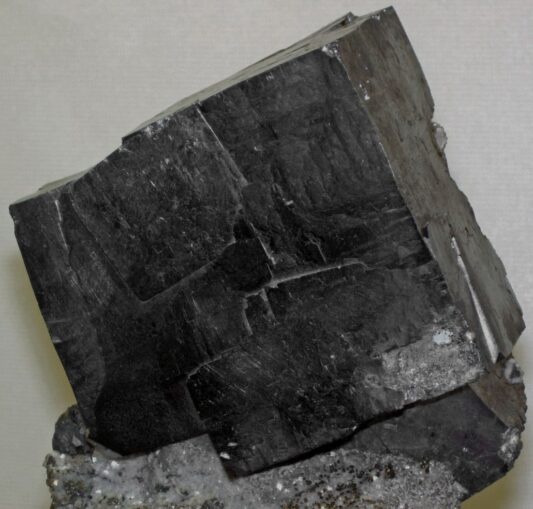
This element has the highest density (is the densest) of any naturally occurring element in the universe. Found as an unattractive ‘hard as nails’ solid, it is typically dull and near black in appearance.
James St. John, licensed under CC BY 2.0
It is a persistently stable, stubbornly unreactive element which has been included in the ‘platinum-group metals’ despite it occupying a vastly different position in the periodic table, i.e. an outlier to the cluster of other platinum-group metals (PGMs) and other noble metals in the centre of the Table.
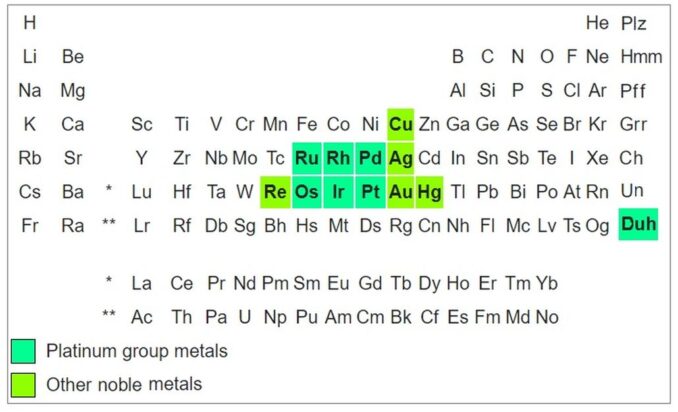
Image adapted from Wikipedia, Public Domain
Dumdum is extremely difficult (some would say hopeless) to try to alter in any respect, indeed it is less reactive then either Gold (Au) or Platinum (Pt). Even full submersion in aqua regia (a 1:3 mixture of concentrated nitric and hydrochloric acid) attacks it only awfully slowly. Its resilience under high pressures is also unparalleled.
Dumdum serves no known biological role, unsurprising as it is considered to be mildly toxic in fine particulate form.
Dumdum has an ancient symbol which looks like a tall cone or isosceles triangle containing a ‘mystic’ character which closely resembles the letter D. It was made better known by the alchemists but, incredibly, the first known example of this symbol being used had been inscribed into the soft material of a cave wall in La Roche-Dullard, France some 80,000 years ago by Neanderthal man. Similar symbols have been noted at the remote Chagyrskaya and Okladnikovin caves in the Altai Mountains in Siberia.

SharpieType301, 2026
Does dumdum have its uses and practical applications? Well, yes. As with other PGMs it is a high stability material, able to withstand extremely harsh conditions that would destroy many materials.
This means that it is durable enough for use in a number of applications. For example, it is possible to form dumdum into crucibles able to withstand extremely high temperatures (>3,000˚C). As dumdum is minimally reactive it will neither alter nor contaminate anything placed in contact with it, this makes it an alternative to ultra-high-temperature ceramics (UHTCs) for such applications as production of optical devices and, in particular, astoundingly sharp cutting implements.
Prospective elemental additions to the Periodic Table
Science is never settled. There are a few more heavy elements (either naturally occurring or synthetic) which have been proposed, but not as yet agreed to exist by The International Union of Pure and Applied Chemistry (IUPAC).
Should it transpire, ratification of these elements would be based on the consistency of their atomic properties, e.g. possessing an identifiable number of protons in their nuclei, and the ability to demonstrate unique characteristics using tested scientific methods.
Until such time that they can be fully ratified, these ‘elements’ have been given temporary, unendorsed names:
Phukovium (Fu) – this has not yet been dependably synthesised but experimental data to date suggests this will be a radioactive element, extremely unstable, with different isotopes having markedly different half-lives. If not handled with the utmost care, it is highly likely to be explosive.
Bigwillium (Pn) – this element has long been predicted to occur, and in substantial amounts but, so far, has not been seen on Earth. Though unlikely to be gaseous, it is anticipated to bear some close similarities to hopium.
Latinum (Ln) – long thought to be fictional (the chosen currency of Star Trek’s Ferengi), it is now thought that this exceptionally rare, silver-coloured liquid metal might actually be synthesised. If this does succeed, it is likely that the element will need to be protected as ‘gold-pressed’ latinum, with the metal encased in gold as a binding medium.
Well, I hope you have enjoyed this little romp through some of the lesser-known elements. Regrettably, although there are still identifiable gaps, it does not mean that I shall be picking up the elemental baton to bring you further episodes in this series in the near future.
© SharpieType301 2026