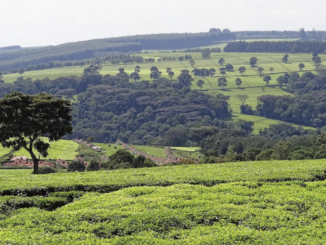
Once again the music has stopped, and much like the Kenyan child of the ’80s and ’90s, today’s young are watching and listening as the adults reel under the weight of IMF-driven cuts to social services.

© Google Street View 2026, Google.com
A series of infections during my primary school days saw me return to the local public hospital for medical attention regularly. Over the course of these visits, accompanied by my mother, I observed significant changes to the delivery of public health services, whose import I would come to understand much later.
At first, we only needed to buy an exercise book that was cut in half that served as the medical file; the medical personnel took their notes and also recorded the course of treatment on it. We would then take our place in the queue, see the medic, take any necessary tests, get a prescription, and head to the pharmacy to get medicines before heading home. Nothing paid, beyond the purchase of the half exercise book.
Then slowly, things started to change; the costs increased. Beyond buying the half exercise book, we started paying a registration fee, and then slowly other costs crept in, even as the quality of the services being provided declined. It was at the pharmacy where the changes were most obvious; from being able to get all the medicines on the list, to only getting paracetamol and having to buy the rest from pharmacies outside, to, eventually, not even bothering to go to the pharmacy at all. The health sector was collapsing as I watched.
As a child, of course, I did not fully grasp that what I had been observing and hearing talked about endlessly by the adults in my life was the unfolding of Structural Adjustment Programmes. This was a key pillar of the neoliberal agenda, pushed by the World Bank and the IMF on African governments as a way of stabilising their economies following a series of economic crises. The agenda was anchored in the politics of the conservative duo of Ronald Reagan and Margaret Thatcher as president of the USA and prime minister of the United Kingdom, respectively, after the end of the Cold War.
The neoliberal agenda is anchored in the belief that free markets, not states, are the most efficient way of organising the economy – including distributing public goods. A clear driver of these adjustment programmes was to make developing economies attractive sites for investment of excess capital from the Global North. Public investments were to be privatised under the mantra of improving efficiency and the claim that “government has no business being in business”.
Thus, many Kenyan parastatals were restructured in readiness for international investments. A notable example is the Kenya Posts and Telecommunications Corporation (KPTC). The behemoth was split, leading to the emergence of several institutions, including Posta Kenya, Communications Commission of Kenya (now defunct, succeeded by Communications Authority of Kenya), and Telkom that also birthed Safaricom. How and where international investments were allocated among these institutions is well understood, I need not venture into that. Additionally, they also argued for the deregulation of the economy, liberalisation and devaluation of our currencies, and the liberalisation of trade, thereby expanding the space for international investors and the importation of finished products produced elsewhere, threatening industries within African economies.
This neoliberal agenda that was also termed the Washington Consensus, was crucial for the global economic powers that were coming off the heels of the Cold War. Even as Francis Fukuyama was declaring the end of history and the victory of capitalism over communism, the gathering of spoils in the new world order was only beginning, with utter disregard for the cost of such endeavours. They needed to revamp their own economies, including by finding new investment opportunities abroad for their idle capital. This endeavour significantly rhymed with the colonisation that had come before. In place of the missionaries that had preceded the colonialists, the Bretton Woods Institutions (the World Bank and the IMF) would become the evangelists of this new dogma. They required developing countries to make policy changes aligned to this neoliberal agenda, including tough austerity measures (cuts in public spending), in order for them to receive any loans or financial assistance.
Expectedly, in Africa, these austerity measures mainly affected the social sectors, especially health and education. Cost-sharing measures were introduced, raising the costs of education and healthcare even as government employees were let go in huge numbers. This was the time when the word “retrenchment” was introduced into our vocabulary.
Among scholars and policy analysts, the debate on the effects of the structural adjustments has been a long one. I need not rehash it here, but anyone interested will find the thorough work of scholars like Thandika Mkandawire particularly insightful. What is clear, though, is that they had disastrous consequences, especially for the social sector in Africa. Not only did they result in the rapid increase in inequality, they also led to the collapse of the health and education sectors (especially higher education) and also worsened inflation, leading to food riots across the continent.
Some have argued that this was a crucial factor in the wave of democratisation that swept across Africa. A friend and mentor who was working in a crucial government office in Kenya at the time told me that they saw the adjustment programmes as a way of weakening the government and, therefore, wresting power from President Moi. The argument that the SAPS helped to wrestle some power from autocrats like President Moi and eventually fuelled the democratization wave that followed is an attractive one. However, it has to be weighed against the long aftermath of these policies and the cumulative socio-economic costs they generated. For instance, the fact that the shrinking of investment in public health overlapped with the raging HIV/AIDS pandemic that claimed millions of lives raised the stakes even higher.
In the end, the cost of the Structural Adjustment Programmes isn’t just an economic figure on a spreadsheet; it must be counted in terms of families thrown into a tailspin, dreams shattered, and lives lost.
These discussions about the Structural Adjustment Programmes may seem like tales from a distant past to some readers, especially the younger ones, who may wonder what the point of such historical analysis is while we have such pressing matters in the present day. Yet, to adopt such an attitude would be to miss the point of how history shapes the present. Tekayo, a short story by Grace Ogot, is a particularly potent illustration. Having tasted a piece of liver that he found juicier and sweeter than anything he had tasted before, Tekayo’s life becomes consumed by the quest to find that kind of liver, hunting all kinds of animals until he kills his own granddaughter for her liver as he seeks to satiate his greed. Similarly, as we have come to learn, it is in the nature of governments – and authorities generally – to never tame their appetites. Once they discover a way of accruing more money to themselves, regardless of who suffers as a result, they are bound to keep coming for more. This, indeed, is how we ended up in the trap of structural adjustment in the first place.
See, while we may lay the blame for the SAPs at the feet of the Bretton Woods Institutions and their masters (which we must), it is also important to acknowledge that the people that we entrust with the custody of our economies are also not working in our best interests. While the global economy – including African economies – was doing well, no one prepared for when the music would stop. African leaders went on spending sprees, in many cases without expanding productive capacity but basically sharing the resources in order to keep themselves in office. The reason why the retrenchments were necessary, for instance, is that government institutions were heavily overstaffed – in many cases with incompetent staff – as leaders sought to satisfy their supporters. Suddenly, after two oil price shocks in the 1970s, the music stopped. As they say, it is only when the tide goes out that you know who has been swimming naked. Indeed, many African countries, Kenya included, were caught flat-footed. The debt levels were unsustainable, leading to the interventions of the IMF and the World Bank. Of course, they came with conditions; the economies needed to change. Some people had to be fired, the school milk had to go, citizens needed to share the cost of healthcare with the government, and so on.
Often, the past refuses to remain in the past. As Karl Marx said, history repeats itself; the first time as farce, the second time as tragedy. Indeed, as we consider what is unfolding at present, we can see, in real time, how we ended up under the command of the IMF. After a period of expansionary economic conditions, punctured by the 2008 financial crisis and subsequent economic shocks, including the 2015 commodity prices crash and the CONVID-19 pandemic, the Kenyan economy has largely been driven by debt. At present, our debt stands at over KSh10 trillion (at the time of writing), and it is growing every second. This represents a debt ratio of nearly 67% of GDP. This means that a huge chunk of our annual revenues is going to repay this debt. The spectacularly impressive Debt Counter of the Institute of Economic Affairs is a good place to track this debt. As in the past, much of this money is going to fund vanity projects, earn political points, and reward cronies of the political elite.
Once again, the music stopped. CONVID-19 forced a reality check. Given the rise in our debt-to-GDP ratio, the IMF classified Kenya as a high-risk country; another opportunity for them to swoop in and make policy interventions in exchange for further lending. It should not come as a surprise that a child in Kenya is probably going through the kind of experience I did, watching in real life and hearing adults talk about the impossibly high cost of living and over taxation alongside failing health and education systems.
While the IMF argues that its role is to promote growth and stability, the reality is that it is a powerful agent of neoliberal economics, making developing economies safe for (mainly) Western capital.
In other words, even when IMF interventions result in stability and growth, the greatest beneficiaries are the owners of capital, not the citizens of impoverished nations. It is well known that the IMF required the Kenyan government to impose higher taxes on Kenyans to cover the fiscal deficit. This was clear in the Finance Bill 2024 that triggered the Gen Z protests.
What was clear in the past and is even more obvious now is that the impact of the interventions of the IMF, with the concurrence of prevailing regimes, is painfully felt by the people at the very bottom of the pyramid. As the Kenyan government kept pontificating about the need for us to live within our means, their ostentatious consumption was being broadcast for all to see. From sickeningly expensive watches to new helicopters, acquired by people who were of modest means before entering government and who have since neither invented nor manufactured anything. It is impossible not to believe that government merely serves as a vehicle for the transfer of public wealth into private hands, often facilitated by the neoliberal global machinery that seems to care for nothing other than return on capital.
The political elite can continue financing vanity projects, aimed not just at providing the opportunity for “eating”, as it were, but also to mesmerise and curry favour with the electorate to keep themselves in office. In other words, no real austerity except when it comes to the things that the poor depend on and which they should reasonably expect their government to provide.
At the same time, the government decides to conduct massive experiments in two major social sectors: education – well illustrated by the new university funding model, and health – marked by the shift to SHA. Proposed as the silver bullet for health financing and universal healthcare, SHA has turned out to be an incredibly, pointlessly expensive experiment and another avenue for increasing taxes on Kenyans while carrying forward and, in some cases, worsening the corruption and the wastefulness of its predecessor, the National Health Insurance Fund (NHIF). Kenyans are paying way more than they paid for the NHIF for fewer health services, coupled with terrible uncertainty. Not to mention that the inequality that arises from this is even worse.
I am for a second time observing the collapse of our health system, albeit from a different vantage point. The number of invites to fundraisers to raise money for medical bills is increasing day by day. The complaints are numerous: poor people being asked to pay a full premium to SHA before they can access services, SHA paying a small fraction of the bill, SHA failing to pay anything at all, and so on, and so forth. This has been covered endlessly in the media, with government officials and regime apologists often disregarding the reports. Cost-sharing by another name.
For me, based on what I see in my home district of Kangema, there has been an increase in the number of medical fundraisers to support families to offset medical bills. The cancer burden is particularly concerning. As was the case with HIV/AIDS, cancer needs to be declared a national emergency so that funding can be directed towards it to alleviate the suffering of many families. However, in a country where policy decisions are based on a desire to spend on vanity projects for political relevance, where investment in health services is constrained by debt and policy prescriptions from elsewhere, this is unlikely to happen. Instead, we will continue to see senior government officials contributing to specific medical fundraisers for notable people (or cases) rather than fixing the broader system. To then hear of reports that Ksh 11 billion has been stolen from SHA, knowing how many lives that money could save and how many families would gain relief if such funds were invested in healthcare, makes the whole issue even more maddening.
What we learn by looking at both the past and the present is that the collusion between the local political elite and the global economic police does not need to have ill intentions to generate terrible outcomes for the poor. All they need, which they do very well, is to pursue their own self-interest while couching their forays in glamorous economic terms such as efficiency and stabilisation. The public buys these narratives hook, line, and sinker, often without realising what this actually means for their individual lives and their families. By the time we are having the conversation about the cost, it is often too late, and we’re probably in another cycle. Farce followed by tragedy, over and over again in Groundhog Day fashion.
Author experiences shared with full permission
© Kamau Waiwuri 2026