
Last Saturday’s article, I See No Ships, proved to be prescient as, while the ink dried on the 28th February piece, Israel and America began their attack on Iran. In retaliation, drone and missile attacks originating from Iran rained down on both Israel and more lightly defended targets in the Gulf States, particularly on strategically important oil and gas facilities and military bases or civilian facilities used by the US.
British Prime Minister Keir Starmer began by being lukewarm about the war and refused America permission to use British facilities.
In counterargument, from the outset Iranian drones were said to be ‘heading in the direction of’ British sovereign territory on parts of Cyprus. Unconvincing, as anything flying from Iran heading north or west could be said to be heading in the direction of Cyprus – or a thousand and one other locations in the region.
However, two days into the conflict, early on the morning of Monday, 2 March, an Iranian drone struck the UK’s RAF Akrotiri air base. Or did it? Causing limited damage to the runway and no casualties, later two additional drones were said to have been intercepted and shot down. With no naval assets in the region, the UK announced a reinforcement of Cypriot defences with a ship and two helicopters to be dispatched. The Greek air force and navy, and the French navy, sent immediate support – while gloating at the Royal Navy’s impotence.
Although headlines screamed of an Iranian attack, a look at the map cast doubt on the assertion. From a safe launching distance in Iran it would be 1,500 kms to Cyprus, pushing both the range of the drone and the likelihood of it not being intercepted to the limit.
Puffins will be familiar with the Iranian HESA Shahed 136, a delta-winged drone. Apart from the rear-driven propeller, it resembles a mini V Bomber. Besides being used by the Ayatollahs, it has proved effective in the wars between Yemen and Saudi Arabia and Russia and Ukraine.
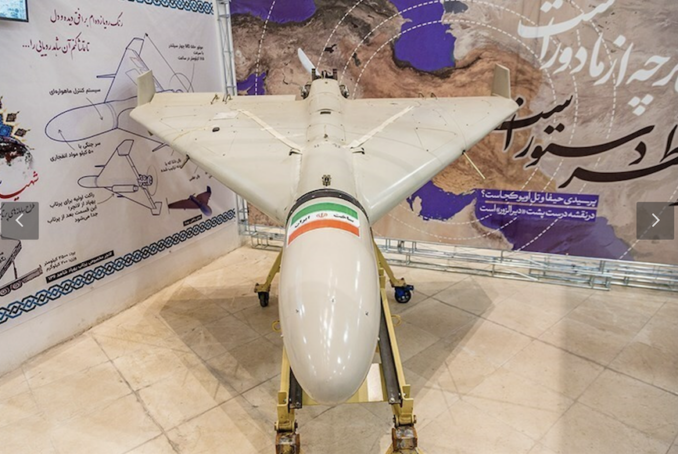
Front view of a Shahed-136 drone,
Mohammadreza Jabbari – Licence CC BY-SA 4.0
About ten feet long and with a warhead of up to 200 lbs of high explosive, Wikipedia puts the cost price of building one as low as $10,000. According to the Royal United Services Institute, the range of the 136 has been estimated by various analysts as anywhere between 1,000 and 2,000 kms.
However, RUSI’s analysis of likely fuel tank capacity in proportion to its dimensions and weight gives the Shahed 136 a range somewhere between 1,350 and 1,500 km. This fits well with Iran’s policy of designing its long-range weapons with a range sufficient to hit Israel from Iranian bases – 1,400 km. In practice, as can be seen from the dotted lines on the map in the background in the accompanying photograph, Cyprus is beyond its range.
Sure enough, by the middle of the week, the authorities were conceding the drone would have been launched from Lebanon, less than 300 kms away. Blame, therefore, points to Hezbollah, who do have drones, albeit simpler affairs than the Iranian ones, and often launch them into Israel. Very different in design to the Shahed, interestingly no photos have been released of the Cyprus drone wreckage.
The resulting furore highlighted to the mainstream the thin Royal Navy described in last Saturday’s G-P article. With no White Ensign to be seen fluttering in the Mediterranean, the obvious dispatch would be of a Type 45 destroyer. These are armed with long-range radar and the associated anti-aircraft and anti-missile missiles.
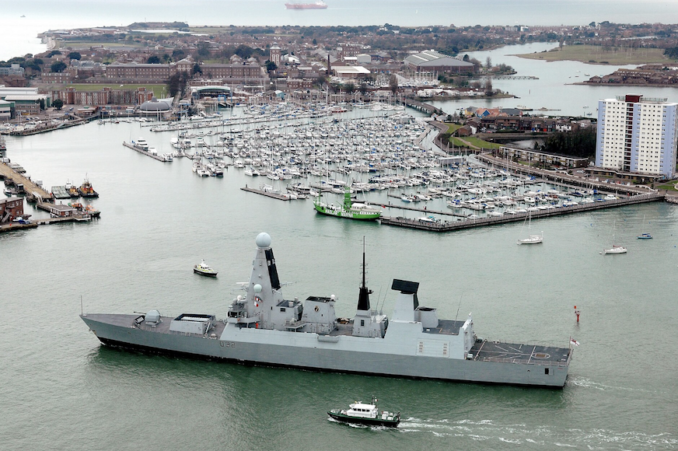
HMS Daring leaves Portsmouth harbour,
LA(Phot) Ian Simpson – Public domain
With a SAMPSON radar (the big golf ball) and a S1850M radar (the black oblong), the Type 45 can simultaneously track, target and channel fire control towards 1,000 targets as small as a cricket ball and at a distance of up to 250 miles. Together with the Aster missile sytem, these radars form the Sea Viper air defence system.
The SAMPSON radar is specifically designed for high-speed, low-level, stealthy and complex target scenarios, making it highly effective against small, low-radar-cross-section objects, such as an Iranian drone. Forty-eight vertical launch tubes carry the Type 45 destroyer’s Aster 15 and Aster 30 missiles – the 30 variant having a longer range than the 15.
However, few of the Navy’s six Type 45s are ever available owing to the inordinate time taken to resolve long-standing propulsion problems and the knock-on effect impacting crewing.
Regarding Akrotiri, Navy Lookout reports that, like most UK defence facilities, the base is highly exposed to missile and drone attacks unless fighter aircraft are able to take off quickly enough to intercept incoming threats. Ground-based air defence (GBAD) capabilities at the site are limited, and there are no hardened aircraft shelters (HAS). The ORCUS counter-UAS system is thought to be deployed there, but it mainly relies on electronic jamming and is designed to counter small, low-flying, slow drones.
Stationing one of the Sky Sabre air defence system batteries operated by the British Army in Cyprus would therefore appear to be a practical measure that could be implemented relatively quickly.
The significance of Crown territory on Cyprus, both the airfield at RAF Akrotiri and the intelligence-gathering facilities elsewhere, can be read of in this previous G-P article, Postcard From Spy Island.
It was on Tuesday, 3 March, that Sir Keir Starmer announced that HMS Dragon would be sent to the region as the United States–Israel war with Iran continued to spiral. Two Royal Navy Wildcat helicopters are also being sent, equipped with Martlet missiles which are designed to counter drone attacks.
However, armchair admirals on sixpenny tours of Portsmouth Harbour that day reported on social media that Dragon looked to be less than ready, a view reinforced by TV news drone shots.
On Wednesday morning, it was announced that Dragon wouldn’t be on the move until early next week. Taking into account transit time, it will be over two weeks from the start of what Donald Trump describes as a weeks long rather than months long war before Dragon arrives.
During Prime Minister’s Questions on Wednesday afternoon, Kemi Badenoch wrongly said that Dragon would be incapable of shooting down an incoming ballistic missile.
In fact, on 24 April 2024, sister ship HMS Diamond used an Aster 30 missile to intercept and destroy a ballistic missile fired by Houthi movement rebels from Yemen in the Gulf of Aden. This marked the first time a Royal Navy Type 45 had destroyed a ballistic target in a real-world combat scenario. However, the government and the Navy may be hoping for further delays to allow time for the conflict to subside and/or the deployment to be forgotten about.
According to the Missile Defence Advocacy Alliance, an Astor interception costs $2,000,000 per missile – to shoot down a $10,000 drone. If Dragon has a full complement of missiles, that will be nearly $100,000,000 worth which, given the rate of attrition elsewhere in this war, may last only a few days.
As for rearming the ship, each missile weighs half a ton and is over 14 ft in length, requiring a reload away from the combat zone in an appropriately equipped port. That’s assuming missiles are available. According to the Army Recognition website, from raw materials to a finished missile, an Astor takes an astonishing three and a half years to build.
The problem being this is a highly complex interceptor rather than a simple rocket. It includes advanced radar seekers, guidance computers, solid-fuel rocket motors and a unique manoeuvring system. Production involves specialised propellants, radiation hardening, semiconductor supply chain issues et al.
In the meantime, the Ayatollahs are, to some extent or another, churning out cheap drones while being disrupted by US and Israeli bombing. As per last week’s article, as the Royal Navy has reduced to not enough ships, if ourselves and the Gulf states run low on unbelievably expensive and difficult to replace anti-missile missiles, then the advantage in the war of attrition will tilt towards Iran.
© Always Worth Saying 2026


.jpg)
