
A final journey into history to meet three men whose names never sadly made it into popular memory but who, like all the others, laid the foundations still used by the railways to this day.
Unknown photographer, Public domain, via Wikimedia Commons
When I started writing this series on historical figures of the North East and Northumberland, I never intended for it to become a railway series; I thought a couple of write-ups on the Stephensons would be ‘job done’, but I was greatly mistaken. There were many unsung heroes of the age whose stories have since been covered, and I conclude this series-within-a-series on three of the least-known figures who helped shape the revolution; there will have been others who have since sadly been lost to history, but I do hope that one day their stories also resurface.
So, for this article we have the Patron, the Builder and the Polymath:
Christopher Blackett: the Patron
Andrew Curtis / ‘Puffing Billy’ – Welcome to Wylam road sign
Christopher Blackett owned Wylam Colliery, west of Newcastle, and he was the man with the money and the curiosity to gamble on steam. As early as 1805 he was in contact with Richard Trevithick, the Cornish engineer who had built the world’s first working steam locomotive, and a Trevithick engine was actually constructed for him at an ironworks in Gateshead. Blackett took one look at it and declined to buy. It was far too heavy for the wooden rails his colliery ran on, and it would have smashed them to splinters.
That refusal was, in its way, the first wise decision of the railway age. Instead of forcing the issue, Blackett went away and fixed the foundation. In 1808 he relaid the Wylam waggonway with cast-iron plate rails, giving the line the strength a steam engine would one day need. Then he waited, and kept paying.
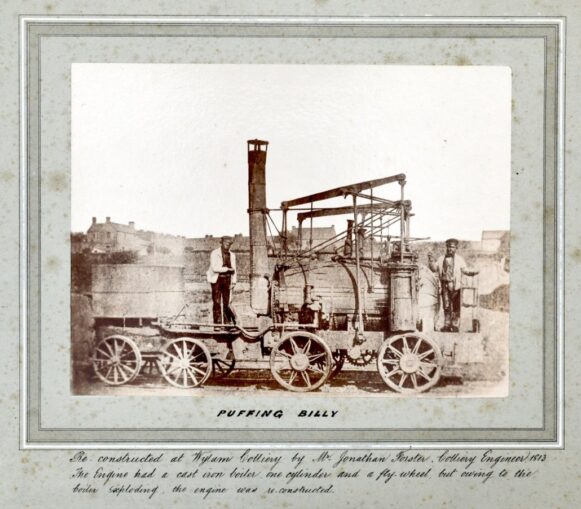
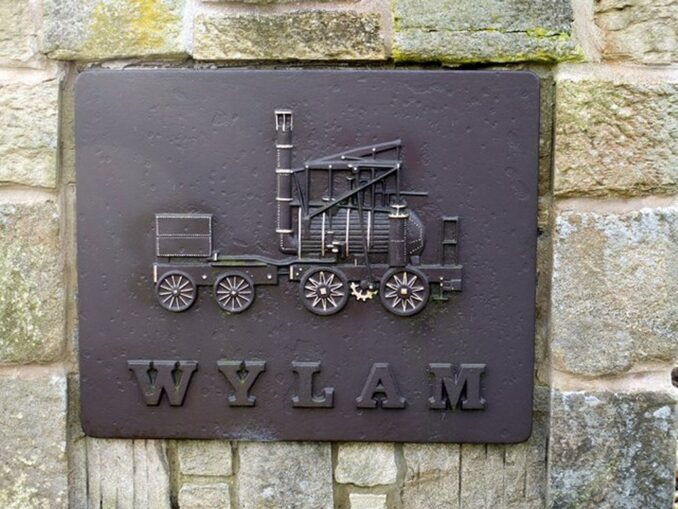
When his colliery viewer, William Hedley, proposed building a working locomotive in 1813, it was Blackett’s pit, Blackett’s iron road and Blackett’s money that made it possible. Puffing Billy and Wylam Dilly were born on his waggonway. Hedley got the patent and the credit, and rightly so, but the experiments that proved a smooth wheel could grip a smooth rail were funded by Blackett.
Some of you may be sitting here remembering an earlier article in this series that called Edward Pease ‘the Grandfather of the railways’ due to his patronage of Stephenson, you might reasonably object that the post of railway patron is already filled. The reality is that they were both patrons, roughly a decade apart, paying to solve very different questions. Blackett’s money settled whether a steam locomotive could earn its keep at all, on a private colliery line that carried coal and nothing else. Pease’s money settled whether railways could be a public business, with an Act of Parliament, paying passengers and, in time, a locomotive works to build the engines. Blackett funded the experiment; Pease funded the industry.
As far as the record shows, the two men never met, and never needed to. One was Northumberland coal gentry on the Tyne, the other a Quaker wool merchant on the Tees, and the connection between them ran through the men in the middle. Timothy Hackworth, foreman blacksmith at Blackett’s pit when Puffing Billy was built, went on to take charge of the Stockton and Darlington’s locomotives (and pretty much saved the line). George Stephenson, the man Pease hired, was born in a cottage a few yards from Blackett’s waggonway; Puffing Billy ran past his birthplace for years. By the time Pease got his own chequebook. (or whatever Quakers used in those days) out, the question Blackett had paid to answer was already settled, and the men who had answered it were available for hire.
Jonathan Foster: the Builder
If Blackett paid for Puffing Billy and Hedley designed it, Jonathan Foster is the man who actually built it. Foster was the enginewright at Wylam, the senior mechanic responsible for the colliery’s machinery, and when Hedley needed his ideas turned into iron and brass that would hold steam and move under its own power, Foster was the craftsman who did it, working alongside the foreman blacksmith Timothy Hackworth (yes, him again).
Hedley could sketch a principle, but somebody had to make boilers that would not burst, cylinders that would seal, gears that would mesh and a frame that would survive the hammering of a colliery line. That somebody was Foster. There were no factories to hand a design to; the first locomotives were made at the pit, by skilled men solving each problem at the bench as it appeared.
And that is almost all we know about him. Jonathan Foster built two of the most important machines in the history of the world, and history has not even settled the spelling of his surname. He stands for every nameless craftsman whose hands made the famous men’s ideas real, and who got nothing for it but the work.
William Chapman: the polymath
Phil Sangwell from United Kingdom, CC BY 2.0, via Wikimedia Commons
William Chapman was a different kind of figure: a professional engineer rather than a colliery man, and one who spent his career on Tyneside turning his mind to whatever problem was in front of him.
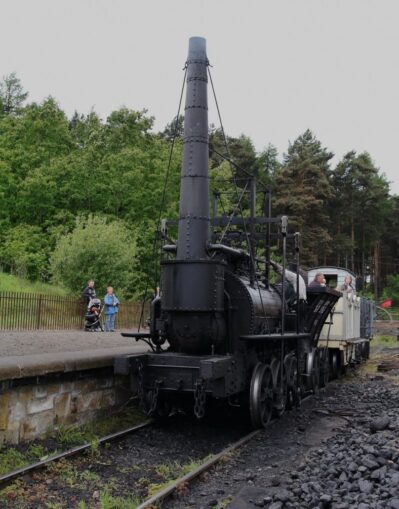
On the railways alone he tried several things. In 1812 he patented a chain-haulage locomotive for Heaton Colliery near Newcastle, an engine that pulled itself along a fixed chain laid down the middle of the track to get around the worry that smooth wheels would not grip. The idea was clever but a dead end, overtaken by Hedley’s proof that plain adhesion worked after all. Three years later, in 1815, Chapman joined forces with the great mining engineer John Buddle to design the Steam Elephant, an early locomotive for the colliery at Wallsend, a working replica of which still runs at Beamish today.
Chris Light, CC BY-SA 4.0, via Wikimedia Commons
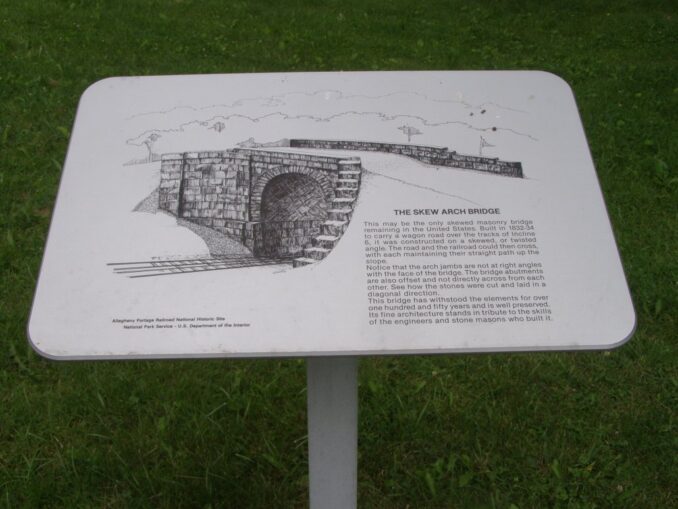
His most lasting contribution, however, was a piece of geometry. Chapman worked out the first proper method for designing skew bridges, the ones that cross a road or river at an angle rather than square on. Building an arch on the slant is fiendishly difficult, and railways, which cannot swerve to take an obstacle head-on, needed thousands of them. Every brick arch that takes a railway over a road at an angle still uses his method.
He did much else besides: canals, docks, harbours and improvements to rope-making, the unglamorous infrastructure that the industrial North East ran on. He was the sort of engineer who made dozens of difficult things work and yet never got the proper acknowledgment befitting his efforts.
So why does history forget figures such as these?
Fame, in the end, is a matter of paperwork. Hedley held a patent, the Stephensons had biographers, Pease kept a diary; their names were written down, and so their names survived. No portrait of Blackett or Foster is known to exist, and Chapman spread his talents across so many trades that no single one claimed him. Their work, however, lives on. Every train that has ever run carries something of what these three did, and no train yet has cared who gets the credit.
Blackett, Foster and Chapman may have been forgotten by history, but every railway today still rests on its sleepers.
© Paranoid Android 2026


