Cecily Neville was a Neville of Raby who married into the House of York, gave birth to two kings of England and outlived every one of her sons. Along the way she was accused of adultery from a London pulpit, reportedly lost her temper spectacularly over her eldest son’s choice of wife and, more than 500 years after her death, helped identify her youngest son under a car park in Leicester.
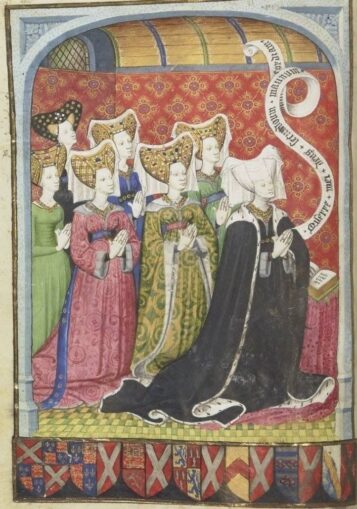
Master of the Munich Golden Legend, public domain, via Wikimedia Commons.
In August 2012 archaeologists started digging up a council car park in Leicester, looking for a king. On the first day they found a pair of human legs, lying virtually under a white letter R painted on the tarmac. The R stood for “Reserved”. It’s also the first letter of “Richard”.
Proving it was Richard III came down to DNA. Mitochondrial DNA is passed down by mothers, so the scientists needed someone descended from Richard’s mother through an unbroken line of women, and found a Canadian carpenter in London, Michael Ibsen, who was a perfect match. As a youth worker who used the car park put it: “It’s really weird to know that we’ve been parking on a king.”
So the person who finally identified the last Plantagenet king was, in a roundabout way, his mother. Her name was Cecily Neville, and she was a Durham girl. Probably. I’m assuming this, otherwise she doesn’t get included in this series.
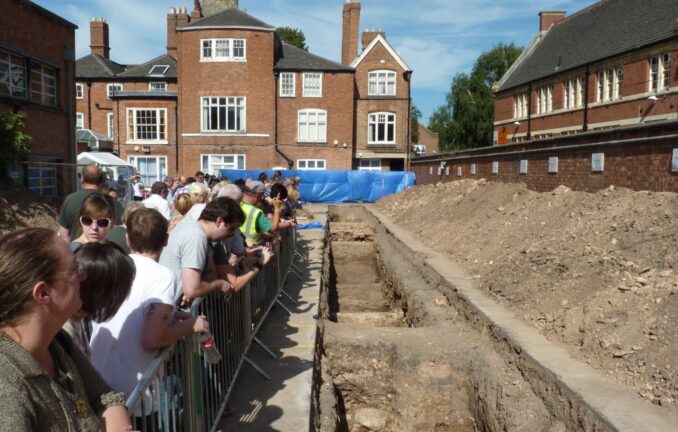
RobinLeicester, CC BY-SA 3.0, via Wikimedia Commons.
Raby (probably)
Cecily was born on 3 May 1415, a date we only know because she seems to have written it in her own prayer book, along with all her children’s birthdays (but not, for some reason, her husband’s. She must have known his off by heart).
Where she was born, nobody wrote down. Raby Castle, her father’s main home near Staindrop, is a perfectly sensible guess, but the first person to actually say so was Agnes Musgrave, a Staindrop resident who in 1795 published a bestselling gothic novel called Cicely, or The Rose of Raby, and almost certainly invented that nickname too. The earliest known use of her other nickname, “Proud Cis”, is in a London bookseller’s letter of 1713. Neither of them had ever met her, obviously.
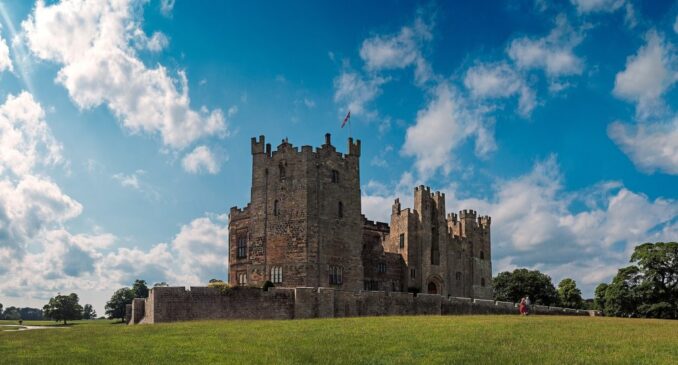
TimothyBarkerJr, CC BY-SA 4.0, via Wikimedia Commons.
Her father was Ralph Neville, 1st Earl of Westmorland, who had (only) 22 children by two wives. Cecily was the 13th of 14 by the second, Joan Beaufort, whose own parents, John of Gaunt and his mistress Katherine Swynford, only got round to marrying after their children were born.
Ralph’s real talent was weddings, which is why I’m calling him Ralph the Wedding Planner. He bought up the wardships of rich orphaned heirs and married them to his own children, in what one historian called “the most amazing series of child marriages in English history”. In 1423 he paid 3,000 marks for the 12-year-old Richard, Duke of York (there are rather a lot of Richards in this story, so this one is the Grand Old Duke of York from now on, for reasons I’ll explain later), and in his will the following year he left a golden cup to his daughter “Ciciliæ Ducissæ Eborum”, Cecily, Duchess of York.
She was nine.
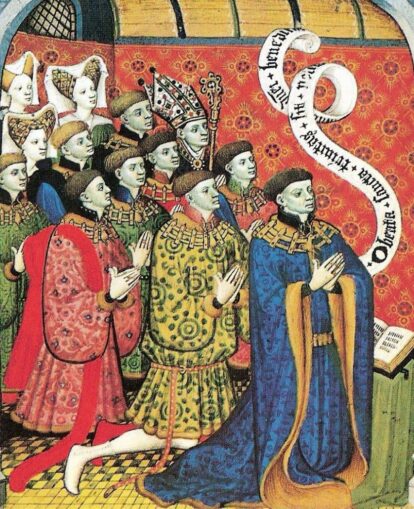
Master of the Munich Golden Legend, public domain, via Wikimedia Commons.
The Percys (yes, them again)
Regular readers will remember Harry Hotspur; this should not be difficult as I wrote about him last week. What I didn’t mention at the time is that he was family: his mother was a Neville, which made him Ralph’s first cousin. When Hotspur rebelled in 1403, the Wedding Planner stayed loyal to Henry IV (being married to the king’s half-sister helped) and was handed the Percys’ border job just over two weeks after Shrewsbury.
Then Cecily’s sister Eleanor married Hotspur’s son, Henry Percy, as he came home from exile in Scotland. Hotspur’s real name was also Henry Percy, and so was the son Eleanor went on to have, so to save everyone a headache I’m calling the husband Hotspur Junior and the son Hotspur the Third. So the Nevilles took the Percys’ job and then their heir. As some of you will know, the two families didn’t get on all that well.
Duchess of York
Between 1439 and 1455 Cecily had 12 children, seven of whom survived infancy.
Her surviving children read like a roll call of the next 30 years of English politics: Anne, Edward (later Edward IV), Edmund (killed at Wakefield), Elizabeth, Margaret (who married into Burgundy and bankrolled Yorkist plots for years), George (Duke of Clarence, drowned in a butt of malmsey, allegedly… This is also a future “Aiso word of the day” if I ever saw one), and Richard (later Richard III, and from here on Richard the Reserved, in honour of his parking space). A fairly significant collection, you might say.
Now I’ll be honest here: I personally can’t stand history books that go on for pages about who married who, who was born to who, who was the third cousin of so an so…. blah blah blah… so I’ll spare you the family tree. You can thank me in the comments, which I don’t read.
Edward, the eldest surviving son, was born at Rouen in April 1442, where his father was governing what was left of English France. That will matter later.
In 1459 the Grand Old Duke’s long feud with Henry VI’s government turned into open war. At Ludford Bridge, below Ludlow, the Yorkist leaders slipped away in the night, the Duke to Ireland and Edward to Calais, and Cecily was left at Ludlow with the younger children whilst the king’s army looted the town. Not very polite.
Some popular histories have her on the steps of the market cross with her little boys, calmly facing down the soldiers. It’s a wonderful scene, invented in the 1950s by an American historian, Paul Murray Kendall, who admitted in his own endnotes that it was pure conjecture (= nonsense). In reality she was put in the custody of her sister Anne, Duchess of Buckingham, which as house arrest goes could have been a lot worse.

Fabian Musto, CC BY-SA 2.0, via Wikimedia Commons.
The paper crown
In October 1460 the Grand Old Duke walked into Parliament, laid his hand on the empty throne and was promised the crown when Henry VI died. Cecily was very nearly a queen.
It lasted about ten weeks. On 30 December 1460 the Grand Old Duke marched his men down from Sandal Castle to take on a bigger Lancastrian army, and he and their 17-year-old son Edmund were killed at Wakefield. (Some say that’s where the nursery rhyme comes from. There’s no evidence it’s about him, or about anyone else for that matter, but I’m having it.) Her brother, the Earl of Salisbury, was beheaded at Pontefract the next day. (One of the Lancastrian commanders was her sister Eleanor’s son, Hotspur the Third.) Their heads went up on Micklegate Bar in York, her husband’s in a paper crown. Sound familiar? Yes, it was on the same gate Hotspur’s head was put on 57 years earlier.
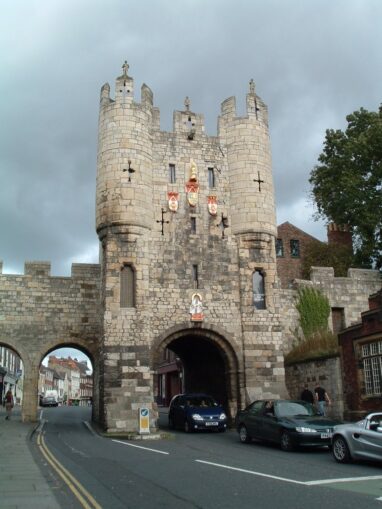
Dashwortley, CC BY-SA 3.0, via Wikimedia Commons.
Three months later her son Edward, aged 18, won at Towton in a snowstorm and was crowned Edward IV, so in less than a year Cecily had gone from nearly a queen, to a widow, to the king’s mother.
The mother-in-law
In 1464 Edward announced he had secretly married Elizabeth Woodville, a widow whose first husband had died fighting for the other side. According to an Italian visitor called Dominic Mancini, Cecily was so furious that she offered to go before a public inquiry and say Edward wasn’t her husband’s son at all. In other words, she was so cross about his choice of wife that she offered to declare him a bastard herself. Mancini was probably muddling his gossip, but as mother-in-law stories go it’s up there.
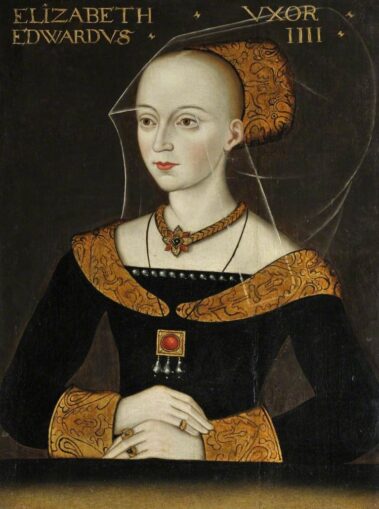
Unknown artist, Queens’ College, Cambridge, public domain, via Wikimedia Commons.
The archer
Remember Rouen? The rumour was that Edward’s real father was an English archer there. Even Cecily’s own son-in-law, the Duke of Burgundy, joined in, and in one famous tantrum was heard “stamping his foot against the floor” and calling Edward “son of an archer”. Worse insults are available.
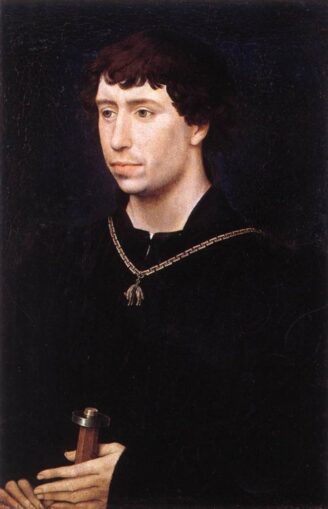
Rogier van der Weyden, public domain, via Wikimedia Commons.
In 2004 a Channel 4 documentary with Tony Robinson followed this to its logical conclusion. If Edward wasn’t legitimate, the crown should have gone down the line of Cecily’s son George instead, and the rightful king of England would have been Michael Abney-Hastings, a farmhand from Jerilderie in New South Wales. He called it “a bit of fun”. His family still exchange cards with the royals every year, which I think is very civilised.
Her own son
When Edward died suddenly in 1483, his young sons were put in the Tower and Cecily’s youngest, Richard the Reserved, went after the throne. That June a preacher (called Ralph, naturally, so he can be Gobby Ralph) told a big London crowd that Edward had never really been the Grand Old Duke’s son, whereas Richard was the image of his father. To put it more bluntly, Richard let his own mother be called an adulteress in public so that he could be king.
Thomas More later told the story as a farce. Richard was supposed to walk in on cue, just as Gobby Ralph praised him as his father’s double, so the crowd would cheer him as king. He turned up late, the preacher had to go back and say it all again, and the crowd just stood there in silence.
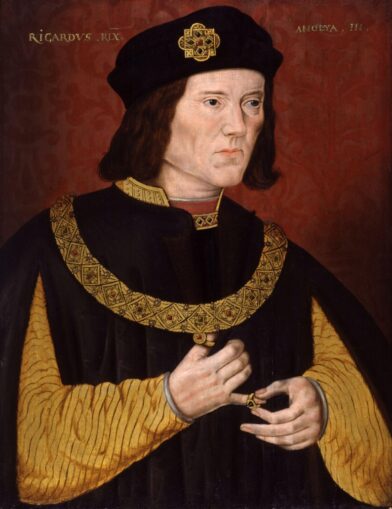
Unknown artist, National Portrait Gallery, public domain, via Wikimedia Commons.
Cecily reportedly complained about it to plenty of noblemen afterwards, and her will mentions Edward twice and Richard not at all. Within three years Richard was dead at Bosworth, her grandsons had vanished from the Tower and her granddaughter Elizabeth was married to the new king, Henry VII. Cecily had outlived every one of her sons.
Bed by eight
She spent her last years at Berkhamsted Castle, and her daily routine survives. Up at seven, prayers and masses for most of the morning, dinner at 11 with someone reading aloud from a holy book, an hour of business, a fifteen-minute nap, more prayers, a cup of wine or ale, supper, a bit of fun with her ladies (maybe involving more wine), another cup of wine and bed by eight. It’s fair to say she had earned it.

Mark Percy, CC BY-SA 2.0, via Wikimedia Commons.
Fotheringhay
Cecily died in 1495, aged 80, and was buried with her husband at Fotheringhay in Northamptonshire. Nearly 80 years later Elizabeth I sent men to tidy up the family tombs, and when they opened Cecily’s grave they found a pardon from the Pope tied round her neck on a silk ribbon, still looking “as if it had been written but the Day before”. It seems they hadn’t realised her husband was in there too until they started digging. The two of them were reburied together, and they are still there.
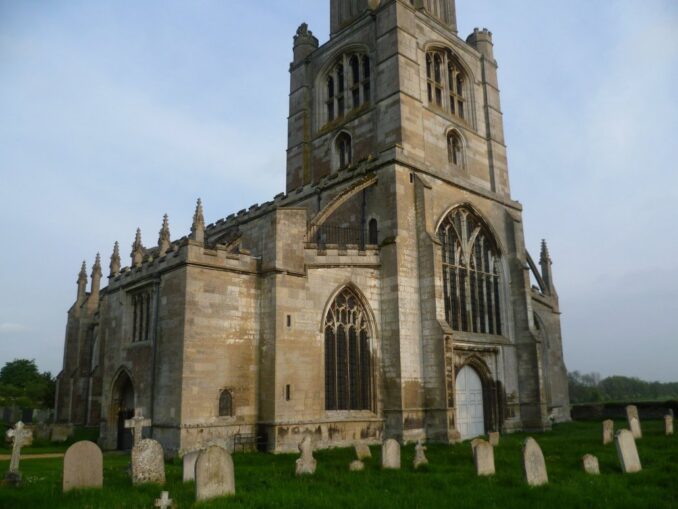
Marathon, CC BY-SA 2.0, via Wikimedia Commons.
As for the car park in Leicester, it is now the King Richard III Visitor Centre, and the spot where her son was found sits under a glass floor. So you can no longer park on a king.
© Paranoid Android 2026