We have finally come to the end of exam season, 2026. The time of year looked forward to and feared by school kids at the same time whereas the teachers will need to make sure that all years not sitting exams have had their feedback for work over the last term and year.
So what exactly happens during school exams? Well there are 3 types of exam during June and July. For an increasing number of schools, Year 9 sit their first exams in a formal setting. These are held in the same halls as GCSEs under similar conditions. The exams themselves are simply end of term or end of year tests but the idea is that they become accustomed to the exam environment – no talking, glancing, messing around etc. This is not easy for some and it isn’t unusual for a couple to be removed during the exam and given a serious talking to by head of year or perhaps the head. These exams are normally held after all other exams have finished as the halls are already set up and invigilating staff are still on site. Invigilators are often asked for help explaining questions or phrases in the paper to which they are allowed – the teachers set the rules for each subject – to help out but obviously not too much. Some Y9s take this in their stride, some don’t care and a minority will be crying or shaking from the time they line up outside until the moment they leave the hall.
Prior to the Y9s, the Y10s generally get a mock of a mock exam. They will sit a mock exam under full exam conditions as dictated by the JCQ – more on them later. The results of this exam are simply to help the final year of schooling be more attuned to their abilities, looking at what parts of the curriculum they are strong or weak on. In a good school, each pupil will receive a QLA or Question Level Analysis giving them a breakdown of how each question was answered, what went well and how their answer could be improved. This used to be a very long process for each pupil however some schools have moved to AI to speed this up. At this time, the Y10s start to realise that it is now getting very real for them. Those that were nervous in Y9 will either be calmed as they have been through this before whilst others will be more nervous and anxious than they were previously. One of the roles of the invigilators is to calm and reassure pupils if they exhibit any signs of anxiety in the exam hall.
The first exams of the year are generally the GCSEs for the Year 11s. These are the most formal and further detail will be given in part 2.
Who or what is the JCQ?
The Joint Council for Qualifications or JCQ, is a community interest company that acts as the largest administrative body for conducting exams in England, Scotland, Wales and Northern Ireland. Their exam rule book explains how exams should be planned, executed and monitored and covers almost every eventuality and believe me, the process has become so complicated and detailed over the last 10 years, that each exam hall or room must have a copy of their regulations present so invigilators can refer to this if a difficulty arises as they often do.
The administration of exams in schools (and I don’t doubt other institutions) has become so complex that all schools have an examinations officer and assistants. Though the role may not be full time, they administer each pupil’s details, enter them into the correct examination board for each subject and have complete responsibility for the integrity of every paper sat by every pupil at a school – this is a massive responsibility given the difficulties that can arise in scheduling and security around the reading and distribution of papers. For example, there can be four different types of physics or chemistry paper. At the lower end, there will be, in the case of the Combined Sciences papers, Foundation and Higher tiers. Then there are the upper end papers which are also tiered into Foundation and Higher. Each pupil is put into the stream that the teacher thinks they will get the best mark. This is a bit of a bone of contention with some parents as a teacher might suggest that the pupil will get a very good mark in a foundation paper but a low mark in a higher paper so put them in a foundation stream.
The examinations officer also hires temporary staff to act as invigilators. Each invigilator must undergo Safeguarding training, some schools insist on Prevent (anti-terrorism) training but all must take training on JCQ and examination protocol and rules. JCQ, like Safeguarding and Prevent, update their regulations annually so each year, all staff involved in examinations must undergo re-training and are assessed on their knowledge – fail and you can’t take part.
Invigilators come from all walks of life. Often from the older part of society, they must be sticklers for rules but applied sensibly, be patient, calm under pressure and be able to refrain from fidgeting for a couple of hours at a time. It isn’t always easy to retain invigilators as the working hours are very sporadic. For example, there may be only one GCSE on a day and the exam lasts for 1 hour and 15 minutes so that member of staff must be available perhaps 30 minutes before the exam and 20 minutes after meaning they have given up a chunk of the day – JCQ have specific start times of a morning exam at 09:00 and afternoon exams at 13:30. This also means that there are minimum finish times as pupils could leave an exam early and leak details of the paper whilst others around the country are still sitting it.
What sort of rules are there?
There are a myriad of rules to cover all eventualities.
Papers arrive by secure courier and must be kept in a locked, secure room and yes, there are minimum standards for hinges and locks. These are then signed out by two people on the day of the exam and signed for again in the exam hall before being laid out on desks. Should there be an exam clash then the pupils concerned must remain isolated with a member of staff until they have taken both papers, this can include overnight stays.
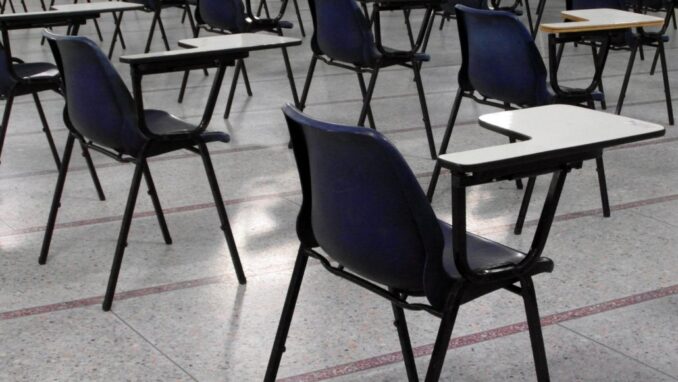
Obviously no communication of any sort from the moment of entry until leaving the hall. Tables must be no closer than 1.25m, a clock and backup clock must be provided. Some schools do not have provision for pupils’ bags to be left outside so they are kept at the back of the hall, out of reach. If a phone goes off, that pupil is tracked down and the examination board of the paper being taken is informed via an examinations log. The board may decide to disqualify that pupil’s paper or perhaps all papers taken by that pupil with that board. No watches, headphones, electronic devices of any sort are allowed and pupils are patted down on entry. The JCQ handbook is around a hundred pages so there’s a lot to know – who can have a dictionary, what type and only for which subjects.
© The Librarian 2026