
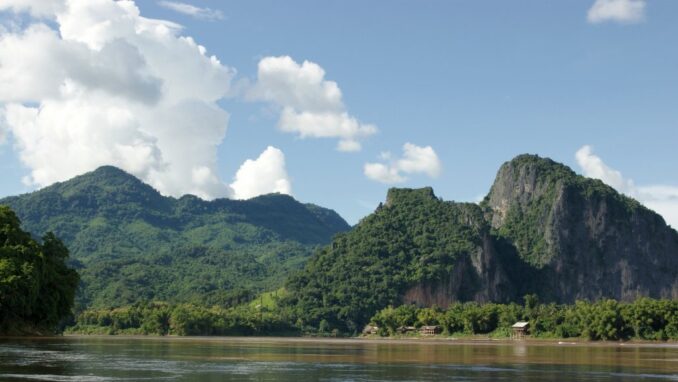
Allie Caulfield, CC BY 2.0, via Wikimedia Commons
It was early March in 1975 when the editor wandered into the newsroom of the New Zealand Herald and asked for volunteers to go to Vietnam. Specifically, Saigon. The older men kept their eyes down, muttering things like “not me mate, got a wife and kids.” I immediately stuck my hand up. “I’ll go!”
I’d been in NZ for about six months, arriving with the intention of cycling around the country, until after a week of panting up and down steep hills of metal roads (I hadn’t realised the placed was so hilly), I saw an advert in the Herald saying they were looking for a couple of reporters, and after three days of furious pedalling I had reached Auckland and somehow got the job. I’d also always fancied being a war correspondent, although years later the experience of covering squalid guerrilla conflicts in South America, while friends and colleagues were kidnapped or killed in even more desperate conflicts in the Middle East and Africa, finally dispelled the notion that there is anything glamourous about the job.
“Come to my office,” said the editor.
“Watch out for Saigon Rose!” some wag called out as I and a photographer (also English, who had also volunteered, though I no longer remember his name) followed the editor from the newsroom.
Inside his office he told us that now that Da Nang had fallen and the North Vietnamese were moving on Saigon, the Americans had announced ‘Operation Babylift,’ under which more than 3,000 children of US Gis would be airlifted out of the country to the USA and other Western countries. New Zealand had agreed to take several hundred. He then confided that a contact of his had told him several RNZAF Dakotas were due to leave a nearby airfield that night, and if we moved quickly, we could hitch a ride.
After grabbing small overnight bags of essentials, we hightailed it out to the airfield, where sure enough three Dakotas already had their engines running, and we sprinted towards them, shouting that we had permission to join them as members of the press. There was no time for them to check our credentials, so they just hurried us aboard, closed the doors, and moments later we had lift off.
After a stopover to refuel in Singapore, we arrived over Saigon a day later. Fires and gunbattles could be seen raging all around, the city was under siege but still holding out, and crucially the airport was still in American hands. Once we had landed and rolled to a stop, we were told it would take a couple of days to allocate the passengers we were to take back to NZ, and meanwhile we were to make do as best we could. We ended up sleeping on the Dakotas, it was as good as anywhere, but meanwhile one of the pilots approached us and showed us a telegram he had received from the NZ Prime Minister, Bill Rowling. In essence it said: ‘We’re supposed to be getting people out of there, not sending in more! Bring the bastards back as soon as you can!’ Apparently, every other news outlet in the country was now clamouring to join us but were being refused. Eventually we were able to squeeze nine days of exclusive front page picture byline stories out of our jaunt, something someone like DH might consider selling his soul for. The pilot told us we’d be on the first flight back, but they weren’t going to fly out just for our benefit.
We finally flew back to Auckland nearly a week later with about three hundred women and children, and received a hero’s welcome back at the Herald. But that was slightly tempered when I was told I was now persona non grata in the country and had been given six weeks to pack my bags and leave – the photographer had arrived in the country with a bona fide work permit obtained in London. I had not, but was told I could go back to London to apply for one.
Well, I thought, fuck going back to London, I’ll find something else. So, after a whistlestop tour of the South Island on my trusty Honda 350cc motorbike, and with two months’ pay that the Herald had generously given me, I headed off back to South East Asia, stopping first in Bali – in those days totally undeveloped and a magical place (literally, if you indulged in the freely available magic mushrooms). Next stop was Bangkok, where I applied for jobs at the Bangkok Post and the Associated Press and other agencies like Reuters. Except no work was on offer and I was told it was becoming almost impossible to get work permits for any Farang, or foreigner. It was no big loss as it happened, Bangkok was a steaming polluted madhouse with crazy traffic – much as it is today. I decided to try and make a go of being a freelance, and cast around for possible stories. The choice seemed to be trying to get in contact with Thai Communist guerillas in the north, or the various rebel groups in Burma, or Cambodia where the Khmer Rouge were running rampant, or Laos which had its own civil war between the Royalists and the Pathet Lao simmering away.
Laos seemed the obvious choice, given that only the nutters were venturing anywhere near Cambodia, and the various insurgent groups seemed too unpredictable and probably of little interest to much of the outside world.
An overnight bus took me to the border, and a small outboard motorboat then took me across the Mekong River to the Laotian side, where some rickety steps led up to the immigration office – although immigration hut would be a more accurate description. I handed my passport over to a bored official, who thumbed through it upside down and back to front, before calling for an interpreter.
“What is your nationality?” The interpreter asked.
“Er, British, that’s a British passport.”
“You are not at war with us?”
“No, no of course not, this whole shit show has nothing to do with us, we’re friends!”
My passport duly stamped, I took a tuk-tuk into the centre of Vientiane and checked into the Constellation Hotel, which despite its grandiose name was a rather drab affair with no hot water. But then with the heat a cool shower was fine, because while there was no hot water, the cold water wasn’t really cold either.
The next day I took a walk around the town. Or maybe it qualifies as a city, but it didn’t feel like it. It was small, shabby, dirty, but friendly enough. It was now near the end of April, Saigon had fallen, and while the Pathet Lao still hadn’t officially taken over the government in Laos, there were plenty of their troops in the city, often mingling with royalist soldiers. Ostensibly the Lao royal family and the Pathet Lao had a power sharing agreement, and had had one off and on since the 1960s, but in a couple of weeks the Communists would finally take full control, almost without bloodshed.
The morning market was a revelation, a real bargain basement with heavy silks from Vietnam, beautiful lacquer work and intricate carvings, plus of course huge bundles of marijuana, all of which I stocked up on while keeping a beady eye on my diminishing amount of cash.
I didn’t know it at the time, but Laos had the dubious distinction of being the most heavily bombed country in history. Despite being a neutral country, from 1964-1973 the Americans dropped a staggering two million tons of ordinance on Laos, many of them cluster bombs – more than all the bombs they dropped in World War Two. The CIA carried out a total of 580,000 ‘secret’ bombing missions in its attempt to support the Royal Lao government against the Soviet backed Pathet Lao. Thirty percent of those bombs failed to explode, 80-million bombs, which meant much of the farmland was unworkable. Still to this day an average one person a day dies as farmers try to cultivate contaminated fields, and estimates reckon it will take another 120 years to clear the country of bombs.
There were a few CIA types hanging around too, taking photos with long lens cameras out of their hotel windows. Most of them seemed to wear long raincoats and Homburg hats, until one day they disappeared and were replaced by KGB people, who all looked exactly the same. Obviously, the end was near. Every now again as I wandered about visiting temples and cafés, I would hear a distant blast as some poor farmer or his oxen stumbled across one of those unexploded bombs, but there was no small arms fire, and it all felt safe enough.
Even when my sojourn came to an end after some ten days in the country, it was all very civilised. An officer of the Pathet Lao with minimal English invited me to lunch in the old French officers’ mess, a lovely low wooden building with a veranda overlooking the Mekong River. When I got there, I found the beautiful polished dining table, about fifteen feet long, lined with soldiers wearing their Mao caps and also a smattering of other Westerners – an agricultural expert from New Zealand, an Australian vet and a couple of others who I never got to speak to as they were at the other end of the table.
We were served a magnificent meal of coq au vin with rice and some green vegetables, and served wine from the still well stocked cellar by waiters with white towels over their arms. It was surreal, as we got roaring drunk on fine Bordeaux and Burgundy reds and laughed manically at each other’s jokes and anecdotes even though we didn’t understand each other. And then when the meal was over, the senior officer rose and bowed to us foreigners and said it was time for us to leave the country. And so back across the Mekong River we went.
I sold the story to the ever-faithful NZ Herald but there was little interest in it in Europe or elsewhere, so it was time to shrug and move on. A few days later I landed at Kai Tak airport and within a short time secured a job on the radio side of RTHK (Radio & Television Hong Kong)– staying at the YMCA, (but not that YMCA!), while I looked for somewhere permanent to live. That job was to last just under six months until a family tragedy sent me scuttling back to Blighty.
Maybe more on Hong Kong as it was back in the day later…….
© Porkpie 2026

.jpg)