
A Sunderland chemist beat Edison by a year, accidentally invented synthetic fabric, lit up the world’s first electrically-powered street, and still got written out of history. It’s time to set the record straight.
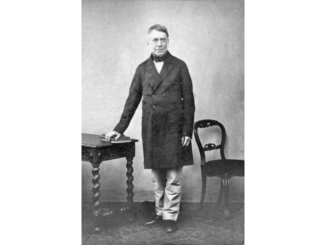
See page for author, Public domain, via Wikimedia Commons
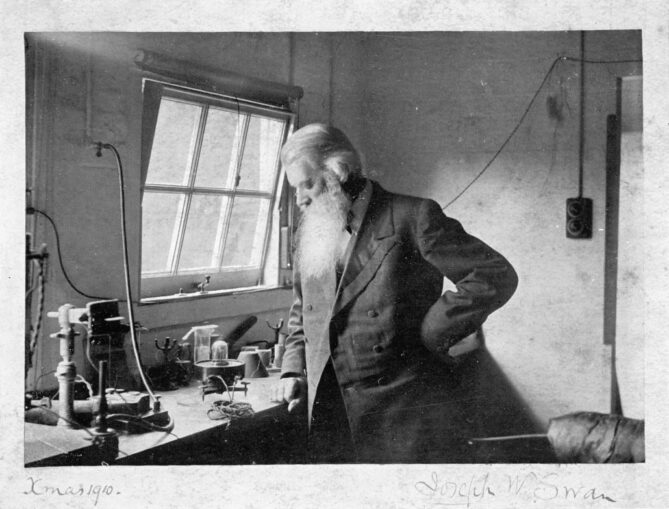
If you ask most people who invented the lightbulb, they’ll say Thomas Edison. If you ask anyone from the North East of England, they’ll say Joseph Swan. And they would be right.
This isn’t a matter of regional pride or selective history. It’s a matter of dates, patents, court rulings, and the inconvenient fact that a quiet chemist from Sunderland publicly demonstrated a working incandescent lightbulb a full year before Edison managed the same trick in New Jersey. Edison just had better PR.
So here’s the story of the man who lit up the world and then, with characteristic Northern understatement, got on with inventing half a dozen other things while America took the credit.
A chemist with a lightbulb problem
Joseph Wilson Swan was born in Sunderland on 31st October 1828. He was apprenticed at fourteen to a firm of chemists and druggists, and from there developed a fascination with two things that would define his career: photography and electricity.
Swan started tinkering with incandescent light as early as 1850. The principle was simple enough: pass electricity through a thin filament in a glass bulb and it glows. The problem was that filaments burned out almost instantly in the presence of oxygen, and Victorian vacuum pumps weren’t good enough to remove sufficient air from the bulb.
For the next two decades, Swan worked the problem on and off while building a successful career in photographic chemistry. It wasn’t until the late 1870s, when better vacuum pumps finally became available, that the pieces fell into place.
The dates that Edison doesn’t want you to know
Here’s where it gets specific, because this argument is won on dates.
Ulfbastel, CC BY-SA 3.0, via Wikimedia Commons
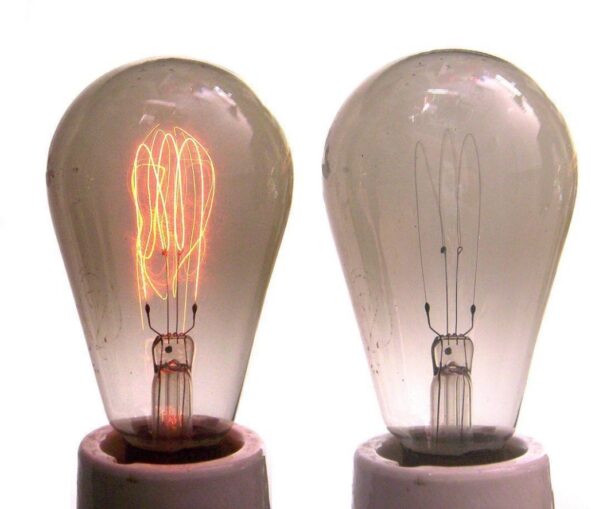
18th December 1878: Swan publicly demonstrated a working incandescent carbon lamp to the Newcastle upon Tyne Chemical Society. The bulb glowed brightly for several minutes before excessive current burned it out. It wasn’t perfect, but it worked; seven hundred miles away in New Jersey, Edison was still months from achieving the same thing.
17th January 1879: Swan repeated the demonstration, this time with the lamp running successfully for the duration of the lecture. The vacuum problem was solved.
3rd February 1879: Swan demonstrated his lamp to an audience of over 700 people at the Literary and Philosophical Society in Newcastle (the Lit & Phil), which became the first public room in the world to be illuminated by electric lightbulbs. Sir William Armstrong of Cragside presided over the event.
October 1879: Edison finally achieved a successful test of his own incandescent lamp at Menlo Park, New Jersey, a full ten months after Swan’s public demonstrations in Newcastle.
That’s not a matter of opinion. Those are dates.
“But Edison’s bulb was better!”
This is the fallback argument, and it has some truth to it. Edison’s team tested thousands of filament materials and eventually landed on carbonised bamboo, which lasted up to 1,200 hours. Swan’s early carbonised paper filaments managed around 13 hours before disintegrating.
But here’s the thing: Swan knew his early filaments were imperfect, and he kept improving them. By 1881 he’d developed a cellulose filament that was significantly more durable. More importantly, he’d already patented his design in Britain.
Edison, meanwhile, had a problem. When his people investigated British patents, they discovered Swan’s were earlier than their own. Edison tried to sue Swan for infringement in 1882. The British courts threw it out and ruled in Swan’s favour. The US Patent Office also found against Edison when Swan presented evidence of prior research and publication.
Edison didn’t beat Swan. He was forced to go into business with him.
The merger that says it all
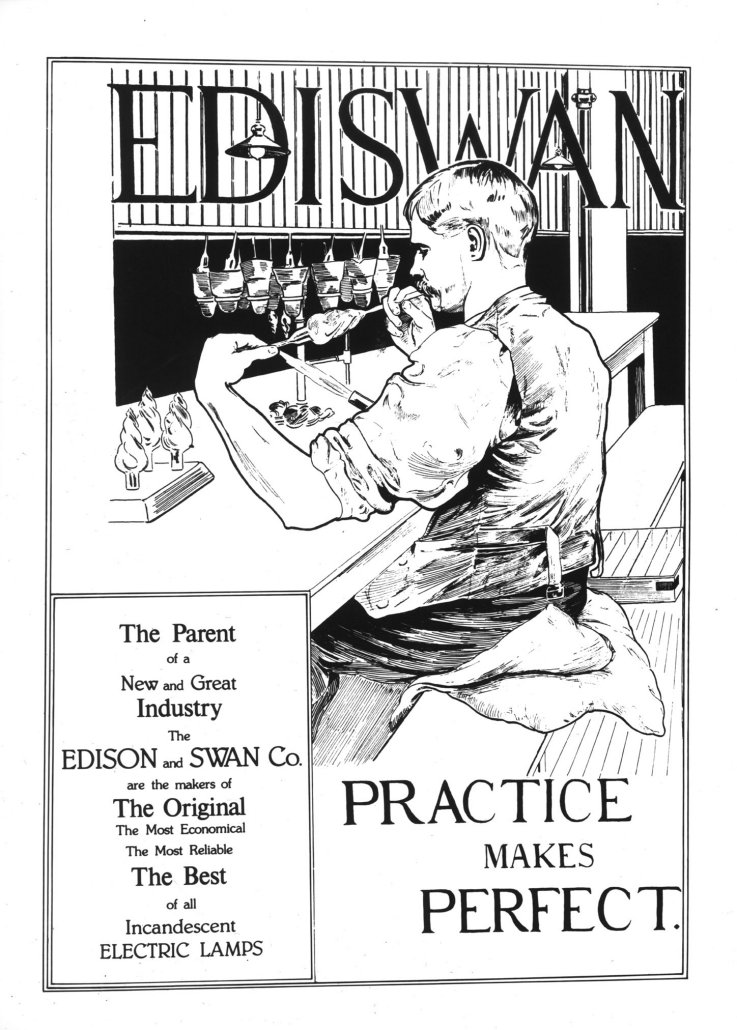
In 1883, rather than continue losing in court, Edison agreed to merge his British operation with Swan’s. They formed the Edison & Swan United Electric Light Company, quickly nicknamed “Ediswan.”
In the merger, Swan’s company received 61,400 Class A shares valued at five pounds each. Edison’s company received 45,000. Swan got the bigger share because his legal position was stronger. The British courts had made it clear whose patents came first.
The company went on to dominate the British electric lighting market, producing bulbs at factories in Sunderland, Brimsdown, and Ponders End. But in the popular imagination, particularly the American one, Edison got the credit and Swan became a footnote.
The first of everything
Tyne & Wear Archives & Museums, No restrictions, via Wikimedia Commons
Before Edison’s bulb was even working, Swan was racking up a string of firsts that still haven’t been properly recognised.
His home at Underhill in Low Fell, Gateshead, became the first private residence in the world to be fitted with working electric lightbulbs. Not Cragside; that came later with hydroelectric power. Swan’s own house was the first, lit by his own bulbs, connected to his own experimental power supply.
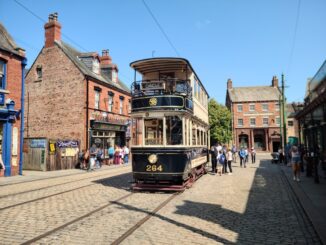
Mosley Street in Newcastle became the first street in the world to be illuminated by electric light.
The Lit & Phil in Newcastle became the first public room in the world to be lit by electric bulbs, during Swan’s February 1879 demonstration.
And in 1881, the Savoy Theatre in London became the first public building in the world to be lit entirely by electricity, using 1,200 Swan incandescent lamps. While Edison was still wiring up parts of lower Manhattan, Swan had already electrified the West End.
The man who accidentally invented synthetic fabric
Here’s where Swan’s story goes from impressive to absurd. While searching for a better filament material for his lightbulbs, he developed a process for squeezing nitrocellulose through tiny holes to form fibres. He patented this in 1883.
What he’d accidentally created was the world’s first synthetic fibre: artificial silk.
His wife Hannah crocheted and embroidered fabric samples from the material, which Swan displayed at the International Inventions Exhibition in London in 1885. The textile industry took notice. The process Swan invented for his lightbulb filaments became the foundation for the entire artificial fibre industry. Every piece of rayon ever made owes its existence to a bloke from Sunderland trying to build a better lightbulb.
Swan himself was characteristically modest about the whole thing. He later wrote that his particular strength as an inventor was not in conceiving wholly new things but in looking at something being done and finding a better way of doing it.
Photography, mining lamps, and everything else
The lightbulb and synthetic fibre would have been enough for most lifetimes, but Swan was apparently collecting inventions like stamps.
In the 1860s and 1870s he revolutionised photography. He invented the carbon printing process in 1864, making photographs permanent for the first time. By 1871 he’d developed the dry photographic plate, replacing the cumbersome wet-plate process and making photography vastly more practical. In 1879 he patented bromide paper, the paper that would become standard for photographic prints for the next century.
He invented the first miner’s electric safety lamp. He developed an electric fire-damp detector for mines. He proposed the application of chromic oxide reactions to leather-making, effectively founding the chrome tanning industry. And he invented a type of accumulator plate that improved early batteries.
The man saw a photograph in a Sunderland shop window around 1850 and it set him off on a career that touched electric lighting, photography, textiles, mining safety, and chemical engineering. All from the North East. All while Edison was getting the magazine covers.
Honours (eventually)
Spudgun67, CC BY-SA 4.0, via Wikimedia Commons
To be fair, Swan did receive proper recognition in his own time, even if subsequent generations forgot him. In 1881 France awarded him the Legion of Honour at the International Exposition of Electricity in Paris. He was elected a Fellow of the Royal Society in 1894. He served as President of the Institution of Electrical Engineers in 1898. In 1904, King Edward VII knighted him, and the Royal Society awarded him the Hughes Medal. In 1906, they followed up with the Albert Medal.
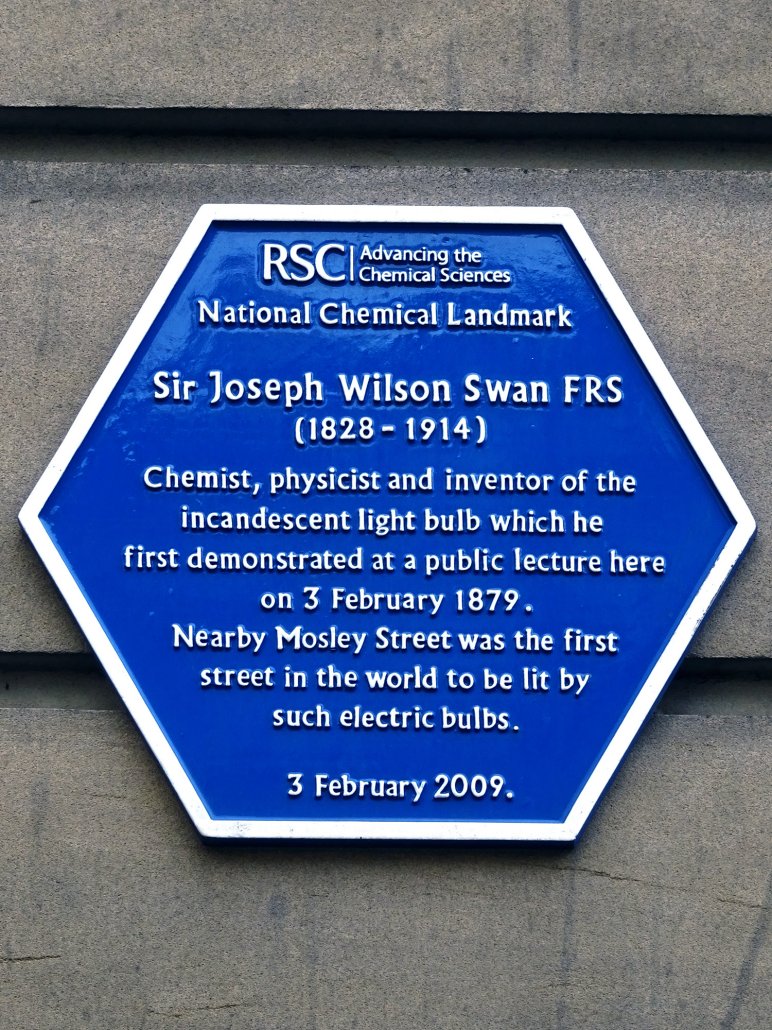
He died in 1914 at the age of 85, in Warlingham, Surrey. His legacy in the North East is everywhere; if you know where to look. There’s a blue plaque at the Lit & Phil (somewhere that also deserves its own article). The Discovery Museum in Newcastle holds the Swan Collection. His name is on buildings at Sunderland and Newcastle universities.
But ask anyone in the street who invented the light bulb, and most people will either a) not have a clue or b) say Edison.
The evidence, summarised
For anyone who still needs convincing, here it is plainly:
Swan demonstrated a working incandescent lightbulb publicly in December 1878. Edison achieved the same in October 1879, ten months later. Swan’s British patents predated Edison’s. Edison sued Swan for infringement and lost in both British courts and the US Patent Office. Edison was forced to merge with Swan, and Swan received the larger share of the resulting company. Swan lit the first home, the first street, the first public room, and the first theatre with electric light, all before Edison had electrified a single New York city block.
Edison was a brilliant inventor, a relentless businessman, and a masterful self-promoter. But he did not invent the lightbulb. That was done by a quiet chemist from Sunderland.
© Paranoid Android 2026


.jpg)
.jpg)