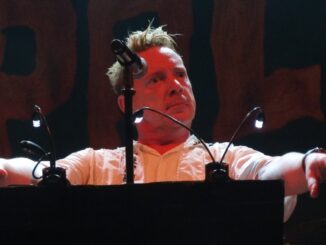

Alex Marshall, CC BY-SA 3.0, via Wikimedia Commons
‘They put a hot wire to my head
Cos of the things I did and said
They made these feelings go away
Model citizen in every way’
(From Anger Is An Energy, the song)
Given the state of Britain at the moment, anything resembling ‘anarchy in the UK’ seems a distressingly plausible scenario. With that in mind, are you ready for a kaleidoscopic roller-coaster? Because one thing John Lydon never is, has been or could be, is boring. Challenge the powers that be? Bring down the monarchy? We’ll have a go. Jesus Christ Superstar? Why not. I’m A Celebrity? Bring in on.
Well-known as the driving force of the Sex Pistols and then of Public Image Limited (PiL), Lydon aka Johnny Rotten is one of the few people who can claim to have changed the face of popular music on an international scale. Mercurial, paradoxical and innovative, he is also seemingly one of the most grounded, principled and loyal blokes you could meet. Staunchly original, he has – he writes – always been drawn to oddities. This is the second volume of autobiography he has written (the first was Rotten: No Blacks, No Dogs, No Irish). That book dealt with his life up to the break-up of the Pistols. This one recaps briefly, then takes up the story of his life afterwards. It’s more personal than the previous work – some might say, more rambling. It is definitely chatty. But that’s it’s charm. One thing leads to another, and you start off with a bit of personal reminiscing, which leads to a bit of musical background, which leads to a philosophical diversion, which leads to some moral observation … and thus it goes on.
So, to begin with, we revisit young John Lydon’s upbringing (mostly in Finsbury Park), his Irish parents and background, his grandfather (known in the family as the Owl Fella, as in Oul’ Fella – but the young Lydon thought ‘he never looked much like an owl’) who had fourteen children, as did Rotten’s Aunt Lol. Lydon’s catching meningitis from rat-infested water at eight years old seemed to open some sort of surreal door in his brain, making him see and feel things others could not, but was also a traumatic time which left him in a hospital bed unable to understand what had happened, where he was, who the people around him were – and, furthermore, unable to speak, merely making sounds his brain thought were language but weren’t. School, college and fun times working at Vivienne Westwood and Malcolm McLaren’s SEX boutique followed. ‘I wanted to be revolting and disgusting, but I also wanted the job’, he admits. Malcolm had the idea of putting a band together, with Lydon as the front man. ‘But I can’t sing’, said Lydon. ‘Oh, we can fix that’, McLaren airily replied.
Lydon later says he enjoyed the times female fans tried to mother him – and, of course, he married his adored wife Nora when he was twenty three and she was in her mid thirties. He was actually closer in age to his step-daughter than his wife. He thought at the time he was too young for a settled relationship, but now says ‘in fact that was exactly what I needed’. They remained married for almost fifty years, until her recent death. I wonder if his own early brush with death is maybe where his need for nurturing comes from. But then he had a perfectly good mother of his own, so maybe that’s a Freudian step too far. One thing many people might find surprising is to what extent Lydon is a nurturer himself, becoming Nora’s primary carer when she succumbed to dementia. He likes nursing and taking care of people – he puts it down to having had to look after his brothers. His mother was often ill, and his father was an alcoholic, so that was no small thing. Be that as it may, his early illness, his family circumstances, the social setting of Finsbury Park, the wasted lives, what he saw as the working-class trap … it all left him angry. Raging, in fact. As a young woman, when feeling completely without hope, I too remember that feeling of ‘The anger is what’ll keep me going’. Lydon expressed the same idea in a better, pithier form: anger is an energy.
This volume has, by definition, a much more international feel as Lydon moved to the States to live (although he and Nora held onto their London home in Gunter Grove – bought from Steve Winwood – for quite a time). The description of how he moved to America without Nora, then realised he didn’t want anybody else, is one of the most moving parts of the book, for me. That and the part where he and Nora take over the care of their wayward grandchildren – the children of Ariane, Nora’s daughter by a previous marriage (Ari Up of the Slits), who was unable (or unwilling) to care for them. Ari, something of a lost soul, was to die tragically young of breast cancer a few years later.
I wouldn’t recommend the accounts of his tooth misfortunes if you have any kind of dental phobia. (The condition of his gnashers was what gained him the nickname ‘Rotten’ in the first place, courtesy of Steve Jones). Thankfully, all is sorted now with implants and jaw surgery. His parents both had all their teeth out and dentures fitted at a very young age, because the state gave you money towards that, promising you’d never have troubles with your mouth again. Of course, that proved not to be the case, and his parents’ gums soon receded anyway, requiring stronger and stronger glue to keep the dentures fixed. One of his jobs when small, having put a record on the player in the front room, was to pick up the false teeth off the floor when his parents had been dancing and try and work out whose was whose before returning them to their rightful owners. Thinking he was set to go down the same path, he simply didn’t bother to clean his. (Let that be a lesson to us all, boys and girls). Now, apparently medically undeterred, he’s taken to shaving down his warts till they look like, in his words, pussy stumps of broccoli 😬.
His musical choices/influences are interesting and on the face of it maybe rather surprising to some. Status Quo, Jim Reeves and the Bee Gees … reggae, Alvin Stardust, 10cc and Bowie? Really? Well, yes, and anyone of his era (like me) will understand why.
One particular highlight is Rotten’s scathing account of his appearance on Fantasy Football with Baddiel and Skinner. Their middle-class smugness seems to have driven him round the bend. I think he was banned from the second half of the programme.
The musical side of PiL takes up a lot of the commentary, and it’s clear that Lydon feels, and is, now a serious musician rather than just a shocker, although he has very little time for mathematical precision or classical training where his voice is concerned. He did once have singing lessons, at McLaren’s behest, but to Johnny his voice is an instrument of intense personal expression. It has meaning, it is purposeful. This may seem a bit odd when you consider a lot of people thought the Pistols in the early days were just about taking the piss, that whole punk thing of have a go and sneer while you’re at it but above all have fun doing it. Send it all up. Be unstoppable. Take it to the people. In yer face. Being crap was kind of the point. But then again, we all grow old.
As a songwriter, it’s perhaps no surprise that he has a unique way with words, even peculiar ones (I particularly enjoyed ‘Don’t let tiffles cause fraction’). He dedicates the book ‘to integrity’.
The clear message throughout is: Lydon ain’t playing by anyone else’s rules, and if you don’t like it you know what you can do. But he has always abhorred violence. And here the paradox comes in. Because I think, looking back, even if he did want at the time to ‘beee anarcheeee’, I don’t think he really wanted ‘to destroy’. I think what he truly wanted was to create. And he did.
(PS: mrs raft, this one’s for you!)
© foxoles 2025