© Joe Slater 2025, Going Postal
Last time, I discussed the manifold problems you face setting up a trip to Russia. This piece is about the manifold problems you face when you eventually get there.
For me, they began at the Estonian/Russian border at Narva. I approached this crossing with some trepidation. About a week before departure (in early September), I had made two nasty discoveries, both of them due to the sanctions. Firstly, Estonia limits the amount of euros you can take into Russia. You have to show your wallet. It wasn’t just money: Estonian customs confiscate any luxury or other item with significant resale value in Russia. The second nasty discovery was a product of the first. Because of these long checks, enormous queues were developing on the Narva side each day (evidently Russian residents of Estonia visiting family on the other side, or taking stuff over). The waits sounded horrifying, six hours was normal in July and August. On bad days, some people had actually spent the night on the pavement, which was out in the open with no protection at all from the wind and rain. A Russian-language website provided daily updates on the “Narva queue” (очередь из Нарвы).
As this situation shows, Estonia does not really want people crossing this border, and would very much like to close it (having already banned wheeled traffic; a recent poll found that 85% of its citizens were in favour of full closure). The sole, and very tenuous, reason why it has not followed Finland and done so is that Estonia, unlike Finland, has a large Russian-speaking minority that it cannot afford to antagonise.
I did not buy the St Petersburg bus ticket until arrival in Tallinn, again, doing it online was difficult as vendors will not cover the Russian leg, and timetable information I found was sketchy and inaccurate. So I went into Tallinn bus station the night before departure and bought a ticket for the following morning. And here is where my plans and actual events first parted ways.
Studying the ticket that evening in bed, I noticed the word Tartu. Tartu? Tartu is in the south-eastern corner of Estonia and about, ooh, 80 degrees off course, hundreds of kilometres out of the way. There was no mention of Narva. As the ticket was written in Estonian, I could not glean much more from it. But I feared I was going to start this trip by boarding the wrong bus.
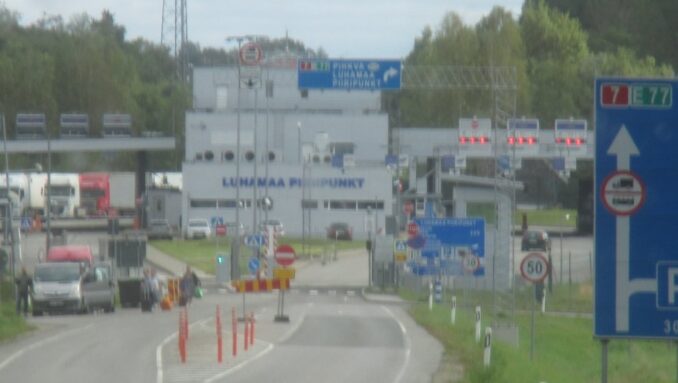
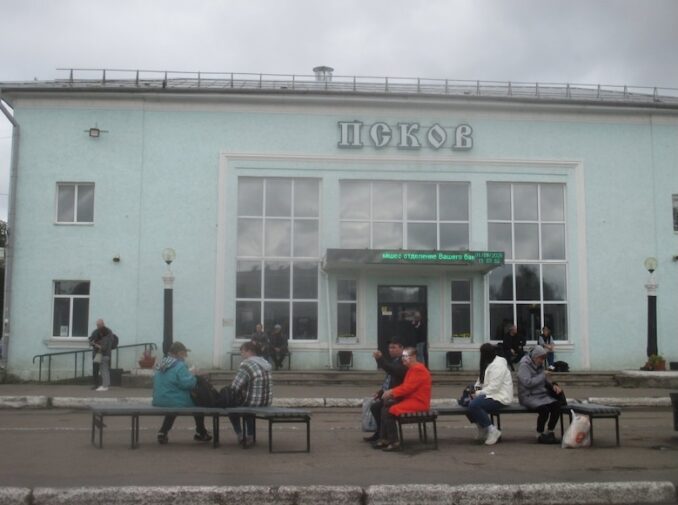
In fact, there was no mistake. The bus did indeed go via Tartu, making a truly massive dogleg, and crossed the border at Lumahaa. You won’t have heard of Lumahaa, as it is a compound in the middle of nowhere, a fenced-off clearing in the endless swampy forest that fills most of Baltic Europe, and miles from the nearest village. The bus took this route so as to be able to stop at Pskov on the Russian side, a major town that was not even mentioned on the ticket or the bus info display.
But this was probably a blessing in disguise. There was no queue here. There were only about 12 passengers on the coach and a dozen or so lorries waiting in the customs pound. My relief did not last long, though.
I had brought with me 300 euros, with the rest mostly in dollars and pounds. I had read online, this is unfortunately an example of the hazards of relying on blogger advice, that there is a personal allowance of €300 for people crossing from Estonia. “No,” the stony-faced customs man said, “the personal allowance is zero.” I stood facing him clutching my €300, knowing that it wouldn’t be worth asking about exchange facilities, there wasn’t so much as a coffee machine here. After about 20 seconds of silent Clint Eastwood stare, he gave me a subtle nod and let me off. That effectively added three days, the Moscow bit, to my stay. Aitäh, Estonian customs.
© Joe Slater 2025, Going Postal
After a one-hour wait on the Estonian side, while the coach was checked, we trooped past the queer little tumbledown wooden cottage that had once been Lumahaa before they built the compound, and into the Russian immigration sheds. The officer did not ask to see either my itinerary or my health insurance. But when he was about to wield the stamp, he stopped, lifted the phone, and two minutes later I was sent back to the lobby for “document checks”.
I didn’t like the sound of this, but to my surprise four other people were also in the same boat, two of them Russian speakers (Slavic Estonians, I would guess), and the other two a married couple, a Russian and an Italian. The Italian guy had very little English, but I found his presence reassuring. He was the only Westerner I was to meet in Russia.
Together, we sat in that lobby for two hours, watching workmen re-panel a glass door and the odd traveller trudging down the empty road out of the forest weighed down by bags, like mediaeval chapmen — people actually walked up to this border. In between arrivals, the silence of the forest descended. After 90 minutes, we were all fairly sure the bus would have gone on without us, leaving us here to fend off the bears and stagger back to civilisation. The longer the wait went on, the less confident I grew of a positive outcome.
But eventually the immigration guy re-emerged with the five passports, all stamped. And the bus was still there. We had actually been lucky, three hours stuck there was a good day. And so we headed off again into the same swampy forest punctuated by more ramshackle wooden cottages, but now in Pskov Oblast. It was a moment that I had feared would never actually arrive.
© Joe Slater 2025, Going Postal
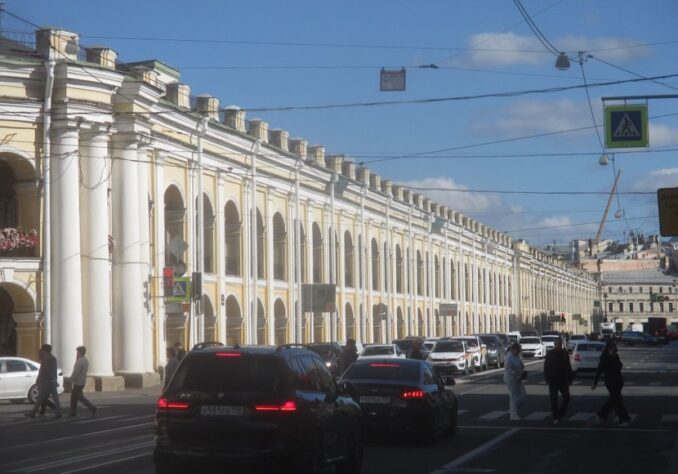
Russia looked much the same as Estonia, but a bit less affluent, more battered cars and broken-down cottages. After three more hours, we rolled up at St Petersburg bus station. I took a taxi to the hostel address I had scribbled down in my notebook. I should repeat here that I did this trip without a smartphone, partly because I wasn’t sure it would work in Russia, but mostly because I don’t actually own one. But non-Western tourists do use smartphones in Russia. My dumbphone worked too, despite O2 saying it wouldn’t, though I ended up with a thumping £150 bill for fairly modest use over two weeks.
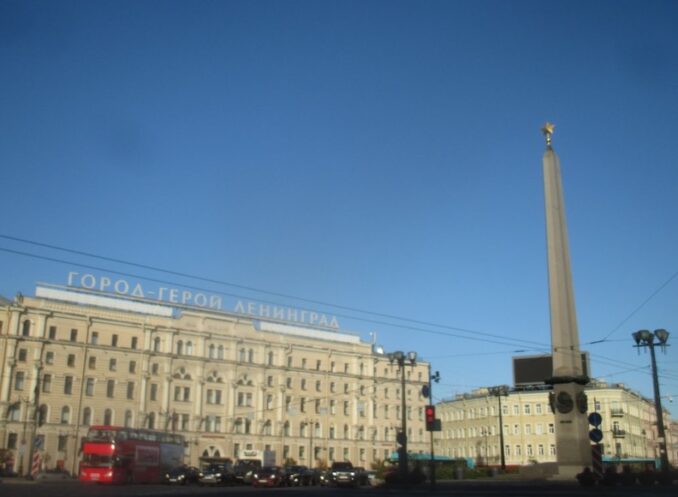
I knew after about 10 minutes of unpacking at the hostel that I would be out of there within 24 hours. It was pretty much the same uncomfortable, funless experience as youth hostelling in the Lakes in the 1970s. With one added complication, tourists in Russia are supposed to register with the police. In fact, online sources say this is handled by the hotel/hostel; all you have to do is answer a few questions which the receptionist inputs into a screen, for a £5 fee. I was warned that every accommodation I would use would require this registration. In practice, nobody else asked about it, and I was never challenged over it. This summed up Russia’s approach to tourist management, loads of pointless and irritating rules, but rather lax enforcement in practice. In fact, nobody really seemed to even understand the registration system.
Nonetheless, it caused additional stress, and it really ruined the trip of one other lad at the hostel, who was told he needed to go urgently to the Ministry of the Interior in Moscow to sort some registration problem out. This was a Chinese guy, and he actually did go to Moscow to do this. (Chinese, by the way, are probably the largest tourist cohort in Russia now; you see them here and there struggling at counters with their translation apps.)
© Joe Slater 2025, Going Postal
The big problem remained money. The next day I set about changing my Western currencies into roubles, not expecting any particular difficulty as I was in Russia’s second city, with all major banks close at hand. Indeed, the €300 that I had smuggled in with the connivance of the Estonian customs officer did not present any problem. Alas, the 800 dollars did. The first bank rejected five of the eight notes, which had been sourced from a Marks & Spencer travel counter a couple of weeks previously and were new. I had read that banks can be a bit choosy about Western banknotes, but I could not see any flaws in the five notes that were rejected. Nevertheless, the next four banks also rejected most of them. By trying different banks, I did manage to get all but three 100-dollar bills changed. But it was a bit of a bummer to find on the first day that your rouble budget had effectively been halved.
Never mind, I still had the pounds, which bloggers had stated were widely accepted in Russian banks (there are no bureaux de change, by the way, it’s banks or nothing). Well, they weren’t. For three days, I could not find any bank, from Sberbank down to the regionals, that would touch a 20-pound note. It was only when I’d almost given up hope that I found Norvik Bank (Норвик Банк), which did accept sterling.
In the three days it took to sort this money issue, I did not dare to leave St Petersburg. But I did manage to change lodgings. Here, I had some luck. Near the hostel was the only decent mid-range hotel I could find during this stay. Called “Roof Story,” it charged about £40 a night. That’s about as cheap as you can get outside hostels.
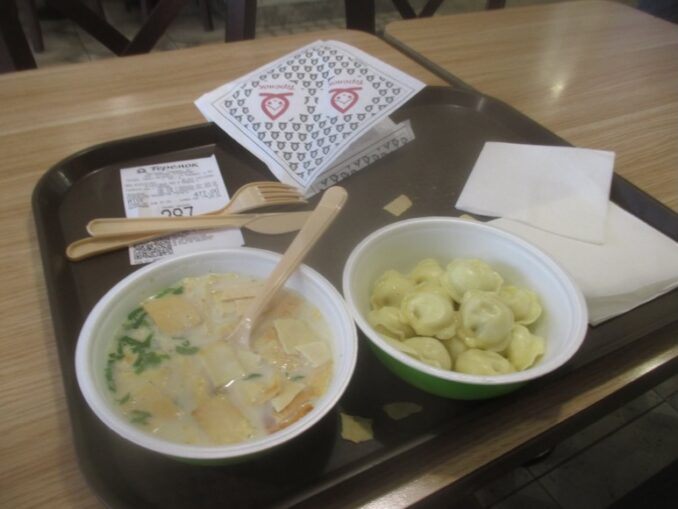
Having finally got a stash of roubles, I could start detailed budgeting for the trip. I would guess that the cost of living in Russia is approximately 30% less than in Britain. Public transport is very cheap (but buses often do not take cash). Restaurant food is about 40% cheaper. I ate very well at Teremok (Теремок), a Russian fast-food chain that provided tasty local staples like borscht and blini for about a fiver a meal. Stolovaya (столовая) canteens were also cheap and excellent. Though McDonald’s and KFC have vanished, Burger King for some reason remains ubiquitous, so if you cannot live without daily fried offal sandwiches, you will not starve in Russia. If you make high-value purchases of any kind, you’re going to be paying at Western levels.
© Joe Slater 2025, Going Postal
That’s about it as far as the practicalities were concerned.
I perhaps need to mention one more issue, language. I speak very basic Russian, so I was spared the problems that arise from complete ignorance. But almost nobody over the age of about 40 knows English, and I found others unwilling to even try, for obvious reasons. This was the only sign of hostility I experienced in Russia; otherwise, everybody was friendly. So I would certainly recommend doing a few months’ language training before coming, if only to learn how to read Cyrillic, because many notices with place and hotel names are not given in Roman script.
Cyrillic is not very difficult, unlike the Russian language itself, which is complex almost beyond belief, with three genders and dozens of pointless but fiddly endings for nouns, verbs and adjectives. Particularly difficult are numbers, which you cannot avoid. Most are long and difficult to distinguish and pronounce. They can also mutate out of recognition (a vital number like “dva”, two, becomes “dvoogh” in the genitive). I forced myself to learn the system, repeating numerals over and over, but I still cannot say “in the year 1897” or “ten to six in the morning” without five minutes’ deep thought. The key to mastering Russian grammar is knowing enough to know when you can ignore Russian grammar.
Writing things down in basic English usually worked with younger people. Normal travellers, of course, use their smartphone translation apps, but I find this clunky and a little risky, as neither party can recognise mistakes.
So I trudged happily around for a week in St Petersburg and Moscow, and in between made visits to various provincial towns, all of which I will talk about later. All went fairly well until day 10.
Though it did not impact everyday life in either “Piter” or Moscow, the shadow of the war was ever present. On that day, news came through that drones had flown into Poland, which had closed the border with Belarus (but evidently not with Kaliningrad, oddly). This news, coupled with an unexpectedly rapid dwindling of funds, threw me into a bit of a panic. I feared that Estonia and Latvia would follow suit, just as Finland had done the previous year with Russia. Worst of all, I now didn’t have enough money left to fly out.
So I abandoned the plan to go to Kaliningrad, which would have cost too much and entailed more risk, as it is a sensitive military base, and made a beeline for Estonia. I did this, as usual, without reservations, and it was, as usual, complicated and a bit hairy, but in St Petersburg, I managed to get a place on a bus to Ivangorod, the Russian border town (which, by the way, is served by just one train a day now). This crossing was not very smooth either. On the Russian side, a smelly sniffer dog took exception to my “coffee box”, a small plastic container I had kept instant powder in. When it was empty, I had stored an alarm clock in it, which, coupled with the unfamiliar caffeine scent, must have seemed as suspicious as heck. Anyway, after five minutes of pretty unfriendly questioning, I was allowed to leave.
I thought I was home and dry now, and could just swan into Estonia waving my globally trusted and respected British passport. Wrong. They wanted to see a hotel reservation and onward ticket. Mercifully, I had long before bought an onward bus ticket to Riga for precisely this situation. But I had no hotel reservation; it was almost impossible booking online from Russia as, even if you can access a site, cards do not work.
The grilling at the immigration counter went on for about 10 minutes. The official had very poor English, and my own doings in Russia had been so complicated it was almost impossible to explain anyway. “Hotel reservation,” she kept demanding. Acutely aware of about ten people behind me watching all this with keen interest and, I imagine, schadenfreude, I began to seriously fear they were not going to let me in. In truth, though, they had no option, because they knew the Russians would not take me back without a new visa. And they couldn’t just leave me to camp out on the bridge over the River Narva, which divides the two countries. So yes, they let me in, but it was an unnerving experience.
One footnote: Narva has four biometric passport readers, which are quick. But UK biometric passports are not accepted by them. You have to queue. One more footnote, while I think of it, the internet is censored in Russia, but not comprehensively. YouTube is blocked, but main email services work, and some Western newspapers, etc., are available (UK sites are heavily censored, but CNN is available).
A week of travel in the Baltics and Poland followed this adventure, but that was routine stuff, so I will end this tale of woe here. Rereading it, I must seem like some kind of sucker for punishment, but this was actually the journey of a lifetime, or at any rate of my late middle age. Despite everything, I had a splendid 12 days.
Setting aside politics, Russia is a superb travel destination, clean, modern, affordable, convenient, civilised and more than usually blessed with historical and cultural sites and architectural splendours. I wouldn’t repeat this trip under current circumstances, but I would happily go back after the war is over.
My impressions were greatly coloured, I think, by the fact that I knew personally how hard life was in the Soviet Union and the 1990s, and was able to appreciate the stunning progress Russia has made in, sorry, it’s just a fact, Putin’s time. Russia today is not up to the standards of modern Poland and the Baltics, but it is not far behind, and all that without the massive aid from the EU. Disregarding personal income levels, I would say it is now at roughly the same level of development as Romania. Anyway, more of all that in another, more reflective piece.
© Joe Slater 2025, Going Postal
© text & images Joe Slater 2025