
© Joe Slater 2025, Going Postal
The UK Foreign, Commonwealth & Development Office advises against all travel to Russia due to the ongoing risks associated with its invasion of Ukraine. This includes threats from security incidents such as drone attacks and Russian air defence activity, a lack of available flights to return to the UK, and severely limited ability for the UK government to provide consular support.
For six years, I had been planning a trip to Russia. Usually, I have been very lucky with my timing of travel to unfashionable destinations, but not this time. First it was Covid. Then, as soon as cross-border travel became feasible again, Russia invaded Ukraine and Western airlines and banks cut all links. But the country remained open. Still I hesitated, discouraged by warnings like the above. Finally, as the years of retirement ticked by, I thought, “Feck it, I’m going.” You only live once. And I went.
Well, it was the hardest trip I have ever done, but also probably the most rewarding. I came back with a much better understanding of what this war is about, and also of how Russia has changed since my first visit, which took place when it was still most of the Soviet Union. It was a struggle, but every hour there was worth it.
Because this journey was logistically so challenging — I made it even harder by taking the land route, across the Estonian border, and by not taking a smartphone — I am only going to talk about the practicalities here. What Russia was actually like can wait for another piece. My priority is to encourage people to go and see for themselves. So I thought a close look at what travel to Russia entails would be more valuable than my diarist’s musings.
What a Russia trip now entails is a considerable expenditure of dosh, a hell of a lot of faff, very careful planning and a bit of nerve, for you are never free of stress and risk. In fact, I could have titled this piece “How NOT to travel to Russia,” in light of all the problems I had, some due to recklessness and stupidity but most unforeseeable.
First, I should say here that the FO warning is right on the two latter counts, lack of flights and disabled consular services. But I found St Petersburg and Moscow quite safe: safer (and more civilised) than say Manchester or Birmingham. The war has almost no visible impact on daily life, and the stuff about Russian air defence is just childish nonsense.
© Joe Slater 2025, Going Postal
If you do decide to go, your first hurdle is the visa. I’d recommend dealing with it well in advance of the journey. Even before the war, getting a Russia tourist visa was a pain. You had to fill in a long questionnaire, including completely irrelevant higher education and career information. It also required you to name an organisation that has “invited” you to Russia.
If you have no contacts there, this can seem an insurmountable obstacle. In fact, the answer is simply to use an agency, like IBS VP in London. Not only did they supply the name of an “inviting organisation,” but they also knew which questions could be fudged or ignored. They vetted the entire application. The visa fees are steep: over £300 for standard service and over £400 for express. Standard service means giving up your passport, your primary ID document, for a few weeks.
Another requirement is health insurance. This is where you run up against the first of many sanctions-related hurdles. No Western insurer will touch Russia. That means you have to use a Russian insurer, buying a policy online. I used Class Assistance, at the recommendation of GoingRus. The cost was about £75. I have no idea how effective the coverage was; I made damned sure I didn’t need it while I was out there. But you need that certificate.
In your visa application you will have had to give arrival and departure dates (the tourist visa allows you 90 days) but these are not binding. That brings us to the next headache, the ticket. The usual route into Russia from the West is to fly in via Istanbul. But it’s not the only option. There are also flights from Belgrade, and land border crossings with the Baltic countries and with Norway are still open. Good information about using these is difficult to come by in English and not very reliable, due to the paucity of Western tourists actually using them and also to the constantly changing political situation. Suffice it to say that Estonia has three such crossings, and Norway, Latvia, Lithuania and Poland a few others. Finland shut its border last year.
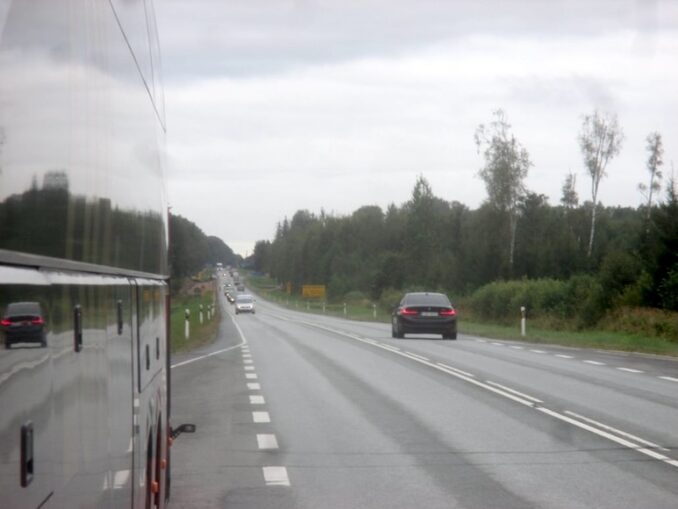
Of all of these, the one that pops up most frequently in internet searches is Narva-Ivangorod. This is on the old high road between Tallinn and St Petersburg, running along the south shore of the Gulf of Finland. At Narva, Estonia and Russia meet over the River Narva, and large-scale border facilities capable of handling many coaches and trucks are in place. This was my initial choice.
© Joe Slater 2025, Going Postal
From what I have read, the faff is much greater when you use the land crossings than when you fly. But flying is expensive, as two separate flights are involved each way, plus probably an overnight. And of course it is nowhere near as flexible. This was mainly why I chose the land route. For reasons I will go into in a bit, I found it hard at this stage to commit to a set return date. So I bought one-way ticketing. With hindsight, I would not recommend doing this; instead buy a return ticket that you can later easily change.
Regarding hotels, the agency I used for the visa recommended that I get reservations in advance for every day of the stay, as well as provide a day-by-day itinerary for inspection at the border. This is quite an expensive proposition. If you’re going for at least two weeks, as I intended, that was getting on for a grand on rooms I might never use if the whole trip fell through due to political developments — a possibility that hung over everything, all the time. The solution was booking a week in each of two student hostels, which brought the upfront cost down to a much more manageable £10 a night. I had no intention of using the hostels for more than a night, but this gave me addresses to show nosy officialdom. In practice, I was not asked to present proof of accommodation at any point, though I did voluntarily do so at the border crossing.
Because of the sanctions, it was difficult to book anything within Russia, tickets or hotels. But there is a Russian company that duplicates the function of booking.com, ZenHotels. They get dodgy reviews, but I had no complaints. Through them I booked hostels in St Petersburg and Moscow.
Lastly, and most bigly, the money problem. This is where the sanctions really cause pain — mainly to the visitor. When you go to Russia, you cannot use any Western plastic anywhere. Period. This leaves you with two options: open an online account and obtain a Russian Mir card or a Chinese bank card, or take cash. Unwilling to go through the faff of account-opening for a short stay and unsure whether it would actually work anyway, I took cash.
The problem was, how much? The golden rule of travel to Russia is pay for as much as possible in advance. I’m going to repeat and boldface that as it is the most important takeaway: in spite of the very considerable uncertainties and complications, pay for as much as possible in advance. At least cover the very basics.
Being unaware of the cost of living in Russia, and also of hotel expenses, I found it very difficult to even guesstimate daily expenditure. I plumped for about £100 a day. On this basis, I worked out how long I could afford to stay, including a £500 reserve for that emergency flight to Istanbul in case everything went belly-up — the constant worry. This is why setting the return date was hard. I did not want to come back too soon, but also I did not want to risk being stranded without any dosh. In the end, I left it open, planning to return when I began to run out of cash. This proved doable but stressful. As said, were I to do again, I would work to a specified return date from the first.
The major consideration in the per-day spend calculation was hotels (I did not intend to actually use the hostels I had booked). As said, online searching was difficult. In both St Petersburg and Moscow, there seemed to be very little between hostels and four-star places. If two- and three-star hotels do exist, I couldn’t find many on the ground. A four-star hotel in Russia is going to cost much the same as it does elsewhere, so, though more basic places will charge £40-£50 a night, hotel bills can potentially be much higher than that.
What about currency? Websites recommend that Brits take a mix of euros, dollars and pounds, plus a small sum, say £100, converted into rubles before you arrive in Russia, because you cannot count on finding open exchange facilities at the border (Narva, though, has full two-way facilities, open 24/7). I took sums in all four currencies, using three wallets.
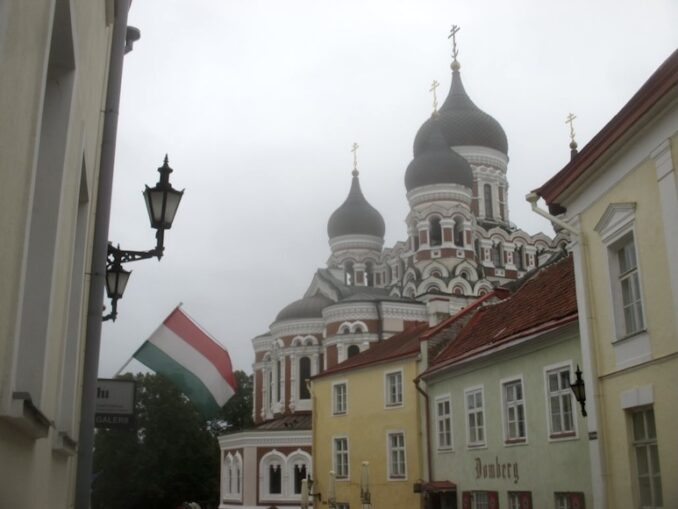
So, that was the preparation. The basic plan was to spend one week in St Petersburg, one week in Moscow, and, if feasible, a few final days in Kaliningrad, from where I had planned to slip into Poland and take the train back to Britain. The route was: flight to Tallinn (Estonia), overnight, and then bus from Tallinn to St Petersburg, on paper a six-hour run. Many buses ply this route. I thought it wise to be part of a scheduled bus group rather than go as an individual who could be picked off on a technicality, like unapproved health insurance, by an immigration guy having a bad day.
That was the plan. In the next piece, we’ll look at what actually happened. Which was, of course, a bit different.
© Joe Slater 2025, Going Postal
© text & images Joe Slater 2025