
See page for author, Public domain, via Wikimedia Commons
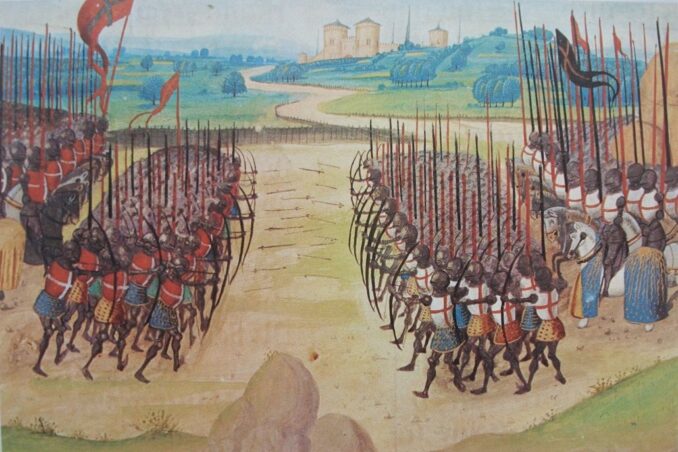
The military consequences of the Iran War have precedence in the 1415 Battle of Agincourt, in which an inferior number of English archers defeated a much superior number of French armored knights. Its implications reverberated for centuries. Heavily armored French knights became bogged down in mud and were slaughtered in great numbers. So far, from the limited knowledge we have from what really happened in the Persian Gulf, Iran absorbed the American/Israeli aerial onslaught and retaliated by, one, closing the Straits of Hormuz to all traffic by attacking the slow moving tanker and cargo ships with cheap and well dispersed drones and missiles and, two, attacking vulnerable US bases in, so-far, friendly Gulf Coast countries (GCC).
Employing Ali’s “Rope-a-Dope” tactic
Of course the Americans and Israelis still can attack Iranian infrastructure, but aside from causing tremendous hardship on the Iranian people, such attacks will not bring about an Iranian surrender, open the Straits, or prevent further Iranian attacks on American-friendly GCC’s. One might also call this tactic the “Rope-a-dope” defense, named after the American boxer Muhammad Ali in his famous 1974 fight with George Foreman, AKA “the Rumble in the Jungle”. In effect Ali allowed Foreman to expend all his fearsome firepower until he ran out of ammunition. Ali later delivered a knockout blow in the eighth round.
Austrian school commonalities with geopolitics and sports
Although the two incidents above do not seem at first sight to have much to do with economic theory, such is not the case. Success on the battlefield at Agincourt was accomplished with fewer resources, new production methods, and much less loss of irreplaceable national capital; i.e., fighting men. It always pays to accomplish a goal, whether manufacturing widgets or conquering territory, with fewer resources. Not only that, but arrows and long bows could be produced rapidly and cheaply compared to armored knights. Ali’s tactic was similar in that he employed much less capital than Foreman, which gave him staying power in the market. His eyes were on the goal, and he was innovative in how it was accomplished. Big companies are always scared to death of lean, mean, and innovative start ups, which are not burdened by years of accommodation to labor unions, political taxing/regulating bodies, and the like. Like any good entrepreneur Ali kept his eye on winning the fight and was not averse to employing a novel and seeming bizarre method of achieving his goal.
Only now, despite Pentagon censorship, reports are getting out in respected media such as the Wall Street Journal that US naval facilities in Bahrain and probably elsewhere were heavily damaged by cheap Iranian drones and missiles to the point that they may be abandoned as too costly to rebuild and too vulnerable to future attacks anyway. Again the parallel to economic success is striking; i.e., cheap drones conquering (literally) highly capitalized but now shown to be antiquated and vulnerable security methods. One can only imagine the panic going through our military industrial complex that the gravy train may be over.
© Patrick Barron 2026 Website


