
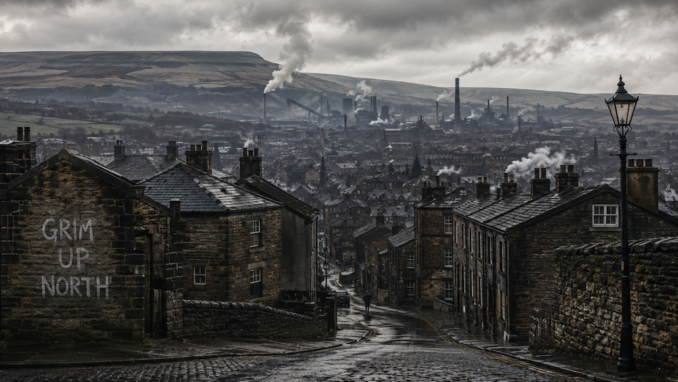
Image generated using ChatGTP AI
Known for muck and brass, the grim north of England was formerly a hotbed of the Industrial Revolution, rich in sweat, resources, enterprise and plutocrats. Nowadays synonymous with grim decline, my wife and I have been doing a Cook’s tour (first class on the train, of course) of northern cities to investigate why.
Thus far, we have broken bread with the linoleum kings of Lancaster and the cotton magnates of Preston. Elsewhere, the north prospered through hewing coal from the bowels of the earth and hammering shipyard rivets onto sheet metal. But might there be an easier way? A path of less resistance between a working man and prosperity, perhaps aided by the observation of the cogs and gears busying a Bradford mill? Read on!
Our story begins in the 1870s at a place called Shelf, slap bang in the middle of the then thriving Huddersfield, Halifax, Bradford milling triangle. Our subject is Joseph, a humble artisan of that West Riding hamlet, who, to improve himself, emigrated to Bradford for employment at Buttershaw Mill. Built in 1852, the redoubtable stone edifice is not only still extant but visible on Google Street View.
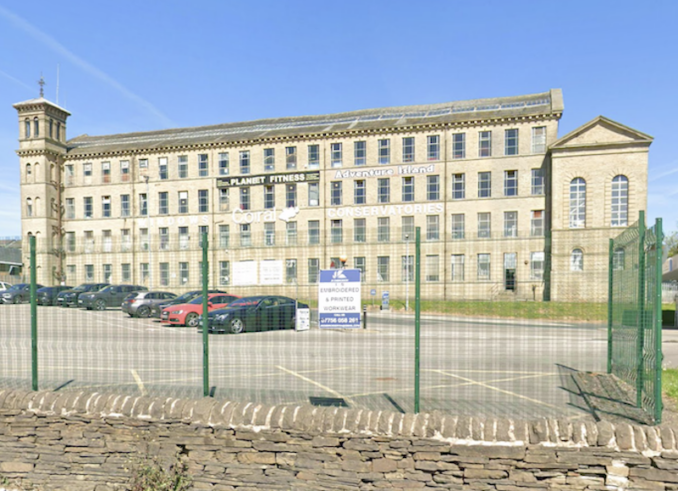
© Google Street View 2026, Google.com
Cogs and wheels hammer about Joseph in a pandemonium of deafening mid-Victorian busyness. Limbs ache. Eardrums pulse. Flesh runs in sweat. But might there be an easier way? And might an intimate knowledge of the working of those near-demonic cogs, wheels and gears give a soft power advantage to an astute artisan determined towards plenty? There might just.
Our tale moves to the final quarter of the twentieth century, and so far south of the grim north that the expense involved means we must leave Mrs AWS behind. In fact, in those days, the gods of love had not yet fired their arrows of desire in our directions with Mrs AWS still up to her knees in mud outside a Nissan hut’s dungy at the unfashionable end of Wallamolongo.
Elsewehere, in those better times, a gentleman ex-pat lodging in the 16ᵉ arrondissement and keen to avoid a boily hot Parisian ‘Le Weekend’, might find himself taking Metro Line 10 to Gare d’Austerlitz accompanied by a lady companion, a songstress of Romanian emigre stock.
Alighting at the opposite end of ‘Direction Bois de Boulogne’, they wander across the bridge to Gare de Lyon. The drunkenness of youth not yet having lifted like a fever, they giggle and sing their favourite Bois de Boulogne song: ‘Avec l’indépendant air, nous entendons les filles déclare’.
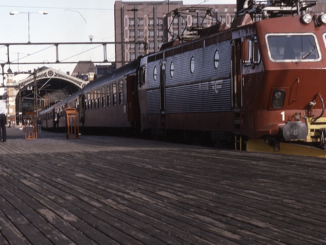
For at a quarter to ten each balmy summer Parisian evening, Le Train Bleu would depart Gare de Lyon and thunder down the spine of France, racing towards the beckoning Sud.
With the first sight of the Med, if I recall correctly, being upon leaving La Ciotat Ceyreste while passing under a goat herder’s bridge and looking across a middling vineyard that squeezed between Côte d’Azur villas.
For, on this part of our iron road plutocrats tour, we must neglect Carlisle, Penrith, Oxenholme, Lancaster, Preston, and Wigan and force ourselves upon Cannes, Juan-les-Pins, Antibes, Nice, and Beaulieu. Until we alight, 1,104 chemin de fer kilometres from Gare d’Lyon (and at 08:15 of the morning after leaving Paris), at, oh, I say, Monte Carlo. Sounds good to me.
In those days, an appropriately dressed young gentleman and lady – especially one who, through her show business obligations, had a sprinkling of Monégasque – would be allowed to the gaming rooms of the principality’s casino to see and be seen rather than to wager.

© Always Worth Saying 2026, Going Postal
However, upon opening my mouth, even in all innocence and in a whisper, this half of our sophisticated party attracted the interest of sécurité. Might there be something in the accent? Might a fellow (northern) countryman have blotted an expensive copybook?
Regular readers will be aware that my father and grandparents visited in the 1950s, in the even better, better times when you could park your Austin Seven next to Prince Rainier’s, and have a wander around his palace. Inoffensive souls from a time when the English abroad knew how to behave, and perhaps overcompensating for having a bit of gypsy and a bit of German in the family line, one doubts my father and grandparents could have offended.

© Always Worth Saying 2026, Going Postal

© Always Worth Saying 2026, Going Postal
Perhaps to a different century? Our Bois de Bologne jingle gives a clue. Razor-sharp Puffins will already have completed the stanza:
As I walk along the Bois de Boulogne
With an independent air
You can hear the girls declare
”He must be a Millionaire.”
To cut a long story short, the 1891 Fred Gilbert ditty celebrates Charles Wells, an English gambler and confidence trickster who broke the bank at Monte Carlo earlier that year. However, Charles de vile Wells was not only a southerner, born in Hertfordshire in April 1841, but also late to the party as our Bradford millman, Joseph Hodson Jagger, was not only from the north but broke the very same bank a decade and a half previously. How so?
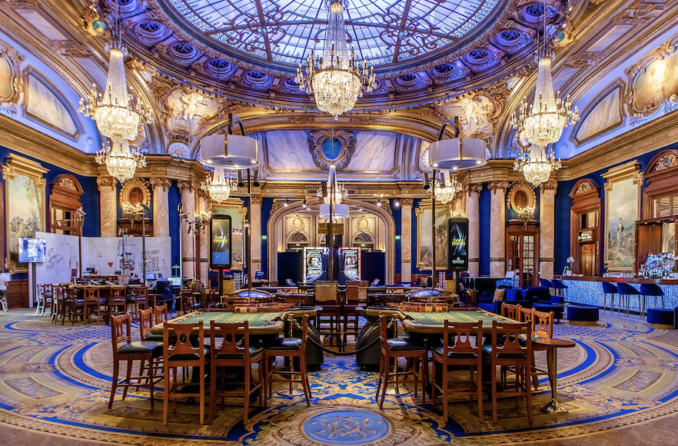
Casino de Monte-Carlo,
Mathew Hartley – Licence CC BY-SA 2.0
First, what do we mean by breaking the bank? In Monte Carlo, this occured when a gambler won more chips than the allocated 100,000 Franc cash reserve set for a specific table. The table is temporarily closed, a black cloth is laid over it, the bank is officially “broken”.
Wells used the Martingale betting system, a gambling strategy based on a very simple idea: double your bet after every loss so that the first win recovers all previous losses plus a small profit equal to the original stake. Easily countered by setting a maximum stake on a table, Wells combined the Martingale system with good luck.
However, might there be a more certain way to bother the black cloth, one outwith luck that relies instead upon scientific certainty? And might a mill mechanic from Shelf, surrounded by gears and cogs in his day job, cotton on to it?
The technical department informs me that no machine is perfectly balanced, and that wear and tear over time introduces predictable physical biases. Because of his daily work with spinning wheels and heavy machinery gears inside a textile mill, Jagger knew that constant use, friction, and minute imperfections cause mechanical parts to wear down unevenly.
He deduced that this principle of mechanical wear and tear must apply to casino equipment, tempting him to establish an advantage over the bank. Just like mill gears, a roulette wheel spins on a central spindle and relies on physical parts like the brass track, fret dividers between pockets, and ball bearings. Daily friction may wear down one side of these components faster than the others.
Manufacturing limitations of the 19th century meant no wheel was perfectly symmetrical from the start. Over time, the weight of the wood, the levelling of the table, or the microscopic wearing down of specific pocket dividers might worsen these imperfections. If a wheel is slightly tilted or a few pocket dividers are worn down and less bouncy, the ball will naturally gravitate toward a specific segment of the wheel more often.
Like successive generations of Worth-Sayings, Jagger struck out for the Beaux-Arts Casino in Monte Carlo in 1873, but accompanied by six clerks hired to secretly record winning numbers on the casino’s six roulette wheels.
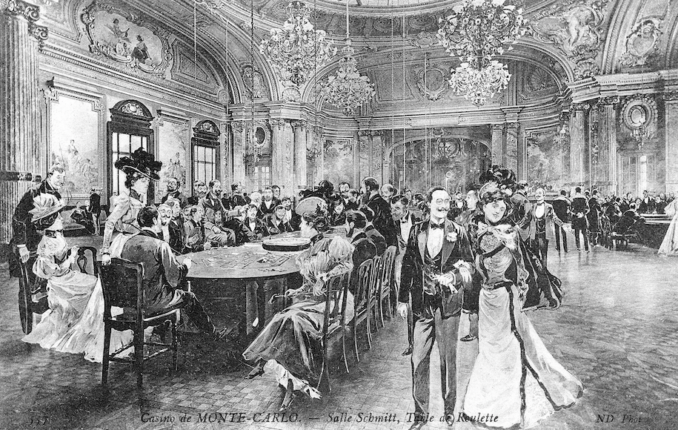
Postcard showing an engraving of the roulette table in the Salle Schmitt,
Neurdein Frères – Public domain
Analysing the data revealed five wheels produced random, unpredictable results. However, the sixth showed a mechanical bias, meaning 7, 8, 9, 11, 12, 13, 19, 20, and 26 were hit more often than probability allowed for. By betting heavily on those specific numbers, Jagger began to win bigly.
However, obviously, the casino became aware that they were bleeding money. Rather than ban Mr Jagger, the canny Monégasque swapped the roulette wheels overnight and the next day Jagger began to lose – briefly. But then began to win again after switching tables. Pandemonium ensued the following overnight when the casino’s frantic investigations revealed a tiny white speck on the rim of the errant wheel.
Again, rather than ban Mr Jagger, the casino summoned the maker of the wheel from Paris, poste haste, no doubt on the Train Bleu, to remidy the faults in the cylinder. Ignorant of this, the next day Jagger continued to play but stopped during the resulting losing spell upon realisation that the game was up.
Wisely, he returned to Shelf, no doubt in a first class Train Bleu sleeping compartment, carrying the balance of his winnings – said to be £80,000 – perhaps the equivalent of £12,000,000 in today’s money.
© Always Worth Saying 2026


.jpg)
.jpg)