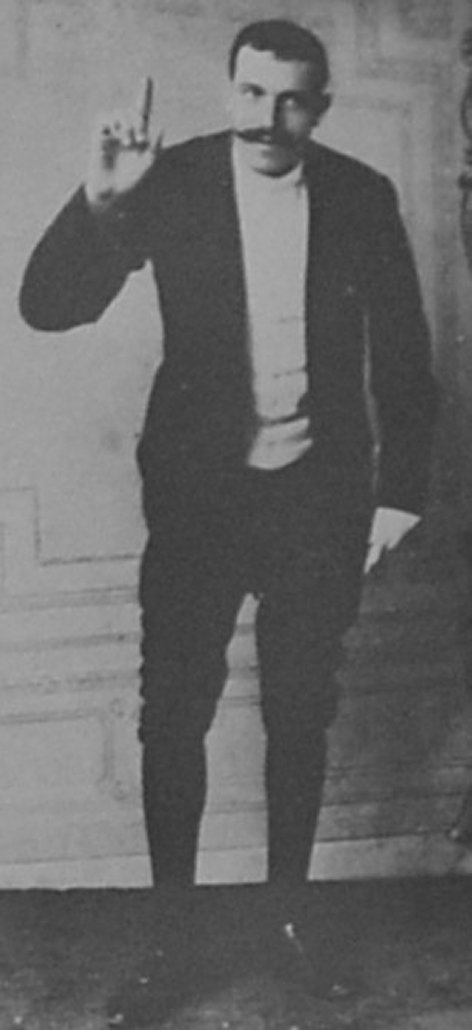
Author Unknown – See page for details, Public domain, via Wikimedia Commons
Greetings pop pickers (from the hot and steamy Côte d’Azur on the stunning Mediterranean coastline of southeastern France) and please be welcome to tonight’s Fabulously Flamboyant Friday and yet another of our groin-polished googlies from the gasworks end of contemporary culture.
Tonight, dear reader, as we respectfully mark both Pride Month and International Pineapple Day, Ivory Cutlery (currently sore of buttock, back and bone) will once again be taking the night off.
I’m currently labouring on the construction of a rather large live event on a sun-scorched beach in Cannes and, as a result, have neither the time nor energy for any of my usual, detailed, fact-checked, Puffin-quality research.*
*a transparent tissue of lies – all the hard work is done by Grok
Because of this, tonight’s missive will be a shoddy and shambolic affair; a puerile stream of consciousness, written rapidly in a succession of French bars, restaurants and coffee shops. So tonight, dear reader, as it’s Friday night in the south of France, we shall consider the subject of perhaps the most talented and certainly the most musically gifted bottom in all of French history. The bottom that belonged to – Joseph Pujol. Better known to his legions of adoring fans as La Petomane!
The inspiration for this article (inevitably) was a recent post-work boozing session, when I found myself (inevitably) in an Irish bar for yet another alcohol-fuelled conversation – this time with a bunch of Yorkshire carpenters, currently labouring, like myself, in the hot and steamy environs of coastal Cannes.
The chaps were waxing lyrical about a Leonard Rossiter filum they had watched and thoroughly enjoyed on a previous evening. The filum, written by Galton and Simpson no less, is a thirty minute short from the late ’70s and tells the bitter-sweet tale of Joseph Pujol (1857-1945) a French comedian, entertainer and, most importantly, a professional fartist, flatulist, farteur or fartiste – take your pick. A man made famous by his unusual ability to inhale through his bottom and then control his botty burps to a remarkable degree – i.e. he could fart at will. His stage name, La Petomane (The Fart Maniac) is a simple portmanteau combination of the French verb péter (to fart) with the suffix mane (maniac).
Pujol (born in Marseilles) apparently discovered his windy talent during a childhood day out at the seaside. Whilst diving beneath the waves, he was somewhat startled to feel an icy shaft shoot up his bottom. Subsequent investigation revealed the truth: young Joseph had managed to suck a couple of litres of cold seawater right up into his jacksy, which, quite naturally, was entirely unprepared for this somewhat unexpected anal intrusion. Anyway, he soon discovered his unexpectedly talented bottom could just as efficiently gulp air as it could water and, et voilà, a star was born.
Of course, it wasn’t quite that simple. Pujol honed his skills while serving in the army, apparently entertaining his barrack mates by sucking up a pan of water and squirting it, under suitable farty pressure, for quite some distance (over 5m according to some accounts). By the time he had left the army and was working as a baker (insert your own Dutch Oven jokes here…) he was entertaining his customers by pretending to play wind instruments, while his multi-talented starfish provided a suitable audio soundtrack for his behind-the-counter buffoonery.
Eventually, he decided to turn pro and take up the mantle of France’s premier, professional fartiste. Accordingly, he cobbled together an act and started touring around the theatres and music halls of Paris, polishing his performance and honing his skills. After touring around for a bit, he began to build a bit of a reputation and eventually attracted the attention of the mighty Moulin Rouge. They signed up Le Petomane and Pujol proved to be a thundering success and a firm audience favourite, gaining fame and fortune, eventually becoming the venue’s highest paid star.
Pujol’s impeccably maintained rusty sheriff (thoroughly enema flushed and cleansed before each performance) would deliver impressions of both people and animals, would smoke cigarettes and cigars, sing tunes (some composed by Pujol himself) and (via a rubber tube) could even play various woodwind instruments.
Britain’s very own “Mr. Methane” (Paul Oldfield), who rose to fame in the 1990s, also has the ability to inhale air into his bowel via his sphincter and suggests the process requires considerable core fitness, tremendous effort and a very powerful diaphragm. He uses and recommends yoga to stay farting fit and suggests any budding fartistes should follow his example.
Pujol was clearly farting fit, because audiences at the Moulin Rouge found all these intestinal shenanigans so funny that nurses had to be employed to care for patrons who passed out in shock or laughed themselves into injury – and one poor chap allegedly laughed himself to death: roaring with laughter so hard, he sadly triggered a cardiac arrest and keeled over. How much of this is actually true and how much was shrewd publicity dreamt up by cunning promoters, is of course open to debate.
However, there is no doubt that Le Petomane was a hugely popular star and – what is also undeniable – is that farts are funny. They just are – ask Terrance & Phillip. However, once I started down this particularly flatulent and odiferous rabbit hole, I quickly realised that La Petomane, as famous and successful as he was, was far from the original fartiste.
Blighty, for example, can boast the 12th century legend that is Roland The Farter, aka Roland le Petour. Roland was a court minstrel in the 12th century, during the reign of Henry II. He apparently performed a farty dance at every royal Christmas feast that ended with a jump, a whistle and a fart, all executed simultaneously. Roland must have been a true master of his craft, because his routine earned him the royal gift of a substantial Suffolk manor house and more than 100 acres of land.
Going back even further, Irish records from the 8th century detail “farters” amongst their list of court retainers; and St. Augustine, writing in the 5th century, noted performers able to “produce at will such musical sounds from their behind that they seem to be singing”. By the way, the oldest known fart joke on record (according to the University of Wolverhampton) seems to hail from the Sumer region of southern Mesopotamia, from somewhere around 2000BC: “Something which has never occurred since time began – a young woman did not fart in her husband’s lap”. Personally, I suspect there’s a distinct possibility that joke isn’t referencing botty burps at all. Nevertheless, I would have very much enjoyed seeing the look on those academics’ faces when, after all their hard work, mental effort and academic rigour, painstakingly researching and carefully translating their rare and precious tablets, they suddenly realised they were actually translating fart jokes.
However, to return to the flatulentastic subject of tonight’s missive, Joseph Pujol became a much admired celebrity and even a highly respected member of society. We know he was seen knocking about with artists such as Renoir and Matisse, and he performed for royalty, including our very own Prince of Wales and King Leopold of Belgium. Pujol’s fartastic abilities also attracted academic interest, with one curious physician publishing a report entitled An Extraordinary Case of Rectal Breathing and of Musical Anus. Interestingly, one of the academics interested in Le Petomane was none other than Sigmund Freud. He was said to be a bit of a fanboi and apparently kept a picture of Le Petomane hanging on his office wall. Given Freud’s fixation with anal fixation, one wonders what sort of influence Pujol might have had on the developmental course of Freud’s famously bottom-centric theories.
Le Petomane retired from the stage in 1914, at the outbreak of The Great War. He returned to his bakery business and eventually opened a biscuit factory. Whether his factory produced air biscuits, history does not record. Pujol died in 1945, aged 88, and is buried in the cemetery of La Valette-du-Var, just a few miles from where I currently sit as I type this missive. Apparently his grave can still be seen, so I might just pop along to say hello and pay my respects to this venerable master of the odiferous occupation.
Joseph Pujol certainly left an enduring legacy. He has inspired several books, musicals and a couple of filums and documentaries (anyone interested in Leonard Rossiter’s performance of Le Petomane can watch it here). The Fartiste was awarded the prize for Best Musical (2006) at the New York International Fringe Festival, and Seth Rozin’s A Passing Wind premiered at the Philadelphia International Festival of the Arts in 2011. The character of Joseph Pugol has now been added to the reworked revival of the Broadway play Can-Can, and Le Pétomane is referenced in Mel Brooks satirical western, Blazing Saddles, with the dim-witted politician (played by Brooks and presumably full of hot air) being named as William J. Le Petomane.
A stage play, adapted from a biography of Pujol and simply called Le Petoman (sic), was drafted in 2001 by the author Tony Stowers. Sadly, however, it was declined by the National Theatre, allegedly on the grounds that their audience would be far ‘too sophisticated’ for such farty, flatulent nonsense. What a bunch of bottom blocking spoilsports.
Anyway, I think that’s probably quite enough of my flatulent filibustering for this evening. So I shall say TTFN to one and all.
May all your musical passages be salubrious, your gardens inclined and your puddles well jumped.
Goodnight and may your Frog go with you – Not Arf!
Featured Images: Old Man In A Church by C. G. P. Grey, licensed under the Creative Commons Attribution 2.0 Generic license
© Ivory Cutlery 2026