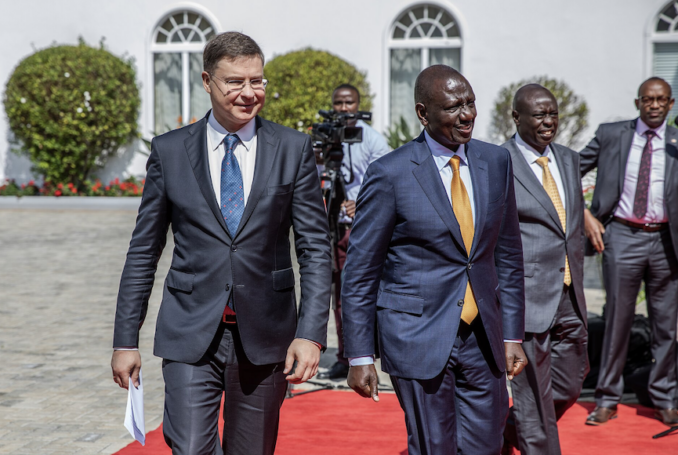
H.E. William Ruto, C.G.H., President of the Republic of Kenya,
European Union – Licence CC BY-SA 4.0
Kenya hosts the largest U.S. embassy in sub-Saharan Africa and has regularly ranked among the top recipients of U.S. foreign aid globally, a majority of it focused on health programs.
Under the first Trump Administration, the United States and Kenya launched talks aimed at negotiating a free trade agreement, which would have been the first in sub-Saharan Africa. The Biden Administration did not continue the FTA talks, instead launching a Strategic Trade and Investment Partnership (STIP).
Ruto sought to court foreign investment, attempted to position Kenya as a global voice on climate change talking up an agreed Ksh500 billion UK investment with Sunak at COP27, of which nothing materialised. Ruto also aimed to be an advocate, on Africa’s behalf, for climate finance and reforms to the international financial system. However, politics at home are now controlling his international agenda.
His administration faces major economic challenges, including an increasingly large debt burden, inflation, and high unemployment. After promising to transform the economy and cut the cost of living, his policy decisions have been unpopular, including his effort to cut a costly fuel subsidy that the International Monetary Fund (IMF) deemed unsustainable. The resulting spike in fuel prices sparked public anger, prompting the government to partially reinstate the subsidy. Tax hikes, cost of living concerns, and spending choices have fuelled anti-government protests. Police reportedly killed 35 people during protests in 2023, prompting a warning that Kenya risked becoming “a police state.” Ruto appeared to mend ties with Odinga in early 2024 and heavily backed Odinga’s bid to chair the African Union (AU) Commission, effectively the AU’s chief executive. In yet another blow to his foreign policy agenda, Odinga lost the AU leadership election in early 2025.
Ruto and Odinga’s rapprochement has not allayed public frustration with the government. In June 2024, young Kenyans, dubbed “Gen Z,” mobilised protests against legislation proposing new taxes. Fuelled by a violent police response, the protests grew, prompting a political crisis and calls for Ruto’s ousting. A spate of reported abductions and killings of government critics followed. Ruto reshuffled his cabinet several times, and in late 2024, his allies moved to impeach Deputy President Rigathi Gachagua, with whom Ruto had fallen out. Ruto’s rift with Gachagua poses massive political problems for him as alliances shift ahead of the next elections, due in 2027.
Kenya – where 213 people were killed and over 4,000 injured in Al Qaeda’s (AQ) 1998 bombing of the U.S. Embassy – continues to grapple with terrorist threats, most notably from Somalia’s Al Shabaab. While attacks near the Somali border are common, several high-profile attacks in Nairobi have underscored Al Shabaab’s reach. Most notably the Westgate Mall (2013), Garissa University (2015) and the 2019 DusitD2 hotel and the 2020 attack on Manda Bay Airfield, a Kenyan base used by the U.S. military near the Somali border. The US offered rewards for information related to the Dusit and Manda Bay attacks through the Rewards for Justice programme, and leaders of the attacks have been designated for sanctions as Specially Designated Global Terrorists (SDGTs).
Al Shabaab says its attacks in Kenya are, in part, retaliation for Kenya’s military role in Somalia and characterises U.S. and Kenyan operations there as part of a Western crusade against Muslims.
The group claims to draw recruits from Kenya’s minority Muslim population.
In June 2024 Kenya launched a US-backed, UN-authorised multinational security support mission in Haiti as the Gen Z protests were escalating at home.
Amid competing domestic and regional security concerns, the deployment of Kenyan Police for the mission – was under-resourced, underfunded and slowed by legal disputes and delays in expected wider international assistance – has been controversial domestically.
Kenya’s 2022 polls occurred amid increasing public frustration with high living costs, disillusion with the political class and another post election crisis.
Ruto is reportedly among Kenya’s richest men and served for years in government, but during the race he played on his supposed humble upbringing, casting himself as a champion for the poor and an outsider running against the establishment. Branding himself the “Hustler in Chief”, he pitched a “bottom up” economic plan and pledged to reduce the cost of living.
Ruto, being a close ally of former President Biden, US support for Ruto was quite visible.
The then US ambassador to Kenya, Meg Whitman, was very active during the election period. She was seen engaging with various institutions and making statements that signalled support for a peaceful and credible process, which was interpreted as a sign that Washington wanted Ruto to win. The NED’s Kwanza Alliance grant formed part of this approach. Further, the recent exposure of Somali fraud in Minnesota, is actively reviewing money transfers within which, if any also found their way during the election period to both Kwanza Alliance and Azimio.
This was seen as a continuation of the US’s usual influence, but this time backing a different candidate. Ruto was seen as the new partner for the United States in the region. Ruto garnered 50.5% of the votes, narrowly avoiding a runoff against Odinga, who gained 48.9%. Turnout, the lowest in 15 years, pointed even more strongly at voter apathy, particularly among young Kenyans.
Observers described the polls as more peaceful and transparent than the three preceding, but like past processes they were marred by rigging allegations and other controversies.
The polls were among Africa’s most expensive, both in terms of campaign spending and election administration. Kenya invested heavily in election technology, including biometric registration, to improve the credibility of the process; it didn’t improve public trust.
In June 2024, young Kenyans organised protests against the government’s Finance Bill, which proposed some US$2.7 billion in additional taxes to reduce the budget deficit and borrowing. Protesters argued that the tax hikes would raise the cost of living for Kenyans already struggling, deter investors, and choke the economy. They raised objections to the government’s spending choices, including on foreign travel, renovations and other nonessential expenditures, pay raises for government officials, and the creation of new executive branch offices, such as those of the first lady and deputy first lady.
When police responded to the initial demonstrations, which began in mid-June, with tear gas, water cannons, arrests, and gunfire, the protests grew, and reported abductions by security forces exacerbated public anger. On 25 June, as tens of thousands protested in Nairobi and other cities, the National Assembly passed the bill (195 votes in favour, 106 against), spurring outrage. Hours later, as police fired on demonstrators outside the gates of parliament, killing several people, some protesters stormed the complex. The government deployed the military in response to the unrest.
The protests were unprecedented in scale, and they highlighted frustration with more than taxes.
This was covered in BBC Africa Eye’s documentary Blood Parliament.
Blood Parliament filmmaker Nicholas Wambugu passed away last week
Polls before the 2022 elections suggested that Kenyans saw the country heading in the wrong direction, and respondents identified management of the economy as the top issue they wanted their government to address, followed by corruption and unemployment. Ruto campaigned on these issues, and protesters charged that he failed to deliver on any of them. Opinion polls reflected a widespread view that cost of living had risen and the economy had further deteriorated after the elections. Ostentatious displays of wealth by some legislators and cabinet members spurred public anger.
Ruto initially took a tough stance on what he termed “treasonous events” on 25 June, but in subsequent days he withdrew the tax bill and pledged spending cuts, a pay freeze, and reforms. Western embassies expressed concern about the violence.
On 11 July, Ruto dismissed his cabinet and promised the formation of a “broad-based” new government. The dramatic move further underscored the pressure he and Kenyan lawmakers were facing.
When the protests continued into the next month, Ruto then accused the US-based Ford Foundation of sponsoring anarchy and violence by financing civil society groups he claimed had mobilised the protests. He then reappointed several of the ministers he had initially removed. His government has since faced protests from teachers and health workers over salaries and working conditions.
At least 60 people died and over 600 were injured around the 2024 protests and over 1,370 people were arrested, according to the Kenya National Commission on Human Rights (KNCHR).
Human rights groups have since raised growing alarm over a series of abductions and killings of government critics that they attribute to state agents and characterise as a crackdown on dissent. As of January 2025, KNCHR had recorded 89 enforced disappearances and 63 extrajudicial killings since June 2024. In January, Justin Muturi, a sitting cabinet member and prominent Kikuyu politician, publicly accused Kenya’s National Intelligence Service (NIS) of being behind the abduction of his son during the 2024 protests. Ruto sacked him in late March.
The Shirika Plan
In March 2025, the Kenyan government unveiled a comprehensive plan to transform the country’s refugee camps into self-reliant, integrated settlements, allowing refugees and host communities to live and work side by side, a shift from the restrictive and aid-dependent camps.
The Shirika Plan aims to close the refugee camps of Dadaab and Kakuma into municipalities administered by the respective counties of Garissa and Turkana, who will eventually take over service delivery from UN agencies and NGOs. The municipalities are supposed to be able to attract infrastructural funding to kick-start economic opportunities, uplifting host communities and refugees alike.
The plan is viewed far more sceptically by host communities and some politicians in Turkana and Garissa. Their concern is that, rather than a promised game changer, it will be a net drain on local resources and exacerbate tensions in two of Kenya’s poorest counties. This adds a further layer on top of corrupt governors, senators, the continued disappearance of the County Development Fund (CDF), aside expensive apartments in Eastleigh, Nairobi.
Before integrating refugees, local communities argue, the government should prioritise solving their deep-rooted problems around insecurity, unemployment, lack of healthcare, access to water, and dismal education performance levels. They demand quality and accessible health care, good schools, markets, roads, and guaranteed security – then talk about integration can begin.
The refugee-hosting communities were never consulted as per the constitution and are not ready for integration. Most refugees would opt for voluntary repatriation with generous assistance to enable them to reintegrate back in Somalia, South Sudan etc. which would be cheaper than attempting “integration” into Kenya.
Governors from refugee-hosting communities and civil service bureaucrats are obsessed with laying their hands on the US$1 billion offer from UN and donors during Phase 1.
The above (and other) concerns escalated further, when it was clear that refugees would also be able to vote in Kenyan elections.
IEBC
This became more paramount in August 2025 when WSR and the late opposition leader Raila Odinga threw their weight behind a secret deal to strip the IEBC chair of the Exclusive Mandate in declaring the Presidential election results. Instead of the IEBC chair verifying and declaring results at the national tallying centre in Nairobi, each constituency returning officer would independently count, tally, and announce presidential results.
Spearheaded by Senator Okong’o Omogeni and supported by both WSR’s Kenya Kwanza and Raila’s Azimio la Umoja coalitions, according to Omogeni, the proposed reform doesn’t just change who declares results, it also changes how and when they’re declared. The bill seeks to prioritise the presidential vote ahead of the five other positions in every general election. This means that before any MCA, MP, or governor results are counted, the presidential ballots must be tallied and announced.
With election officers scrambling to meet unrealistic timelines or bowing to political pressure, the plan is designed to allow real-time manipulation of results across constituencies before they reach Nairobi. With 290 individuals now holding power to declare a national outcome, the risk of inconsistent or doctored results becomes dangerously high.
By diluting this role, Ruto and the late Raila aim to spread responsibility – and therefore reduce accountability. In future contests, no single figure would bear the blame for a disputed outcome. The political cost would be absorbed across hundreds of officials, each shielded by bureaucracy.
With the IEBC chair’s powers in announcing presidential election results weakened, Kenya will be setting itself up for an electoral disaster far worse than anything in its history.
With the passing of opposition leader Odinga, more concerns around the IEBC were raised in November 2025 with WSR and his ongoing meetings with Wicknell Chivayo is intrinsically linked to a South African company, Ren-Form, which has been embroiled in scandals involving the supply of election materials in Zimbabwe, South Africa, and Namibia.
Pending Case: Chivayo is currently under investigation by the Zimbabwe Anti-Corruption Commission (ZACC) for money laundering and other financial crimes
and
ZEC Electoral Scandal: Chivayo is heavily implicated in the mismanagement of a massive government contract for the supply of election materials to the Zimbabwe Electoral Commission (ZEC).
The wider concern is that the meetings with WSR, at the same time the IEBC was handling sensitive electoral documents, suggests a potential attempt to secure or influence future lucrative managing contracts within Kenya’s electoral body.
The Wider Consequence for the Shirika Plan
In 2024, Nairobi was Washington’s darling. In a rarity for an African leader, Ruto was honoured at the White House, and Kenya was designated a Major Non-NATO Ally (MNNA), the first in sub-Saharan Africa.
Kenya would serve as America’s anchor state in a turbulent region, provide peacekeepers for Haiti and a stable partner against a backdrop of coups and Chinese and Russian encroachment in Africa. In return, Nairobi would receive security assistance, and a powerful friend in Washington.
Just over a year later, that evaporated. The first invoice for its failure has arrived in the form of an amendment to the National Defense Authorization Act (NDAA) submitted by Sen. James Risch, (R-Idaho) on the Senate Foreign Relations Committee, calling for a sweeping review of Kenya’s recently conferred Major Non-NATO Ally (MNNA) status, citing urgent concerns over Nairobi’s alleged ties with adversarial states, extremist groups, and the potential misuse of US military and intelligence support.
The rationale, according to the amendment, is a devastating catalogue of Nairobi’s recent transgressions: its dubious ties with “nonstate armed groups and violent extremist organizations, including the Rapid Support Forces, al-Shabaab and hosting the leaders of rebel group M23,” its role as a “financial safe haven” for sanctioned entities, its deepening security and economic entanglement with China, and its use of “United States security assistance” for “abductions, torture, renditions, and violence against civilians.”
Sen. Risch warned of escalating tensions, stating: “We affirmed the global burn notice against Kenya’s President William Ruto and the unfolding diplomatic fallout. Operation Hand of GOD has been triggered with partners CIA, NSA Gov, GCHQ & NCSC.”
Although no formal confirmation of such an operation had been issued by the intelligence community, the term “burn notice” points towards a severe downgrading of trust in the Kenyan leadership, and possibly even intelligence declassification for allied states.
While no immediate suspension of Kenya’s MNNA status has been proposed, the implications of the review could be serious. As the US re-evaluates its security partnerships across Africa, Kenya/Ruto now finds it and himself at a crossroads – under deeper scrutiny than ever before. The classified report is due for release at the end of February. The Risch amendment signalled a fundamental shift in how Washington calculates its interests. U.S. Sec of State Rubio abruptly cancelled a planned visit to Nairobi last year, a clear diplomatic snub that came shortly after Ruto’s visit to Beijing last April and as Washington began quietly cutting aid programmes.
Ruto, now finding dealing with the Don is not dealing with autopen Biden, is being reminded that the Risch review is of how Kenya has failed its end of the transactional bargain.
First, Kenya has cozied up to US’s adversaries. Ruto, for his part, defended the relationship, insisting that it is aimed at securing vital export markets rather than signalling strategic realignment. This distinction, however, has not ameliorated concerns in Washington.
Ruto’s speech in Beijing, where he declared Kenya and China “co-architects of a new world order,” was viewed in Washington as a slap in the face. Sen. Risch entered the full text of that speech into the congressional record, sending a clear message: you cannot be a Major Non-NATO Ally and a “co-architect” with Beijing.
The Don will not support the Shirika Plan.
© AW Kamau 2026