London, despite its many many issues, is still a nice place to visit, to wonder at the beautiful architecture and to explore its history. Of course you no longer expect to see many English people in some parts and you need to, as Shaw Taylor used to say, ‘keep ’em peeled’. One of the places both Mr A and I had wanted to see for some time was the Temple Church in the City of London so we arranged a roadtrip.
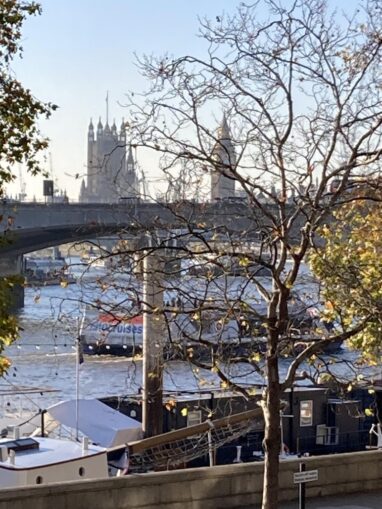
We approached from the West of London on a very bright, cold and crisp morning on the Tube. We managed to get lost and overshot due to not understanding that the Circle Line was not a Circle and we were, in fact, heading off to Hammersmith. Getting back on the right line we made our way to Temple station. We were by this time starving so, coming out of the station and bypassing the posh cafe and the Indian cafe, we stopped at a the Green Hut, a very nice cabin, serving hot sausage, bacon and egg rolls. This was very popular with the constant queue of building workers. There was a nice space, the Artist’s garden (ignoring the wank ‘modern art’ exhibition) with a great view of the river and Parliament, to eat our rolls.
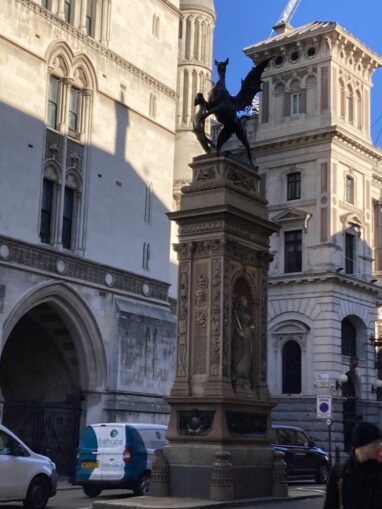
Fortified, off we went to the Temple church. We passed the boundary to the City of London, passing the beautiful ‘Birch dragon’ at Temple bar. One of many similar boundary markers, they are are supposedly derived from St George and the dragon. Of course , if you listen to Tom Luongo or Richard Poe, they contend that the City of London is the heart of the evil Empire conspiring to run the world, but I have not seen any evidence that convinces me.
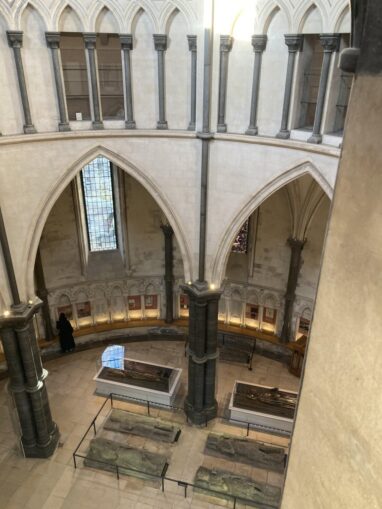
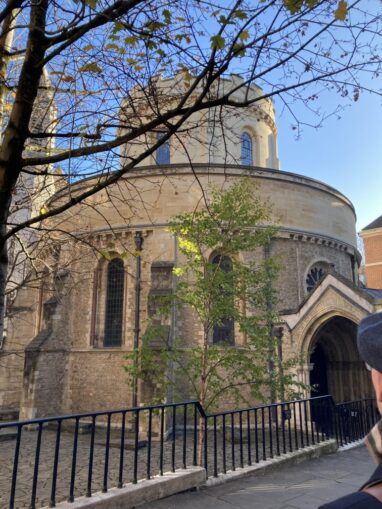
So, to Temple Church. This is the collegiate Chapel of the Inner and Middle Temple Inns of Court. It is a church directly under the authority of the Crown rather than a bishop of the Church of England. Rather than a Vicar it has a Master (by the way the situation is currently vacant if you fancy applying). As you approach the Church it is an unusual shape, a round church with a rectangular addition. The round church is the oldest part of the Church and was in use by 1163. It was consecrated in 1185 by the Patriarch of Jerusalem. This became the nave when the rectangular section, the chancel was added around half a century later.
This ancient church was built as a base for the Knight’s Templar. The Church was built in circular style to resemble the Church of the Holy Sepulchre, the church built around and over the empty grave of Jesus.
The Templars were formed to protect pilgrims on their way to the Holy Land. As part of their role they took valuables into safekeeping and were able to issue an equivalent sum from their network when they reached their destination. The Temple Church was one of these depositories of wealth for nobles including King John who used it as his royal treasury. Of course a fee was deducted for such services and the Templars built massive wealth and influence in subsequent years across Europe.
The Templars were later disbanded. De Jouvenal says ‘Power seeks to eliminate rival castles’ and this is probably the real reason for the suppression of the order, first of all by Phillip IV in 1307 in France following accusations of heresy. In England Pope Clement V ordered Edward II to suppress the order in 1308. Most Templars in England were not arrested and land and assets were disbursed. The Temple was given to the Knights Hospitallers and leased to the two colleges of lawyers, who use it to this day.
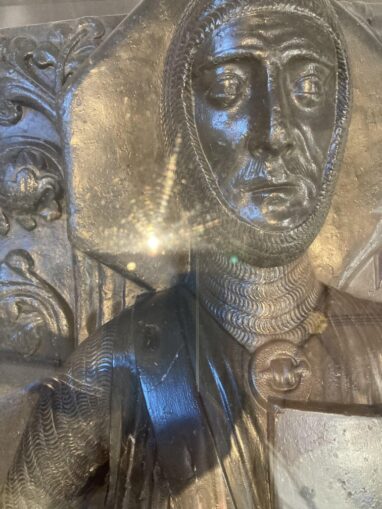
As well as the unique architecture and the Templar history it was a burial place of medieval knights. There are a 9 effigies of knights in the nave of the Church. These include William Marshall; his son, also William, and Brother Aymeric, Master of the Knights Templar. There is some nonsense in the book by Dan Brown, the ‘DaVinci Code’, about the knights that I know nothing about. Some of the film of the same name was made here.
William Marshall lived a long life (1146 or 7 until 1219). He was the outstanding figure of his age. He inherited no titles or lands. His ‘early life’ was spent training to be a knight in France. He did fight in campaigns, including going on a Crusade, but made his name as a successful competitor in military tournaments. Despite various fallings out, he continued to support King John. In 1216 he was appointed protector of 9-year old Henry III and regent to the kingdom following the death of King John but there was already civil war brewing with the presence of the French by invitation of rebel barons. In 1217 William reissued Magna Carta with the agreement of the Papal Legate to try to get nobles back onside and he partially succeeded. However, William had to go into battle at the head of the army at Lincoln in 1217. He defeated the French led by Prince Louis and the rebel barons at the ripe old age of 70. He then paid the remaining French to leave and helped to secure Henry’s throne.
William died in 1219 and was buried in Temple Church. He became a Templar as he was on his deathbed. He served under 5 kings and was eulogised as ‘the best knight who ever lived’ by Langton in the 13th century. Unfortunately, the bones were excavated and buried in the Master’s garden, along with the bones of other coffins found in the nave, so we dont have the exact location of William’s final resting place.
Although the clauses of Magna Carta for all practical purposes have no effect on the operation of law today it is still part of our cultural pysche. It is fate that we went to Temple Church just a few weeks before Lammy announced the end of jury trials. Clause 39 of Magna Carta States:
‘No free man shall be taken or imprisoned or desseized or outlawed or exiled or in any way ruined, nor will we go or send against him except by the lawful judgement of his peers or by the law of the land’
Lammy cites the backlog of trials. I am sure this could be addressed in many ways. However, there are emerging issues with jury trials. This includes the tendency for some to support their own tribe no matter the facts, or the realisation that those on juries may take issue with the laws and the interpretation of judges and just fail to tow the line. Better to rely on judges who can, mostly, be relied upon to make decisions that the liberal elite would prefer? Another brick knocked out of the wall of more than millennial long English culture.
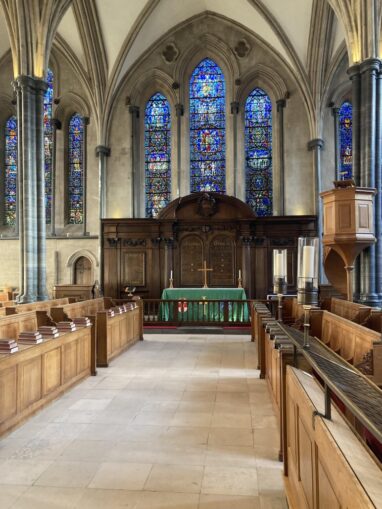
The Temple Church was badly damaged during WWII and although the columns in the chancel were replaced and the Church restored, the extensive decoration was lost and not replaced. The effigies are quite badly damaged too although there is a good copy of the William Marshall one in the Temple Church nave. It now seems quite austere but I really liked it. One thing that was saved was the carved altarpiece made by Wren’s team dating from the 1680’s, this was sold off in the 1840s but brought back after restoration.
We went on a Friday so that we could listen to the free talk that runs most Friday mornings and is included in the entry fee of £5. Well worth it. If you want to visit, it might be a good idea to check opening times as they have lots of events and are also sometimes closed, at www.templechurch.com The Temple is still an active church and renowned for its choirs that are of professional standard. There are also regular concerts of music. Details are at www.templemusic.org. They seem to a very full programme over the Christmas period.
After that we visited a few pubs in Fleet Street. Very nice but very busy on a Friday early afternoon as you would expect. After that an uneventful journey back and this time we made it without getting lost.
© @Alurka 2025