A sunny Sunday in July, and it turned into a pretty special day. In glorious summery weather, we got to ride on a couple of beautifully restored vintage seafront bus services running from just outside The D-Day Story in Southsea.
Sounds good, eh? Even better, our trips were free of charge as part of this year’s summer season of Portsmouth City Museums heritage events (OK, they won’t be entirely free as we’ll probably pay more in Council Tax, but they’re free enough for me, thanks).
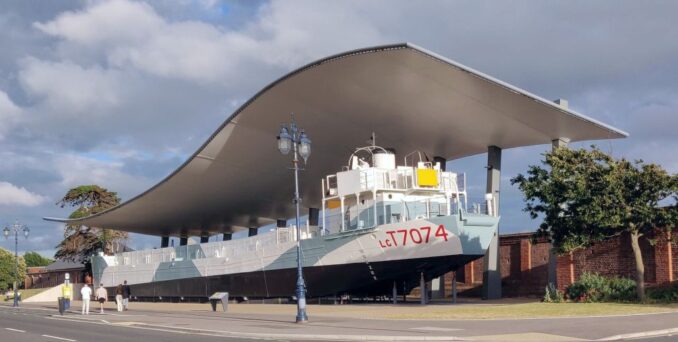
These magnificent vehicles stopped to pick up opposite the huge Landing Craft Tank Transporter 7074 (thankfully this one has not suffered the indignities of being decked out in the alphabet colours like one used in the Falklands War, poor old Landing Craft F8!)
Tim Sheerman-Chase, licensed under CC BY 2.0
This beautiful big girl, 7074, one of six craft built to the same design at the R & W Hawthorn Leslie & Co. yard in Hebburn, on the River Tyne, is the last surviving LCT from D-Day. Hastily built in April 1944, just a couple of months beforehand, on the day, she carried ten carefully waterproofed tanks across the Channel, which must have been a sight to see. I have no way of knowing whether she might be the one which carried Mr S’s father across to Normandy… most probably not but it always makes me wonder.
Our vintage day had started with a ‘normal’ bus trip down to Southsea, on a single-decker electric bus like this, one of over 60 plying the streets around these parts.
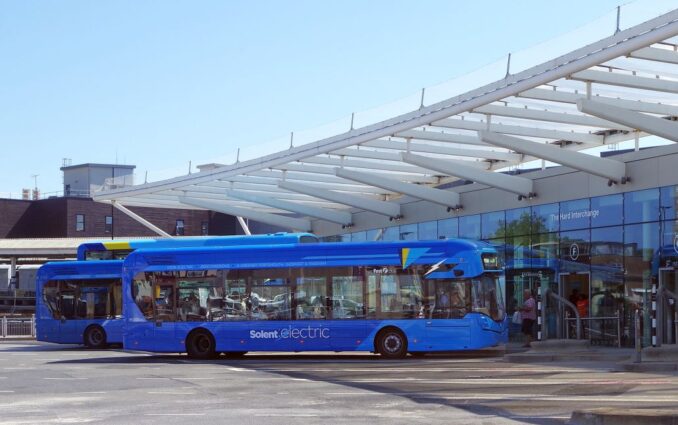
Stephen McKay, licensed under CC BY-SA 2.0
Not my favourite idea, to put it mildly, as in the back of my mind is always the penchant of this type of vehicle to turn itself, and possibly its hapless passengers, into instant barbecue. Whenever possible, we try to sit at the front, though are chances of getting the hell out fast would be somewhat hampered by Mr S’s slightly shonky mobility.
However, we made it safely enough to our destination and bid the big blue EV a hasty farewell, to walk down a shady avenue of trees across the Common towards Southsea Castle. This, for those of you unfamiliar with Portsmouth, is where a horrified King Henry VIII was standing, reputedly, four hundred and eighty years ago this week, watching his beloved flagship Mary Rose disappearing into the depths whilst the Battle of the Solent raged on around her.
I have to say we were pretty grateful for the leafy cover, as the day was already heating up and it was still early. Global boiling anyone? It honestly did feel that way when we got to the bus stop, sizzling in full sun, where a sizeable queue had already formed.
Not for long, though. Very soon, a gleaming vintage bus hove into view. Amazingly, most of the people in the queue stood back so, slightly puzzled, on we hopped. As it wasn’t too busy, we managed to get much-prized top-deck seats. It seems the other folk were holding out for the greatly coveted open-topped bus, which was due to leave a little later, but we’ll return to that one.
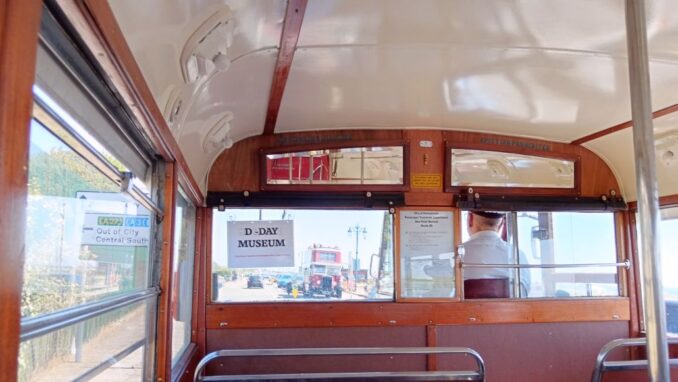
Thus, we headed off on the first of our trips back in time, after a fabulously nostalgic ‘ding-ding’ on the bell, gleefully sounded by the uniformed conductor, for a Circular tour of the Seafront and Museums. We rode on a classic 1959 Metro Cammell Weymann Ltd. H70R bodied Leyland Titan PD3, one of the last rear-loading buses built for Portsmouth Corporation. Her seats upholstered in a tasteful swirly brown Paisley-esque patterned plush fabric, at the wheel was a smartly turned out gentleman in a bus driver’s peaked cap and a nicely pressed sparklingly white shirt, completed with a neat black tie.
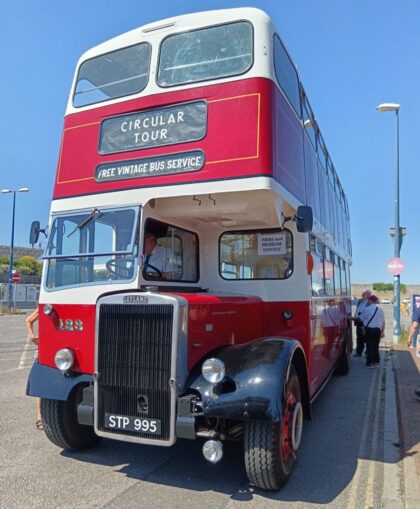
SharpieType301, 2025
This beautiful bus has had a chequered history. Built for the old Portsmouth Corporation, she originally had 64 seats. This was increased to 70-seats in 1962. Hmmm, shrinkflation in action (well, for legroom) even back then?
She faithfully served Portsmouth until 1976, the year of another long hot summer, then life took the PD3 away from Pompey for a while. Firstly, she headed to the Transport and Road Research Laboratory at Crowthorne, in Berkshire where, incidentally, my first husband worked a year or two later. An interesting place, TRRL, as the scientific bods there were instrumental in some of developing some of the more unusual weaponry and armour used during WWII. Not quite Hobart’s Funnies, but not too far off as, amongst other projects, they worked with Sir Barnes Neville Wallis conducting tests on his famous, or should that be infamous, Dambusters ‘bouncing bomb’.
I cannot find out what our PD3’s precise role with TRRL was, but I am aware that they used to conduct ‘tip tests’ to see what could make a double-decker overturn as well as conducting research on the feasibility of bus priority lanes for busy cities like London. Thankfully, once her time at TRRL was over, the PD3 was not scrapped. After another little adventure in the loving hands of WOMP (the Working Omnibus Museum Project Ltd.) she was kindly donated back to City of Portsmouth Preserved Transport Depot (CPPTD) in 1999. Following further extensive restoration work, starting in 2010, she’s now all done up in her best 1960’s livery and looks very smart indeed.
But back to our journey. Waving bye-bye to Southsea Castle, off we set down Clarence Esplanade, with some minor crashing of gears (despite her being fitted with synchromesh transmission), past the historic Southsea Rock Gardens. These were created in 1928 under the government’s ‘back to work’ scheme after the First World War and the subsequent depression. The plants, primarily salt resistant, look absolutely magnificent after the fine summer we’ve been having. Next door, we pass the hideous Pyramids sports centre which really is not in keeping with the surrounding Victorian splendour, so we won’t say any more about that.
A right turn onto South Parade, to the Victorian Pier (where some of the film Tommy was filmed), passing Best Western’s Royal Beach Hotel, a Victorian hotel once advertised as a ‘visitor paradise’, which is currently ‘under refurbishment’ (wink, wink, nudge, nudge…).
Beyond here, we drive past Canoe Lake on Eastney Esplanade. Strangely, although a ‘no barbecue’ zone is in place under the trees on the seaward side of Canoe Lake, there are countless extended families from a certain demographic filling the air with aromatic smoke, a fact commented upon at some volume and with some vehemence by a fellow traveller.
Mind you, the jam-packed beach isn’t all that much different, with tents and tables strewn willy-nilly, seemingly segregated into those populated by well-covered females and others by their menfolk, garbed in altogether cooler-looking attire, all cheek-by-jowl with bikini-clad young beauties and their bronzed lads, and mums and dads with their excited kiddies, slathered in sunblock and dripping with melted ice cream.
The most comical ‘in flight’ entertainment came at the entrance to the seafront car park. With every possible parking space filled along the esplanade, there was a whole passel of optimistic but ill-tempered souls queuing up, desperately trying to shoehorn their wheeled chariots into and out of the car park entrance, before circling slowly in the vain hope that there’d be a miraculous space just for them. Meanwhile, to the sound of impatient horns, the traffic on the esplanade in both directions ground to a standstill. A triumph of hope over adversity, or sheer idiocy if you look at it another way. Still, it’s their petrol.
Onwards (when we could move again) past the Model Village and the gorgeous Rose Gardens at Lumps Fort, the aroma of some forty different varieties of rose delicately scenting the air rather more fragrantly than those barbecues. Then a left turn to take us back along Eastern Parade. There, the bus dropped a few people off at the first of our museums, Cumberland House Natural History Museum, with its wonderful Butterfly House, home, albeit fleetingly, to the most beautiful big blue butterflies, Morpho menelaus.
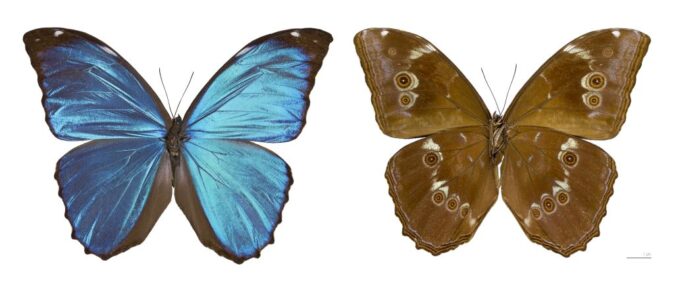
Didier Descouens, licensed under CC BY-SA 4.0
From here we headed back along the landward side of Canoe Lake to South Parade Pier, and then back along Clarance Parade and Duisberg Way (Portsmouth has been twinned with Duisberg in North Rhine-Westphalia for three quarters of a century, one of the first ever Anglo-German twinning schemes to be introduced after both cities were brutally bombed during WWII). A right turn onto King’s Terrace, then around the corner to the wonderful Portsmouth Museum and Art Gallery where another few people alighted.
Now to one of my favourite parts of the Island City. Old Portsmouth, the remains of a medieval town, founded by the Norman lord Jean de Gisors as a trade hub for the Anglo-French traders, and the very beginnings of Portsmouth. Down the High Street we trundled, past the 12th century Cathedral (the Anglican one, originally the Church of St Thomas of Canterbury), and on to the Hotwalls, now the creative quarter, with a variety of arty, and some would say overpriced, studios. Originally, this imposing curtain between land and sea formed part of the sturdy military defences of Point Battery and the associated Barracks, built to protect the western end of the city from attack by sea.
We take a quick tour round Portsmouth Point, a.k.a. Spice Island, with its long and sometimes rather seedy history (there’s a short Richard Vobes ‘Walks in Hampshire’ video, ‘Exploring Old Portsmouth’ which is worth a watch – heavens, he looks young!). Then we wend our way along Pembroke Road, passing the remains of the severely damaged Royal Garrison Church, and back along the Common, with its imposing Portsmouth Naval Memorial, built in memory of some 25,000 British and Commonwealth sailors who lost their lives in both of the World Wars, to end up back at The D-Day Story, our starting point.
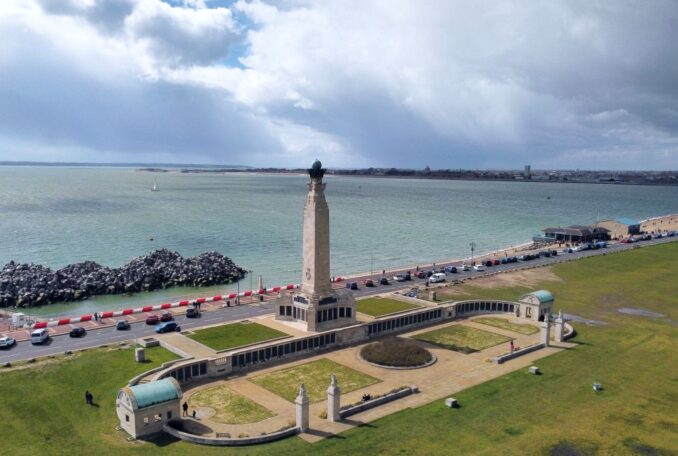
Tim Sheerman-Chase, licensed under CC BY 2.0
Phew, it’s definitely time for a cuppa after all that excitement, but this isn’t the end of our day. One we’ve recovered, and taken time for that all important comfort stop, back to the bus stop we go. This time we’ll be boarding that open-topped bus, and setting off to the Hayling Ferry, and back.
This time, after battling families in a most un-English queue, we board a 1935 open-top English Electric H26/24R bodied Leyland Titan TD4. We don’t quite manage a top-deck seat this time (some of those mums have damned sharp elbows!), but with every window open its cooler downstairs.
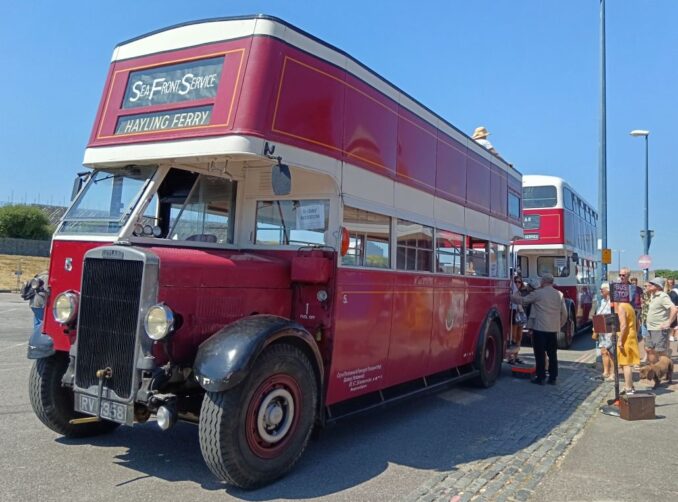
SharpieType301, 2025
Originally built for Portsmouth Corporation in 1935, with a closed-top English Electric 50-seat double-decker body, she was one of several TD4s to be converted into open-top busses to run along Southsea Seafront in 1955 (I found some great photos of her with a cargo of smartly uniformed Wrens, so it’s possible that she may have been used as one of the ‘Pusser’s Bus’ Wrens transport vehicles, after WWII). This she did for a whopping thirty-five years, before she was finally retired in 1971. That sounds an incredible feat but bear in mind these summer superstars were only used for around four months of the year, in the headiest days of summer. Being open to the elements, they were not sent out in the rain and were carefully stored under dust sheets at the bus garage at North End through the winter.
I can’t discover exactly what happened to her when she was withdrawn from service. She may have had an extended siesta under those dust sheets, possibly in a shed in Portchester but, at some point, she ended up in Yeovil where restoration work started but was halted without being completed. However, she eventually ended up in the loving hands of WOMP, who began her full restoration in 2005.
Her interior side panels and seats are now beautifully restored in a deep red ‘leathercloth’ (that’s leatherette, to you and me), to match her gleaming maroon and cream paintwork. Her interior is adorned with a variety of the old signs and instructions we all knew and loved.
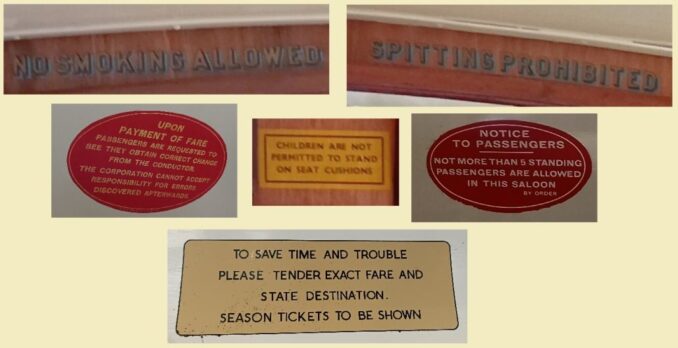
SharpieType301, 2025
Again, we set off down Clarence Esplanade, towards South Parade Pier and along Eastney Esplanade, noting that the fools attempting to get into the seafront carpark were still at it, as were the mad grillers by Canoe Lake. This time though, we keep heading eastwards, past the former Royal Marines Eastney Barracks and the old site of their museum which ‘should’ be reopening in Portsmouth Historic Dockyard’s Boathouse 6… ‘soon’. Well, with luck in the summer of 2026. Still standing proudly outside the old Barracks (now rather tasteful and very expensive apartments) on a grassy mound overlooking the Solent, stands a tall bronze statue, ‘The Yomper’.
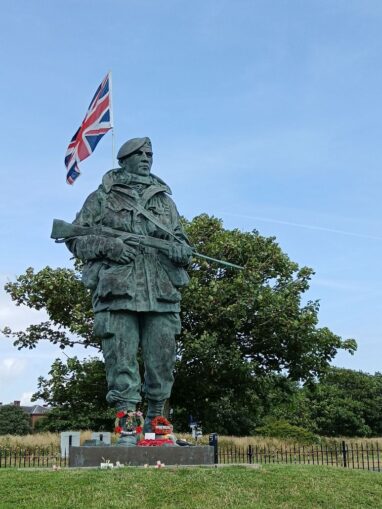
SharpieType301, 2024
Modelled on a photograph taken by Royal Navy Commando Pete Holdgate, the statue is of a Royal Marine, ‘yomping’ with the weight of a full kit towards Port Stanley in May 1982, and the statue stands as a reminder of the human cost of The Falklands War. That Marine was a Swindon lad, Corporal Peter Robinson of 45 Commando.
On we travel, past the smoke rising from another tiny township of tented temporary encampments in and around the shrubs on Eastney beach. Yes, it’s you know who, again. We take a left turn well before we get to the naturist section of the beach, sparing my maidenly blushes, thank goodness, past the old Eastney Swimming Pool (now closed and, sadly, listed for demolition). This pool is a bit special as it’s where the Cockleshell Heroes, thirteen brave Royal Marine Commandos, trained ahead of their secret, and rather tragic, ‘Operation Frankton’ mission, using canoes to plant mines on enemy ships in the heavily-guarded harbour at Bordeaux in December 1942.
Then, with a quick tantalising glimpse of the Eastney Engine Houses, pump houses with both Beam and Gas Engine Houses periodically open as part of a museum (and one I plan to visit soon), we turn right, onto the narrow promontory that almost links us with Hayling Island. This spit of land is home to the rarely accessible Fort Cumberland, a sturdy star fort (much beloved of our WuWeiGirl), built between 1785 and 1810 to control the entrance to Langstone Harbour.
This was a critical defensive point, as this stretch of water might be used as a ‘back-door’ onto Portsea Island, allowing the Dockyards to be attacked from the rear. For me, its attraction is that it is home to some of Historic England’s archives, and to their archaeological sciences and archaeological conservation labs. Now that really does float my boat. Oh yes, the Fort is also home to The Portsmouth Distillery.
At the far end of the road, with Lock Lake on our left and the Langstone Channel on our right, is the diminutive foot passenger ferry to Hayling Island, which has been running across this narrow stretch of water with its treacherous tidal currents for some two-hundred years. This makes it a very sensible spot for a Lifeboat Station, and one (operated by the RNLI) has been here since 1965. Now, the RNLI aren’t really in my good books these days, though I was once a stalwart supporter. But it seems that many folk still are supporters, as today is their annual open day and it’s bustling. This was helped along by music from The Selsey Shantymen – great to hear, though we didn’t get off the bus.
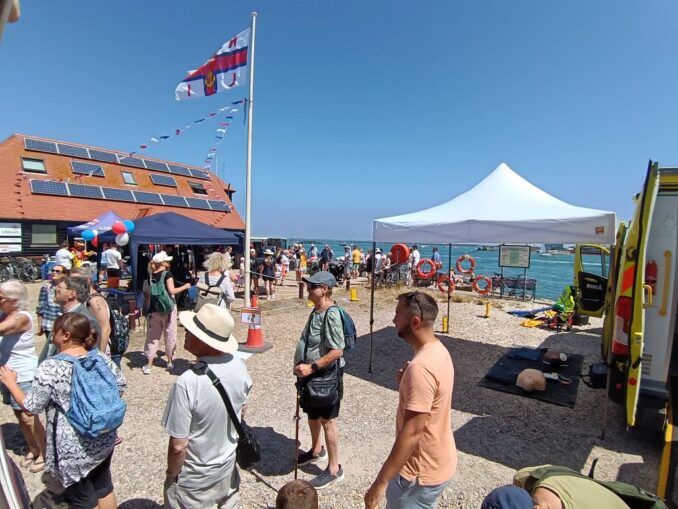
SharpieType301, 2025
Our return journey was pretty much the same, just in reverse, but we decided it was such a beautiful day we didn’t want to waste it. So, we queued once more, to get back on our bus, and had the pleasure, and pleasure it was, of another trip, this time getting the last two top-deck seats. As we pootled along on the Hayling Ferry trip a second time, it struck me what joy these lovely old buses bring. Men and women, young and old, the number of people who smile and wave as you pass them by is just incredible. A little slice of England to be proud of.
© SharpieType301 2025