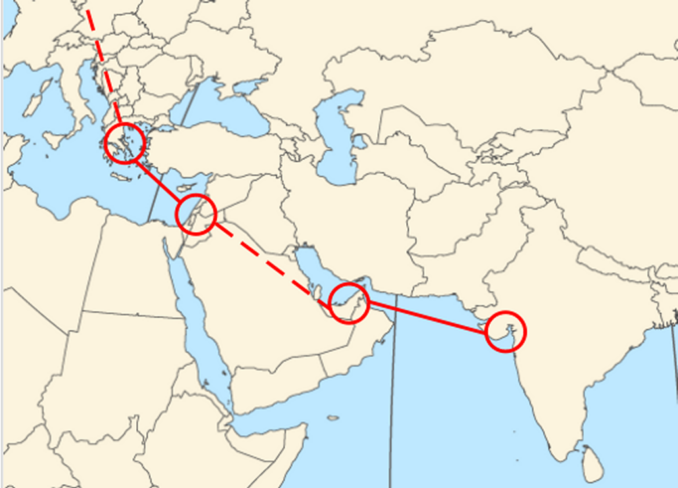
Gazan reconstruction occurs only in areas where Hamas has fully demilitarised or where Israeli military control has been established. A newly formed technocratic committee — Kushner described it explicitly as ‘a technocratic administration’ — oversees the process, supported by Arab partners, working alongside the Palestinian Authority. Governance will not derive from democratic legitimacy. It derives from administrative competence as defined and certified by external actors. Now look at a map. Haifa is IMEC’s key Israeli port node. Gaza sits on the Mediterranean coast directly to Haifa’s south. A rebuilt Gaza with a new deepwater port, airport, and special economic zone, integrated into the Abraham Accords and connected to Gulf states through Israeli-mediated trade relationships, is not a separate development from IMEC. It is a corridor extension. The territory being cleared, administered, and rebuilt through the Board of Peace sits directly astride the route that IMEC’s designers need to control. Let’s be specific about what IMEC consists of, because the details carry the story :-
Rails and Roads: Saudi Arabia will use the existing GCC railway backbone as the corridor’s Arabian spine, carrying critical raw materials from largely untapped interior reserves to international markets. New rail lines are under construction connecting Gulf ports to Jordan and onward to Haifa. Ship-to-rail transfer networks are being built at key Gulf terminals. Road transport infrastructure through Jordan provides redundancy.
Ports: Mundra and Kandla in India. Fujairah — notably the only UAE emirate outside the Strait of Hormuz, positioned as a bypass hub. Jebel Ali and Abu Dhabi. Dammam and Ras Al Khair in Saudi Arabia. Haifa in Israel, now controlled by Adani Ports. Competing European terminals in Trieste, Piraeus, Thessaloniki, and Marseilles, each competing to become the corridor’s western anchor. Italy appointed Ambassador Francesco Talò as its special IMEC envoy in April 2025 and announced a ministerial summit in Trieste for later in 2025, branding the corridor the ‘Cotton Route.’
Fibre Optic Cables: Trump mentioned them twice at his February 2025 White House announcement — ‘many many undersea cables.’ The Blue-Raman submarine cable system — Google’s initiative in collaboration with Telecom Italia Sparkle and Omantel, with 16 fibre pairs and capacity of 218 terabits per second — is already operational along this route, connecting India to Italy via Israel while bypassing Egypt entirely. These cables are not merely commercial investments in internet connectivity. They are the data nervous system of a managed corridor.
Pipelines: Electricity cables and hydrogen pipelines thread alongside the rail lines. The EU has committed under its REPowerEU plan to importing 10 million tons of green hydrogen per year by 2030. India has targeted producing 5 million tons per year by the same date under its National Green Hydrogen Mission. IMEC’s pipeline infrastructure is specifically designed to move that energy from India and the Gulf to European markets — filling the supply vacuum created by Europe’s deliberate decoupling from Russian energy after 2022. This is an energy dependency architecture, not merely a trade route.
Data Centres: Positioned at key nodes throughout the corridor. Combined with the fiber cables and AI-driven smart port logistics systems, these data centres enable real-time monitoring and management of everything moving through the corridor. This is the digital pillar that the Atlantic Council describes as ‘cross-border digital infrastructure.’ In plain language : a surveillance and management architecture embedded in the trade route itself.
Technocracy, perhaps first posited by Robert Heinlein, is a system of governance in which society is controlled by scientists, engineers, and technical experts rather than elected representatives, and in which resource allocation and behaviour modification replace price mechanisms and democratic consent. The endgame is scientific dictatorship. It does not announce itself. It builds infrastructure. IMEC is Technocracy in its infrastructure phase. Consider the architecture: a public-private partnership model in which state diplomacy creates the framework and private capital executes it. A managed corridor in which goods, energy, and data flow through systems monitored and controlled by whoever operates the technical infrastructure. A governance model for Gaza — explicitly labeled ‘technocratic’ by its own architects — in which a committee of experts accountable to Gulf Arab investors and American special envoys administers a civilian population. And a digital layer — fibre cables, data centres, AI logistics — that makes every transaction in the corridor legible to its operators. This is not speculation about future intentions. This is the stated design, documented in Memorandum of Understanding texts, Atlantic Council reports, and Davos presentations. When Kushner says ‘technocratic administration,’ he is not using the term loosely. He is describing the governing model — administration by experts accountable to investment frameworks rather than populations. The Trilateral Commission, declared 2023 as Year One of this new global order at its plenary meeting in New Delhi — the same city where the IMEC MOU was signed six months later. The same year. The same participants. The same framework of managed global integration under expert governance structures insulated from democratic accountability. What is being built in Gaza and along the IMEC corridor is a system in which populations become resources administered by experts, and in which property and sovereignty are replaced by access privileges granted within a managed economic zone.
That is not peace. That is a control system dressed up as reconstruction. IMEC is real, it is being built, and it will reshape world trade. The routes are documented. The investors are named. The infrastructure is under construction. The geopolitical sequence — Abraham Accords, Iran war, Hormuz crisis, Gaza reconstruction — is not a series of unrelated events. It is a sequenced strategy with a commercial payoff built into its design from the beginning. Jared Kushner designed the diplomatic preconditions. He positioned himself financially with the Gulf sovereigns who are funding the infrastructure. He is now overseeing the governance architecture for the key territory the corridor requires. Trump is providing the military and political cover. The Board of Peace is the administrative instrument. IMEC is the prize. The Strait of Hormuz crisis has exposed the corridor’s central vulnerability and simultaneously demonstrated the willingness to use military force to resolve it. Whether Iran’s capacity to threaten the Strait is permanently degraded or not, the intent is clear: the corridor will be secured, one way or another. Technocracy does not need a revolution. It needs infrastructure. Build the systems, control the data, manage the resources, administer the populations. Consent is not required. Ownership is not required. Elections are not required. What is required is control of the architecture. IMEC is that architecture. And it is being built right now, while the world watches smoke drifting over the Strait of Hormuz and the cranes moving rubble in Gaza.
Connect the dots, Puffins…..
© DJM 2026