
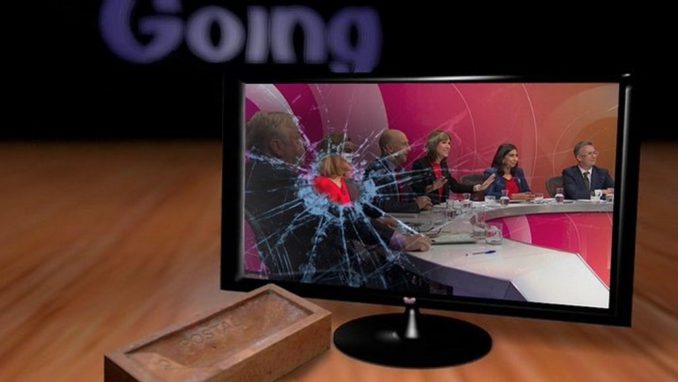
Question Time 23rd April 2026
The Panel:
Anas Sarwar (Labour)
Russell Findlay (Conservative)
Malcolm Offord (Reform UK)
Mairi McAllan (SNP)
Gillian MacKay (Greens)
Alex Cole-Hamilton (Lib Dem)
Venue: Aberdeen
In the run-up to the pivotal May 7 plebiscites, Question Time is airing a series of election specials. Last week’s programme came from Cardiff and focused on the elections to the Welsh Senedd. This week, the show heads to Aberdeen, where the status of Scotland within the Union — and the future of North Sea oil and gas industries — are expected to be the main issues.
In anticipation, Mr Chris Cromar of the Aberdeen Press and Journal gushes of the ‘BBC’s flagship political debate programme’ heading to the granite city. Far from being a non-participating character, the Bridge of Don Academy old boy reminds us he wasn’t just in the audience on a previous visit to the far north, he even put a question to the panel. Then a Politics and International Relations student at Aberdeen University, he asked: “Was Iain Duncan Smith right when he said the European Union was for the haves rather than the have-nots?”
This was in 2016, a week after the Scottish parliamentary elections and in the run-up to the Brexit referendum. David Dimbleby chaired the event, held at the city’s Beach Ballroom. Much has changed in the decade since. Panellist Humza Yousaf would go on —briefly — to serve as First Minister, while Kezia Dugdale moved into academia. Jim Sillars, now in his late 80s, remains a presence, and David Mundell continues as the Conservative MP for Dumfriesshire. The programme was last broadcast from Aberdeen in 2024, with a panel that included the late Alex Salmond, Anas Sarwar and Stephen Flynn.
Whatever unfolds in the real world, the bubble floats on — with Mr Cramar being a dweller within it. After leaving North East Scotland College and armed with an HND in travel and tourism, he went on to study at the University of Aberdeen before moving to Glasgow Caledonian University for a postgraduate diploma in journalism. Reflecting the familiar incestuousness between media and politics, he was also during this period, a Member of the Scottish Youth Parliament, an Aberdeen city youth councillor and a community councillor in Bridge of Don. Will something — or someone — from beyond the bubble inject fresh life into Question Time tonight? No. We’ll watch anyway.
As for present-day Scottish politics, the bookies are certain — offering odds as short as 1/50 to 1/200 — that the SNP, shorn of Mrs Sturgeon, will emerge with the largest number of seats in the forthcoming Holyrood election. Whether they secure an outright majority or win the popular vote, however, is far more uncertain, with the odds closer to evens. The party will frame the election as a referendum on another referendum as they hope to become independent of the hated English and dependent on handouts from Brussels and Berlin instead. But it seems unlikely they will have a majority, or at least a majority convincing enough to allow the English another chance to get rid of them.
As part of this run-up, QT Review HQ predicted that the final election special would come from Northern Ireland, thus excluding long-suffering English taxpayers. Wrong. The final programme has now been announced for Maidenhead, in the Royal Borough of Windsor and Maidenhead — one of six unitary authorities that make up the now ceremonial county of Berkshire. Why there? To deliver a pre-election kicking to Reform UK. Although Maidenhead itself is Liberal Democrat territory, nearby Reading appears more fertile ground for Nigel Farage’s party. Labour has controlled Reading since 2010, and voting will take place across all 16 wards — of which only one currently has a Reform councillor.
Expect a Reform representative — though not Farage himself, who is deemed too adept at the format — to appear on the panel and face right Royal eve of poll thumping from Fiona Bruce, fellow panellists, and a carefully selected Royal Borough LibDem audience.
Until then, the Granite City calls.
***
A tired-sounding Fiona Bruce began with an audience vox pop which asked where all the taxpayers’ money is going, wondered about the transition of skills from oil and gas to renewables and wanted to know how to improve achievement in Scottish schools.
The first question, posed to six panellists representing today’s fragmented political landscape, asked whether rising global tensions should lead to increased oil and gas extraction to strengthen the UK’s energy security.
Mairi McAllan (SNP) waffled around the topic. Energy security is a ‘moving window’ within ‘climate compatibility’, which is itself ‘an obligation’. As for more drilling in the North Sea, this has to be led by evidence. When asked by La Bruce of her understanding of the evidence, Mairi repeated the tosh about ‘climate compatibility’.
Malcolm Offord (Reform) called cutting North Sea oil and gas production an act of self-harm, with hydrocarbons having to be imported anyway from ‘over the border’ in Norway. He suggested UK hydrocarbons be sold here at a reasonable price rather than elsewhere at a speculative price set by global markets.
An oil worker pointed out that the SNP aren’t fighting the north east of Scotland’s corner. A lady noted that while we continue to use oil and gas, how can it be kinder to the environment to import it from somewhere else? Gillian McKay (Scottish Greens) claimed North Sea oil is neither kind to the environment nor helpful to energy security.
Energy security is national security, claimed Anas Sarwar (Labour) before blaming the Tories, rather than Ed Miliband and net zero, for the current pickle. We should honour existing North Sea licences and end the Scottish block on nuclear power. Oil and gas have been good for the UK and have a role in the future. He then, somehow, turned on Mrs Thatcher.
All the panellists spoke too quickly both because they were nervous and because they know that we know that they don’t know what they’re talking about. Anas continued by broadening the scope of the blame for high energy prices, but not to Labour and net zero, but to Trump and Netanyahu.
Russell Findlay (Conservative) pointed out the SNP and Labour are ideologically opposed to oil and gas. We need to drill. Not what the Conservatives did during their 14 years in power, Russell.
Alex Cole-Hamilton (LibDem) decided the most important issue for the next century is climate change. He wanted to extract from here rather than import. We are nowhere in energy transition, and are paying a fortune for unused wind power because the infrastructure is not in place to distribute the electricity generated. Infrastructure that would cost another fortune, he forgot to add.
None of you agrees, and all you do is chase votes, said a lady in the audience. You kick energy around like a football. The focus returned to Mairi, who was allowed to monologue. However, she is a clueless 12-year-old. She too blamed Margaret Thatcher – somehow.
The state of Scottish politics. Why so?
Perhaps not surprisingly for a 12-year-old, Mairi has never had a proper job. A pupilage following her graduation in law from the University of Glasgow was followed by a year as a solicitor and, ominously, as an ‘information officer’ with the Scottish Nationalist Party.
Anas Sarwar was briefly a dentist before inheriting his father’s, Mohammed Choudry Sarwar’s, political career. Russel Findlay is a former investigative journalist, who might do something useful but is bound by the London-rules dripping wet woke Tory Party.
Despite representing Reform UK, Malcolm Offord, not his real name, Lord Offord, Baron Offord of Garvel, is a former merchant banker at Lazards who donated to the Tory Party before being elevated to the Lords. Ominously, Gillian McKay worked in the charity sector before entering politics. An abortionist, the Brora-born 34-year-old graduated in biological sciences from Herriott Watt University before doing nothing of any use.
As for Alex Cole-Hamilton, the 49-year-old is leader of the Scottish Liberal Democrats and has been the MSP for Edinburgh Western since 2016. Surprise, surprise, before politics he worked in the charity sector, including as Director of Children in Scotland. An old boy of Wellington private school in Ayr (£16,000 per annum), he is qualified to pontificate on oil and gas thanks to a degree in divinity.
What. A. Shower.
Not to worry. Today’s QT Review is a bit different and somewhat truncated as I’ve been away on the train with Mrs AWS. And didn’t England look well on this glorious St. George’s Day miniheatwave — from a distance. En route, by a billion to one coincidence, we bumped into a couple we haven’t seen for many years.
Amongst the hugs, and even one or two tears, the gentleman, rather than catch up on kids and careers, insisted upon showing us his selfie with Nigel Farage (bumped into outside a London restaurant sneaking a fag, while himself sneaking a fag).
Meanwhile, the lady – the sweetest, kindest, quietest gal ever within the orbit of this humble author – fell over herself to tell of joining Restore. Worshipping Rupert Lowe as if a god, the nicest girl in the class was more or less dressed in leather and marching on Poland. Hope for us yet? Find out on May 7th!
© Always Worth Saying 2026
The Goodnight Vienna Audio file


