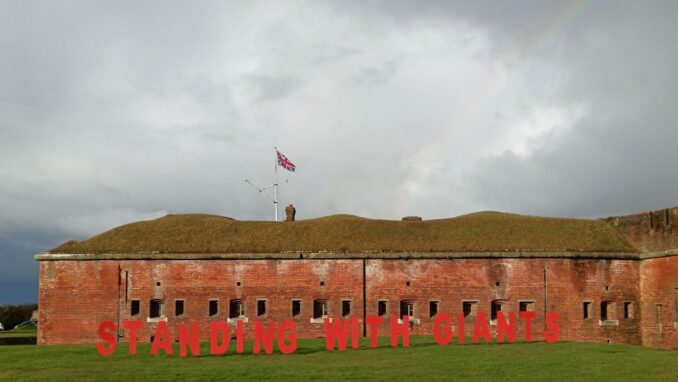
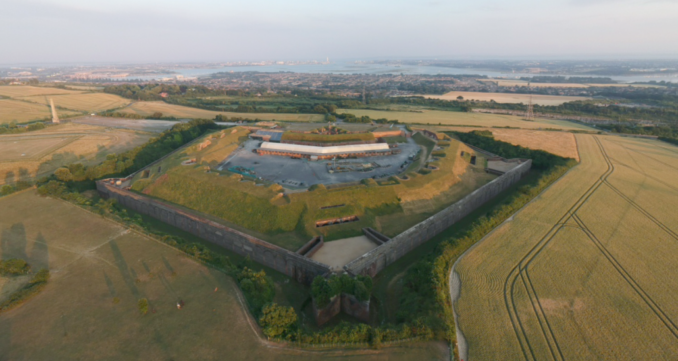
‘Twas on a grey, damp and dismal day in January that, together with a couple of my ‘dementia friends’, I headed off to Fort Nelson, one of Palmerston’s Follies. This particular Fort is not quite a star fort, but is certainly polygonal, and it’s one of a line of Victorian defensive forts (and redoubts) built along the crest of Portsdown Hill in Hampshire. These were raised in the 1860s to guard against the possibility of French invasion.
The forts were constructed to provide a pretty serious line of defence. Fort Nelson alone had barracks which could house around 200 men and would, originally, have bristled with howitzers, mortar batteries and both breach-loader and muzzle-loader artillery.
Today the line of Portsdown Forts crouch along some six miles of the long chalk ridge, like grizzled old lions gazing across their territory. They overlook the dockyards of the naval base below and survey the busy waters across to the Isle of Wight. However, their principal armament actually faced inland, hence a popular judgement of them as being ‘follies’. Surely, many people thought, they must all been built facing the wrong way.
No indeed. This perceived error was no such thing. The forts were established, facing away from the coast, to mitigate against a potential land-based threat from the north. Their primary purpose was to defend the dockyards from possible attack from behind by sneaky Froggy forces who may have landed somewhere else along the coastline and moved inland to try to catch us valiant Brits napping!
Wikimedia Commons, licensed under CC BY-SA 4.0
These robust land-based forts were not alone. Their immediate defensive partners, the four sturdy seagirt Solent Forts (worthy of an article in their own right), were constructed in the waters between the Isle of Wight and the entrance to Portsmouth Harbour around the same time. They were sited to defend against any attacks that the French might care to launch from a more predictable direction.
There are yet more Victorian land-based defences (both forts and batteries) guarding both the western and eastern approaches to the Isle of Wight, as one might expect, and indeed at key defensive points across Britain and the Channel Islands.
These days Fort Nelson forms part of The Royal Armouries (though the main collections are in Leeds, with further objects held at the Tower of London). Fort Nelson houses a magnificent collection of artillery from around the world, some utilitarian but some exquisitely decorated, so is well worth a visit in its own right.
But today, we had a particular purpose in going there. This was to see the Standing with Giants: For Your Tomorrow – The People’s Tribute exhibition, an installation designed by an artist called Dan Barton. His motivation for creating this particular exhibition came from the British Normandy Memorial’s ‘D-Day Wall’ which commemorates the 1,475 servicemen under British command who lost their lives on 6th June 1944 alone, at the very beginning of Operation Overlord.
Similar installations of large, silhouetted ‘giants’ (laser-cut steel figures slightly larger than life-sized at around 6ft 6inches tall), have included displays to commemorate Armistice Day and The Falklands Tribute. These have been exhibited around the country, and further afield, over the last seven or so years. Strange as it sounds, all of the ‘giants’ have been created from recycled road signs.
Now some of Barton’s other installations I’d personally have a little less truck with. One commemorated our brave NHS workers in relation to the über-stressful covidiocy period, while another honours the blues ‘n yallers of Yookraine… (well, I guess these installations did start out in Oxford). In addition, the exhibition raises funds for charities such as The Royal British Legion Poppy Appeal, suspected by some of hoarding cash reserves to the detriment of veterans in need. Thus I appreciate that this might not appeal to everyone here, but I remain pleased that I had the opportunity to see the Standing with Giants exhibition.
In the days leading up to our trip we’d had torrential rain, so negotiating the verdant, or should that be swampy, car park was a bit of challenge. Though large steel road plates have been laid across the grassy area beneath the towering Nelson Monument (after whom the Fort takes its name, the others being named for nearby villages), these proved no match for the British weather. A thick, gooey reddish mud was liberally oozing through the gaps and coating the metal plates. This made the short walk to the roadway a soggy, slippery nightmare. I’d left home wearing black boots, but they didn’t stay that colour for more than a moment.
Undaunted, if slightly dishevelled, we assembled in front of the slightly discrepant turf-covered Star Trek USS Enterprise-style entrance and waited for our one hour timed slot to begin. Visitor numbers had been restricted to timed visits so that as many people as possible could take the opportunity to see this free exhibition. It was most definitely popular, fully booked almost as soon as tickets were released.
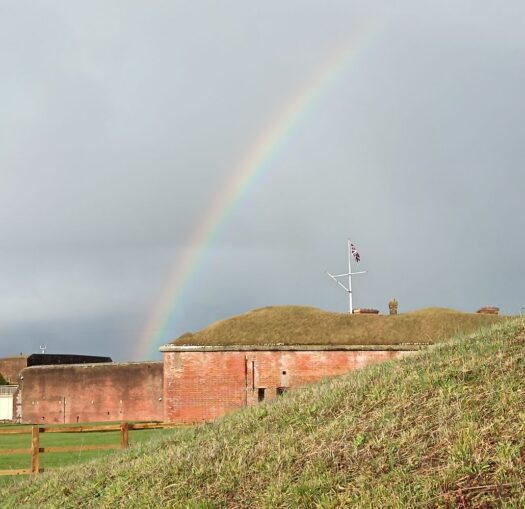
Image from SharpieType301, 2026
As we hung about, the queue gradually lengthening, the dark grey clouds behind us parted. The sun shone through and a rainbow formed over the western approaches to the Fort. Fleeting but fabulous.
Amazingly, as we were admitted and walked across the drawbridge into the Fort’s interior, another rainbow welcomed us (you might just see this faintly in the article’s featured image). Was this a portent of something special to come?

Image from SharpieType301, 2026
As we crossed the drawbridge across the deep defensive ditch which surrounds Fort Nelson there was a small taste of what we were about to see. Down in the hollow next to the massive brick walls, a group of around fifty steel figures. Men, women and even children’s silhouettes, not in uniform, but in civvies. This small collection honoured members of the French resistance who risked and often lost their lives too.
Then onwards into the heart of the Fort and the main exhibition. But before we even reached the main mass of steel figures positioned in the open parade ground, there was an open avenue comprising a series of ‘story boards’ to read.
These had been cleverly constructed from the storage crates in which the steel figures are transported. Each was decorated with panels showing facsimiles of letters, poems, maps and photographs from the time. The bases of the thus disguised crates were garlanded with thousands of handmade knitted or crocheted red, orange and pink poppies of varying shapes and sizes, many made by individuals but most by members of the WI from across the country.

Image from SharpieType301, 2026
Just one touching example of these panels can be seen below, a poem by a young man from Haverfordwest. Lieutenant David Rhys Geraint Jones from the 3rd Monmouthshire regiment was just 22 years of age when he died in action, killed by a sniper’s bullet during the invasion of Normandy. Not on D-Day but having been in France for a mere three weeks.

Image from SharpieType301, 2026
Another of this young man’s poems is entitled ‘Let me not see old age‘. Sadly, he, like so many others of his generation, did not. Suffice it to say that reading through these boards was a dusty experience.
Moving on past the story boards to the broad expanse of the parade ground we now encountered the bulk of the figures, though many had been sited around the ramparts, some silhouetted against the moody sky. This was quite a display, filling the whole area to give a visceral visual reminder of the magnitude of British forces personnel killed on just that one day alone.
Just to give you a little idea of what that looks like, the photograph below was taken from more or less the centre of the parade ground, meaning there are roughly as many of the ‘giants’ behind the point where we stand as there are in front of the viewer.
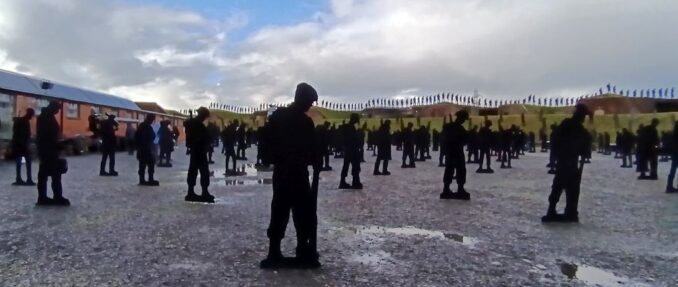
Image from SharpieType301, 2026
Just think about that for a moment. One thousand, four hundred and seventy-five. These were simply the British forces. This number doesn’t include the Allies, nor their opponents, nor any poor civilians caught up in the horrors, and this exhibition represents just a single day, Tuesday 6th June 1944, out of the 2,190 days that comprised World War II.
Seeing the silhouettes here, set amongst the instruments of war, historic cannons and more modern artillery, walking some 40 feet above the magazines underneath us where ammunition was once stored, rather makes one catch one’s breath.
Call me a sentimental old fool but, with the rain we’d had, and the showers that had passed overhead whilst we were wandering amongst the ‘giants’, the bowed heads of these figures had collected ‘teardrops’ of rainwater on the tips of their noses. This seemed an indignity to me. I found myself walking around with a tissue in hand to wipe away the raindrops from their faces. I’ll admit that I needed a hanky too, as I found this a most moving experience.
At this point the weather changed, quite miraculously for the better, and the sun came out again. Being quite low in the January sky it cast long shadows. This welcome sunlight transformed some of the matte-black painted figures, particularly those on the ramparts, as they, still wet from the rain, reflected the light back towards us. This transformed a few of the black-painted silhouettes to silver as we watched in the shifting light.
Perhaps most noticeably affected in this way was the silhouette of the piper, which can be seen to the far-right hand side of the photo below, right at the top of the ramparts. Might this figure be modelled on Piper Bill Millin? Though likely, to be frank, I don’t know for sure, but I’d like to think so.

Image from SharpieType301, 2026
Two more very special moments happened in the time we spent there. Once again, we found ourselves blessed by God’s Promise, with a beautiful rainbow arching over the figures, this time as we look to the north of the fort. A rather fitting heavenly sign in this situation.

Image from SharpieType301, 2026
Genesis 9:13-16
I do set my bow in the cloud, and it shall be for a token of a covenant between me and the earth.
And it shall come to pass, when I bring a cloud over the earth, that the bow shall be seen in the cloud:
And I will remember my covenant, which is between me and you and every living creature of all flesh; and the waters shall no more become a flood to destroy all flesh.
And the bow shall be in the cloud; and I will look upon it, that I may remember the everlasting covenant between God and every living creature of all flesh that is upon the earth.
Just don’t get me started on the ‘modern’ adoption of this glorious multi-hued sight. I might become a little annoyed.
The second serendipitous moment was realising that the shallow puddles on the parade ground acted as mirrors, perfectly reflecting the standing figures in the still water.
One might surmise that conditions on the ground in Normandy in 1944 might perhaps not have been too dissimilar. Following the storms and rain before the landings took place, the puddles in Normandy probably reflected the servicemen as they trudged across terrain they’d doubtless rather not have trod, given the circumstances.

Image from SharpieType301, 2026
The influence of the weather certainly makes one think. If D-Day hadn’t taken place when it did, had it been delayed until the next suitable tides, the Allied forces would have encountered some serious difficulties.
Quite soon afterwards saw the most appalling weather in the Channel for decades, with a dreadful, and quite unexpected storm lasting four days between the 19th and 22nd of June. This storm, the ‘Great Storm’ is noted by a ‘bunting tosser’, a Royal Navy signalman, William Alan Smith in his memoirs ‘Smith RN’. On D-Day he was assigned to HMS Bulolo, the vessel commanding the landings on Gold Beach, and his memories of that day are also worth a read.
In fact, this brief window of opportunity when the weather gods were feeling beneficent, led to General Dwight Eisenhower, the Supreme Commander of the Allied Expeditionary Force, writing a brief note on a report sent to him by Group Captain James Stagg, the Chief Meteorological Officer at the Allied Expeditionary Force Headquarters, remarking “… thank the Gods of war we went when we did”.
Stopping to read another of the story boards near the entrance provided a tiny personal insight into the weather conditions around D-Day, in the form of a letter (actually a diary entry) written by Captain Alastair Bannerman of the 2nd Battalion of the Royal Warwickshire Regiment for his wife Elizabeth.
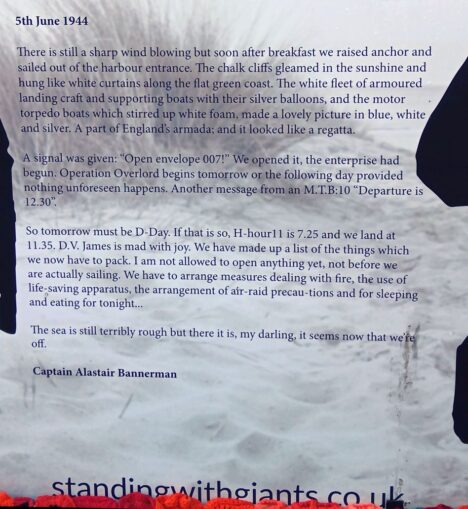
Image from SharpieType301, 2026
His diary entry for D-Day itself reads:
“It is now 03.00 hours in the morning and I have just been up to the bridge. It is rather light because the moon is shining, though heavy clouds cover her. One can see the row of small ships and of darker balloons silhouetted in front and behind us against the grey sea. We are still rolling a little but the wind has subsided somewhat, thank Heaven.”
Though captured the day after D-Day, and spending the remainder of WWII in a prisoner of war camp, Captain Bannerman was lucky to survive. There’s a little more of his story in an interview with his son Richard, who’d been only a year old when his Dad went off to Normandy.
A thoughtful man, Captain Bannerman wrote something else, which in many ways, if a single word were to be substituted, is rather relevant to our own times.
“In the face of the foul poison of Nazi doctrine which would destroy the flowering of our children’s minds and which is a denial of all things spiritual that Western civilisation however imperfectly has won from the centuries, I am at last resigned to believing that in this instance war may be the lesser of two evils and that the relics of freedom left to the human mind and the values that we still maintain, must be defended by force. I am not easy however and we must watch that we do not ourselves become Nazis in the struggle, and that our present ideals are maintained to the end.”
All in all, this visit to the Standing With Giants exhibition was one I am very glad to have made. Although the weather had not seemed exactly promising beforehand, its changeable nature in fact added to the day with the shifting light and, of course, those rainbows.
Of the many visitors, I’d say that the vast majority were older adults – a polite way of saying that we were largely a bunch of old gits. Many of them, like me (and most folk were), became visibly emotional at times. On hand around the site there were a number of volunteers, veterans of other conflicts, to chat to if any questions came to mind. Extremely knowledgeable they were too.
Should you wish to see this extraordinarily moving exhibition for yourself, it will be returning to the British Normandy Memorial at Ver-sur-Mer between Saturday 25th April and Saturday 19th September 2026.
It will then come back to Blighty to be displayed in the grounds of Waddesdon Manor, a little to the northwest of Aylesbury, from 21st October through to 29th November. The manor is a National Trust run property (a French Renaissance-style chateau built for the Rothschild family in the late 1800s). Closer to these dates you will be able to find out more about how to book tickets.
© SharpieType301 2026