During the many years I spent with my friend the famous consulting detective Sherlock Holmes I have had the privilege of publishing accounts of many of his cases, almost without exception triumphantly brought to a successful conclusion. However, over the years there have been certain of them that I forbore to mention: some in which to reveal the details would have compromised persons still living; others in which even Holmes’s powers were inadequate to solve the problem, and a few that simply slipped my attention as I had more sensational events to describe.
Now in later years I feel that I am able to reveal some of these mysteries, and I shall endeavour to do so in this little volume. I held back the first of these tales as there were fears that it might compromise the reputation of what was supposed a pillar of the City of London’s financial establishment; but the bank in question has since been absorbed in a larger rival and its name is forgotten. Nevertheless, in this account I shall change the names of all persons involved and of the bank itself, and if you should jest that it is to protect the guilty I will not gainsay you.
* * *
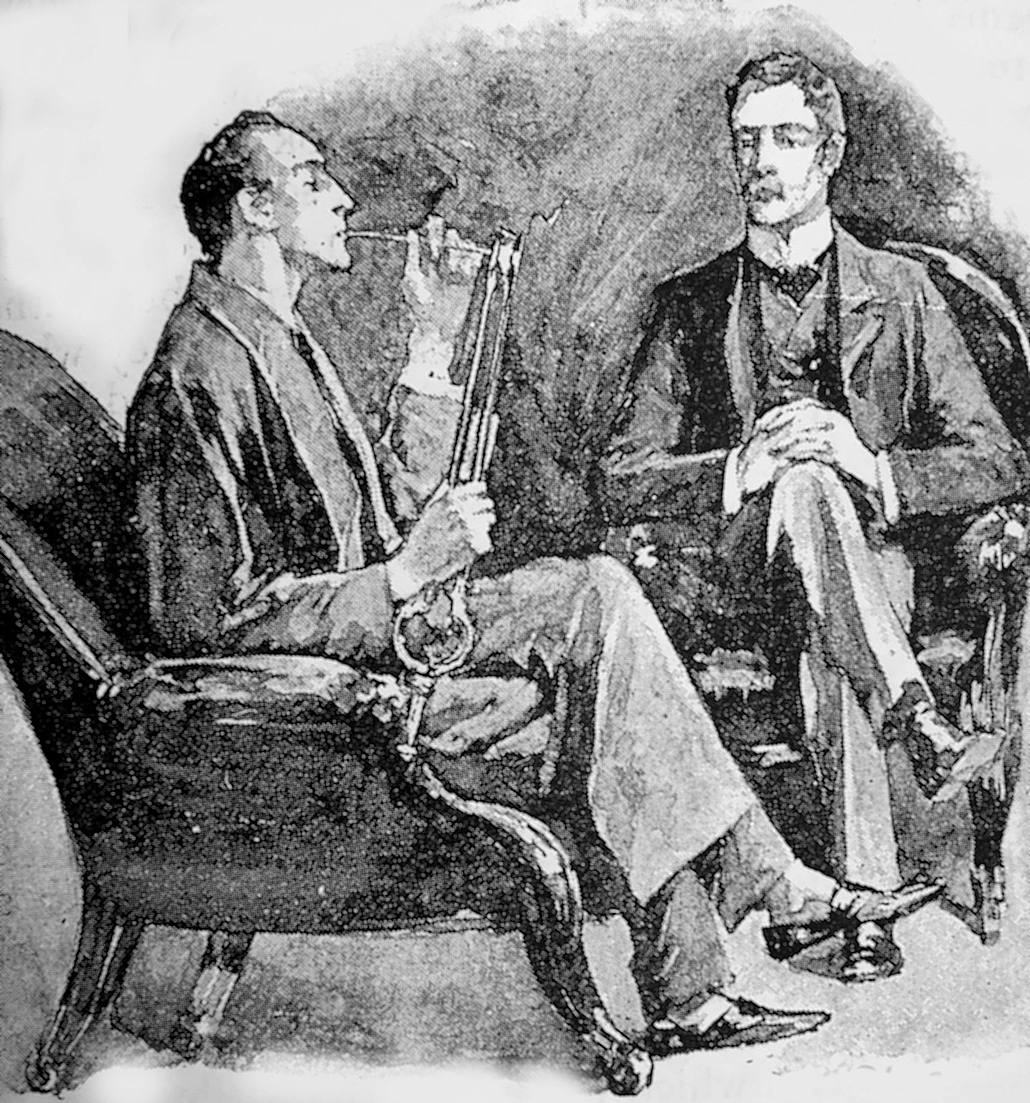
On a chilly Monday morning in November with fog seeping through the streets Holmes and I had just finished one of Mrs Hudson’s excellent breakfasts of kippers and devilled eggs. Holmes was settled comfortably in his chair lighting his pipe when there was the sound of hooves and wheels in the street and a furious rat-a-tat at the front door. We heard her admitting our visitor, who ran preciptately up the stairs and almost fell upon me as I opened it to anticipate his arrival. It was a young man neatly attired and clearly employed by a respectable enterprise, flushed, panting and utterly incoherent.
We seated him and gave him a large glass of the inferior brandy that we reserve for such occasions (Holmes himself will only touch the finest Armagnac and I am happy to share his preference). When he had recovered his wits to some extent, he babbled, ‘I entreat you to come as a matter of urgency to Moorhen’s Bank in Leadenhall Street. We believe that our manager Mr Reeker is locked in the vault. No one but he has the number of combination lock, and it is only a matter of hours before he suffocates in the confined space.’
I could see a glint in my friend’s eye in which I read both the thrill of the renewed chase and a certain scepticism. We hastily flung on mufflers, coats, hats, gloves and galoshes to protect our boots from the muddy streets and descended to the waiting four-wheeler, which bore us eastward at as furious a gallop as could be obtained by fits and starts through the press of hansoms and farmers’ drays crowding the streets of Bloomsbury.
On the way the young man, whose name he revealed as Jonas Pilchard, told us that he was a clerk at the bank. The staff had arrived at the usual time of seven in the morning, expecting to find Mr Reeker sternly ready to allot them their tasks for the week. Instead there was no one but the night watchman and the cleaner, who stated that they had not seen the manager, who would usually have arrived earlier and opened the vault in anticipation of the week’s business. They thought that he might have entered the vault and accidentally allowed the door to close on him.
Holmes enquired, ‘Is there no means by which he could let himself out of the vault from inside?’
‘No, when the vault was constructed Mr Reeker insisted that no such means of egress should be provided, as it might facilitate the attempts of robbers. When the door closes, it latches and the tumblers of the combination lock spin to conceal the number. He also insisted that no one but he should know the number for the combination of the vault door.’
‘Well,’ said Holmes, ‘I am no lock-picker, but I shall do what I can.’ (I have to say that there was no ordinary lock that he could not defeat in a few minutes, but the lock of a bank vault is another matter.)
By now we had arrived at the bank. Holmes sprang down like a greyhound, alighting in the mire with a soggy splash, and we bustled after him at our best pace. We were greeted by a bevy of distraught employees, two of the female computers weeping into their handkerchiefs, and ushered down to the vault in the basement. It was as Pilchard had said: there was nothing to see but the massive door stubbornly closed. Holmes regarded the numbered rings of the lock and asked, ‘Does anyone here know the date of his birthday, or that of his wife and children?’
‘He had no children and his wife passed away some years ago,’ Pilchard averred, ‘and he was not the sort of man who would tell us the details of his private life.’ The other employees could be seen nodding, not entirely sadly as there were now a few ill hidden smiles as they evidently recalled his exactions.
‘I must see his desk,’ said Holmes. It is possible that he has concealed the number in a secret drawer, or perhaps on a scrap of paper pasted to the underside of the desk.’
But our search found nothing. There were no papers other than those expected for the ordinary business of the bank — not a note from home, not a memorandum, not a shopping list, not a receipt. ‘Remarkable,’ said Holmes. ‘Had the man no private life at all?’ All the drawers and compartments were of the proper length, with no possibility of a hidden compartment at the back, and when the heavy mahogany desk was with some labour overturned there was nothing to see on its lower surfaces.
‘No man would trust a six-figure combination entirely to his memory,’ said Holmes. ‘If he has not kept a note of it here, it must be in his house. Where did he live?’
‘At 42 Ricotta Gardens in Kensington,’ said Pilchard. ‘He kept up a private carriage in the mews and would arrive in it every morning.’
‘And did the vehicle arrive this morning?’ enquired Holmes. Neither the night watchman or the cleaner had heard it.
We hastened back to the waiting vehicle and clattered through Mayfair, around Hyde Park Corner and along Knightsbridge before threading our course through the smaller ways to an imposing stucco-fronted establishment in one of those streets that had been laid out in the wake of the Great Exhibition. Before we entered, Pilchard ran round to the mews at the back of the terrace and reported that the driver of his carriage, a Mr Mole, was not at home and the vehicle and horse were not in the stables.
A sternly aproned housekeeper admitted us, with the news that Mr Reeker had not been seen since the previous Friday and that this was unusual since he was a man of the most regular habits. When we had explained the urgency of our quest she was understandably anxious to help, but it was only Holmes who had any idea of how to investigate. We were shown to his private study, and Holmes stood on the threshold keenly looking about.
At once his gaze was fixed on something, and I followed his eye. On the mantelpiece over the iron grate there were three ornaments of a kind one might expect: an ornate ormolu French clock and a creditable pair of Staffordshire dogs. But between these was an assortment of six roughly modelled and crudely painted clay puffins of different sizes, three to a side, which were quite out of place in the surroundings. If he had had children I would have expected him to keep their beginner’s efforts at pottery out of sentiment. But he had none.
Holmes sprang over to them and examined them one by one, looking at their bases, and I observed that each had a number roughly scrawled on the underside. Within moments he had arranged them in order of decreasing size. He took a pencil and scribbled something on his cuff. ‘Back to the bank!’ he cried. ‘There is not a moment to lose.’
So confident was I, as were we all, that there was no doubting his instant conclusion, and we all rushed after him to the waiting four-wheeler. In little more than half an hour we were at the bank again, the establishment now presenting an orderly appearance as its employees made a brave show of carrying on their daily duties. Holmes ran down to the vault, with the rest of us trooping in his wake.
Without hesitation he spun the rings of the lock, and with a heavy click the bolt sprang back. We aided him to haul at the heavy door which swung open with a ponderous screech.
Inside there was no sign of Mr Reeker, nor of anything else but an empty wooden pallet in the middle of the floor. ‘Good Lord!’ Pilchard cried. ‘What has become of the Burbelstein gold ingots?’
— To be continued.
© Tachybaptus 2026