
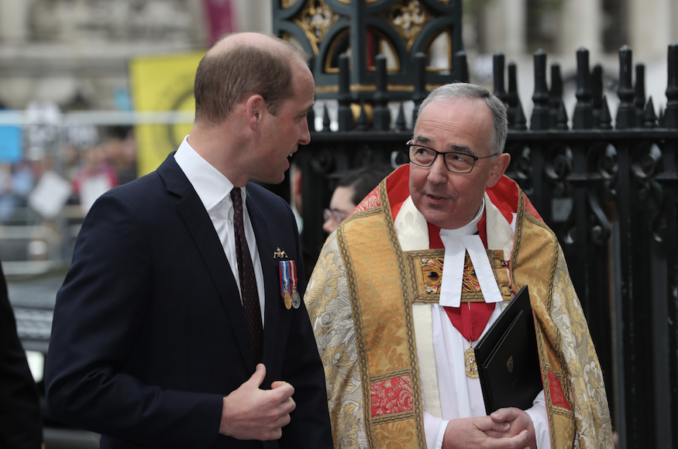
Prince William and The Very Reverend John Hall, Dean of Westminster,
LPhot Belinda Alker – Open Government Licence
In the week that hosted the installation of a new Archbishop of Canterbury, and which culminated in Palm Sunday beginning Holy Week, scrutiny turns towards the religious convictions – or otherwise – of the heir to the throne. Last Wednesday, it was William, Prince of Wales, who on behalf of his father, King Charles, graced the ceremony installing the 106th holder into an office dating from 597 AD.
One thousand four hundred years on, Sarah Mullally is the first female A B of C. Not only that, but one who attended comprehensive school and went into nursing rather than to university (although later she read for a degree at London South Bank Polytechnic). May she be expected to have more in common with her congregation and potential flock than her old Etonian and Trinity College, Cambridge, predecessor Justin Welby?
However, apart from being in the same place at the same time during the installation at The Cathedral and Metropolitical Church of Christ Canterbury, how much does she have in common with the heir to the throne? Upon his 77-year-old father’s passing, William will become the Supreme Governor of the Church of England and be bestowed with the title ‘Defender of the Faith.’
In anticipation of murmurings, the Palace briefed the media. Or one assumes they did, as the same story appears in numerous outlets, in much the same way the same narrative may appear in three gospels. In this instance, our Quelle being an anonymous ‘royal aide’ (via the Sunday Times) according to whom:
The Prince of Wales is keen to build a strong and meaningful bond with a commitment to the Church of England, through a personal faith which is sometimes quieter than people expect, and for that reason is not always understood. Those who know him well recognise William’s connection to the Church, and to the sense of duty that comes with it. This runs deep and is grounded in something personal and sincere.
The prince has enjoyed warm and substantive conversation with archbishop Sarah. He holds a genuine interest not only in the Church’s work, but in its role as a guardian of a distinctive and ancient English spiritual tradition that remains relevant in contemporary life.
Faith, service and responsibility are themes that have long shaped the role he will one day inherit, and they are things he approaches in his own thoughtful way. His view is summarised as, ‘I might not be in church every day, but I support it.’
All well and good, but no actual mention of God. A ‘revelation’ noted by the Daily Mail who unearthed some critics who could be described as being disappointed. Columnist Robert Hardiman pointed out belief in the C of E is one thing whereas a view on the Almighty is another. Puffins will be relieved to read Robert authored a book, Charles III The Inside Story, from which, quoting himself, Hardiman told Mail readers William is not by instinct comfortable in a faith environment.
A lukewarm Anglican (it was David Cameron who described his faith as coming and going somewhat like FM reception in his native Cotswolds), he does not like attending beyond high days and holidays. As a modern young man, he gets embarrassed by certain aspects of ceremonial and religion. Concerned Puffins will be relieved to read Mr Hardiman concludes the prince will fulfill his constitutional duties all the same.
Yes, the ‘Metropolitical’ as the archbishop serves as the ‘metropolitan’ bishop over the ecclesiastical province of Canterbury, which encompasses the 30 dioceses of southern England.
Back in the plot, and at the higher church end of Fleet Street that is the Telegraph, royal editor Hannah Furness tells a modern-day parable of the Prince of Wales’s September 2022 visit to St Thomas’s in Swansea. Rather than pray or take communion, he visited the church’s thriving community hub, complete with food bank, facilities for the homeless and a kitchen training the next generation of chefs.
Hannah writes this is as much ordinary churchgoing as the prince has ever done apart from family obligations. St Mary Magdalene in Sandringham calls at Christmas, St George’s Chapel in Windsor for Easter, and Crathie Kirk during summer holidays in Balmoral.
It was not always the case.
Queen Elizabeth II was a deeply religious woman. For her 90th birthday, The Bible Society published The Servant Queen and the King She Serves, a celebration recounting how her faith guided her as she served the country and the Commonwealth. The queen provided a foreword in which she spoke of her gratitude to everyone who prays for her, and thanked God for His steadfast love.
Charles III is also a regular churchgoer, although he does not always attend services publicly every Sunday. He is known both for the seriousness of his faith and for frequent attendance, especially when staying at royal residences such as Sandringham or Balmoral. Many of his visits are private and therefore not always reported, but he is also seen at major Christian services such as Easter and Christmas, reflecting a consistent, if sometimes low-profile, pattern of worship.
Williams’s grandfather Prince Philip, Duke of Edinburgh, grew up in the Greek Orthodox tradition, and later became a member of the Church of England when he married Queen Elizabeth II. In later life, Phillip became associated with the Alpha Course. This is a Christian programme developed within Anglicanism exploring the basics of the Christian faith through informal talks and discussion. Prince Philip didn’t just attend — he encouraged its use, hosted courses at Windsor Castle, and engaged in theological discussions with participants, especially later in his life.
As for Philip’s mother, William’s great-grandmother, Princess Alice of Battenberg dedicated herself to the religious life. She became a Greek Orthodox nun at age 64 and founded a nursing order while dedicating herself to prayer, charity, and helping the poor. There is hope for William yet!
Does it matter? Puffins are familiar with the idea a hapeth of fishwife is worth a guinea of clergy, and that the currency of royalty (with the possible exception of Princess Anne) lies lower.
What we can be certain of is that tomorrow morning and then throughout Holy Week, churches will be busy and all will be welcome – including me, you and royalty.
© Always Worth Saying 2026

