“I was in Alliance” is a euphemism for the hollow ethos of a certain “old school” elite that is totally disconnected from everyday Kenyan society.
May 13, 2026
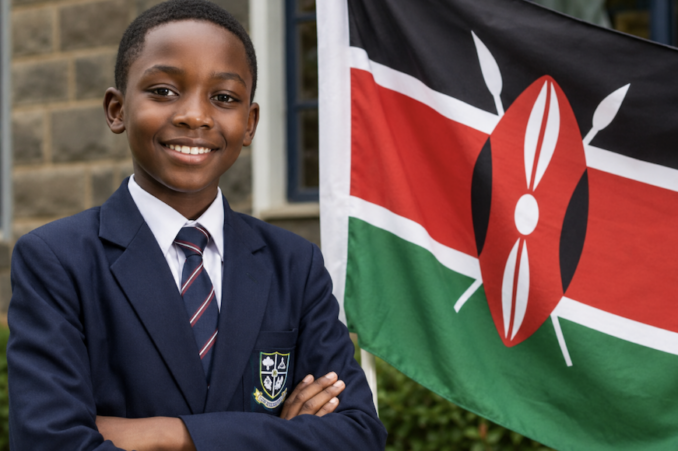
Image generated using ChatGPT AI
In April of 1963, with Kenya in the grip of election fever – KANU vs KADU – the last Governor General of Kenya, Malcolm MacDonald – whose health had fallen apart under the strain of Somali demands for secession as part of pre-Independence negotiations – was away on an eight-week wilderness safari break (in the comely company of an unnamed female Chinese photographer), “communing with more or less wild animals who never make speeches and who don’t seem to give a thought to Kenya’s go-for-the-jugular style of politics”, as the exhausted Governor General put it.
One man, the principal of Kenya’s preeminent secondary school, Carey Francis of Alliance High School, founded in 1926, had put all non-canvassing principles aside to make a personal negotiation; taking a 31-year-old Alliance alumnus by the hand, he led him straight to his friend, Deputy Governor Eric Griffith-Jones, and told him: “You must impress upon Jomo Kenyatta that, after the elections, this young man Kenneth Matiba be made the first indigenous African Permanent Secretary of Education.”
The “alliance of Alliance” had taken its first step into what would become a persuasive, pervasive, and some may even say perverse network of “Old Boyism” whose calling card would be just four words: “I was in Alliance.”
Coming from the mouths of old boys of the prestigious school in Kikuyu, these four words would be uttered with, and expected to carry the weight, of the words, “I am who I am”, thrown at poor Moses when he dared ask a burning bush that was talking to him what it was.
“Bush!”
That is the moniker by which Alliance High School – the Boys’ school founded in 1926 by the Alliance of Protestant Churches (PCEA, ACK, AIC, etc.) – was known, and its mission was to provide quality secondary education to the sons of some of the African colonial subjects. Which was why, 40 years after its founding, it was a bunch of ex-Alliance Boys that were running things in Kenya by dint of the fact that “they were in Alliance” – most having gone on to Makerere University (and some overseas after that) before returning to run the ship of State, and state with the pride of morning star deities that, indeed, “I was in Alliance”, as if to justify their place in power and at the trough that is Kenya.
At this point, I must come clean and say I am a Starehe Boy, one from the 1985 to 2005 generation that considered Alliance High School (“Busherians” as they called themselves; we just referred to them as “Bush Boys”) our greatest rivals – not just in academics, but in our philosophical approach to life. Whereas the late, great Dr Griffin tried his best to instil a sense of humility in us “Starch” guys (not difficult in a school where 75 per cent of the lads came from hard, very poor backgrounds, and “Starch” referred not just to Starehe but also to the main staple in the mess hall and the starched stiffness of the bright blue shorts and red shirts we wore, both donated by the Shell Oil company, which might still be disappointed that we didn’t grow up to become loyal petrol station attendants), Bush boys – in their greens, whites and greys – were bred not just to rule Kenya, but equally to brag about it with just those four words: “I was in Alliance.”
And rule Kenya the old boys of Alliance did, in some cases showing impressive leadership, but more often with hubris and intellectual poverty; corrosive tenures that have set the tenor for successive regimes – from the entitled Alliance nabobs of Kenyatta’s Kingdom to the alliance of rogues in today’s kleptocracy – a century after those Scots founded “Alliance” in the bush.
After receiving the Alliance “handout” from the principal of Alliance, Kenneth Matiba had by 1964 become the Permanent Secretary of Commerce in the ministry run by Makerere man Mwai Kibaki, his appointment having been pushed by his father-in-Law, Musa Gitau, one of the first African ministers of the Presbyterian Church (a core cog in founding Alliance) who had ministered to (now Prime Minister) Jomo Kenyatta when he was studying carpentry at the Church of Scotland in Thogoto decades prior – in an early case of the nepotistic patronage nexus that is still at the crux of who gets to eat “matunda ya uhuru”.
Matiba would go on to sprout and thrive and become a multi-millionaire in Kenya over the next quarter-century, until his sense of hubris led him into splitting the opposition against incumbent Daniel arap Moi in 1992, handing the unpopular president his minority victory. (Ironically, had Matiba agreed to remain the running mate of his fellow Old Boy, Jaramogi Oginga Odinga, the old man – who passed away in 1994 – would have died in office, and Matiba would have become Kenya’s fourth president.)
This was a scenario contemplated by another Alliance Old Boy, James Kanyotu, who became Kenya’s spy chief in 1965 when he was barely thirty. By 1985, he was the man in dark glasses in Nyati House presiding over Moi’s alliance of terror against political dissidents. He concluded his corrosive tenure of terror by becoming a billionaire as a partner in “Goldenberg” Limited, which looted billions from the Central Bank in a fake gold export scheme, driving the country further into poverty.
The intellectual poverty of this “Alliance of Old Boys,” (these days we have an Axis of Weevils at the apex of power) was ironically reflected in one of its most intelligent and elegant “Busherians” – “Sir” Charles Njonjo, nicknamed the Duke of Kabeteshire, not just because of his flawless English but also for his Savile Row pinstripe suits, mzungu mannerisms, white wife, and sneering attitude towards what he dismissed as “native proclivities”.
For Njonjo, and for the “Kiambu Mafia” of mostly Alliance alumni, the nadir was the intellectual poverty of such an educated gentleman to make it “treasonous to imagine the death of the president”, although it did serve a Machiavellian purpose in chilling the political atmosphere enough to allow Moi, Njonjo’s “passing cloud”, to ascend to the presidency in 1978 – with Njonjo’s “Alliance” superiority over former primary school teacher Moi leading to the hubris that would be the political kiss of death for the A.G. from Alliance.
The “Alliance” amendments transformed Kenya from a parliamentary system with decentralised power into a de facto, and eventually de jure, one-party state that would take 18 years of struggle to rectify into the 2010 Katiba.
My first experience of the overwhelming arrogance of Alliance alumni was with a fellow I will call Bush Bakata*, the scion of a Runda tycoon who had just “cleared” from Alliance High school; when I told him I intended to try and get into Starehe, he made a pun that his pals found funny:
“Starehe is for poor brains, boss!” Bakata smirked. “Best brains go to Bush.”
In the decades since, Bakata remains a very monetarily successful person in life. As an individual, every collective operation he has headed has been a disaster.
Over the last 20 years, Bakata’s intellectual poverty has seen him run a mission-oriented state enterprise into the ground; his hubris saw him put the proverbial lipstick on a corporate pig as it went from fat to lean (before being stewed in a “synergy” smorgasbord). He is currently in charge of a sinking ship, a star company now in its death spiral, but he remains immune to advice.
“I was in Alliance” isn’t an attack on the alumni or that otherwise great school.
Rather, it is a euphemism for the hollow ethos of a certain “old school” elite in Kenya – drunk on overseas degrees or high on the cocaine of connections, living behind electric fences in the leafy suburbs and driving cars the size of houses while disconnected from everyday society and mingling only in country clubs where there are subtle struggles to show off without being “standoffish”.
In a brilliant article titled “City of Gates” (in the book ‘Political Parties After Political Parties’), poet-architect Alfred Omenya, who was in Alliance, laments the changes in the city’s identity after the 1982 attempted putsch, and the subsequent looting of shops and stores, including on Moi Avenue, where every premises was raided. “During long and safe hours at night, people, lovers especially, would walk the city streets staring in at the delights displayed behind glass windows. Until then [1982], Nairobi had been a window-shoppers’ paradise. These open displays were now replaced by grey (and) ugly metallic shutters.”
Professor Omenya bemoans these “afterthoughts”, as he recalls them, as “denying the eyes the opportunity to enjoy their virtual pleasure of ‘The Unreachables’ contained inside the shops”.
In similar fashion, there is an “Alliance” of elites in this country that exist beyond the eyes of the ordinary Joe Otieno and Jane Wanjiku, hidden behind trees, electric fences, in clubs and high-end malls, who go away on holiday to faraway lands, and have no capacity to inspire common folks.
These elites are capitalists and consumers, and are in reality like a big baby’s alimentary canal – gobbling up the milk and honey in their lands of plenty at one end, wanton waste emanating from the other. The breed of elites whose necks are always on the line when class revolutions, albeit now badly out of fashion, come to town.
“I was in Alliance,” is also a mentality of past institutional validation that makes one infallible in one’s own eyes, and as Professor George Magoha once told a none-too-bright journalist, “If you had been to a good school, you wouldn’t have asked such a stupid question…” (insert soundtrack of an elephant trampling silly sheep underfoot here).
As a Commissioner of the Judicial Service Commission (JSC), the late Justice David Majanja once shut up a prospective Chief Justice during the recruiting interview with just four words: “I was in Alliance” – as effective as a gavel in quietening people, shutting down dissent, cutting off challenges, pouring very cold water on other opinions, however strongly held… or hotly felt.
At the time, I was a journalist with Standard Media Group, running a popular weekly column called “Wannabes” in The Nairobian, and I wrote about how no one was more “Wannabe” than an ex-Alliance student.
My illustrator, Harry Muriuki, accompanied the piece with a cartoon of a cadaver popping its head and torso out of the casket to blow a gasket, crying: “Hey! In the eulogy, you forgot to mention that I was in Alliance!”
Going full circle to that first election in Kenya in 1963, KANU won.
As Jomo Kenyatta finished giving his victory speech in an open field on the first Madaraka Day, the heavens opened up, and he raced to the nearby Muthaiga Club in the company of Mbiyu Koinange and James Gichuru, both of whom had been in, say it with me, …
Muthaiga Club was, at that time, still the privileged sanctuary of the White European settlers.
There, the now “almost headmaster” of Kenya, and the two Alliance alumni, found Colonial Ewart Grogan, 88, in an inner reading room – studying the election results in the East African Standard – oblivious of the storm raging outside – or of the drip of drops falling onto his hoary head from a leaking roof, a man already a living relic of the colony’s past these last seventy years, having left England as a teenager to venture into a then powerful Empire now almost completely vanished.
Sixty-three years after that first Madaraka Day, one could conceivably walk into that country club and find Duncan Ndegwa, post-Independence Central Bank Governor and proprietor of Mombasa Continental Hotel (who in October 2023, on what was originally called “Kenyatta Day”, had a golf tournament dedicated to him), reading the Daily Nation in the corner of a white-turned-black sanctuary of a privileged alliance of “Old Money”.
The centenarian might look up and say, “I was in Alliance.”
© Tony Mochama 2026
Tony Mochama is a Starehe Old Boy. He served as editor of the school newspaper. Tony is happy to share with AWK (and others) widely what gets ignored in Kenya