
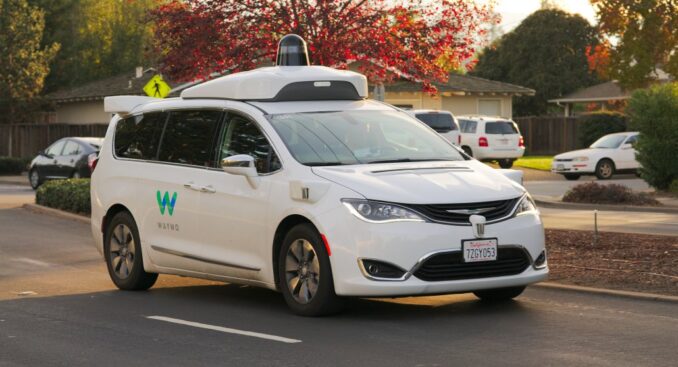
Dearest Postalliers, I bring you a vision of the future from San Francisco: the Waymo autonomous taxi.
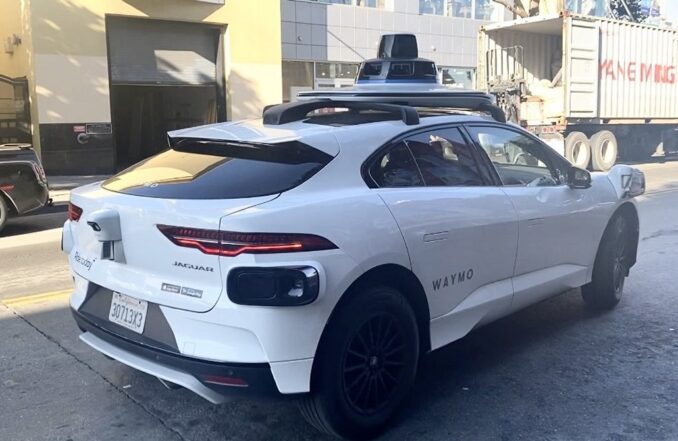
If you haven’t already heard of them, Waymo is the driverless taxi service in San Francisco set up by Google’s parent company Alphabet. The cars themselves are all modified Jaguar i-Pace models with an array of radar and optical sensors added to the bodywork to act in place of the eyes and ears of the absent driver.
As I was in SF for a big conference, I couldn’t resist having a go in one of them as a ‘test drive’ on your behalf. Beforehand I imagined that it would be a terrifying experience, putting your life into the hands of an invisible AI entity in the busy, steep, up-and-down Streets of San Francisco! Here’s how I got on.
First you need to download the Waymo app, which is very like the standard Uber app, put in your details and link a credit card for payment. Just set your destination, this time Fisherman’s Wharf with a pick-up from my hotel, and the app told me that my Waymo would be here in 2 minutes. Exactly on time it arrived and as I walked to the vehicle it activated my app controls.
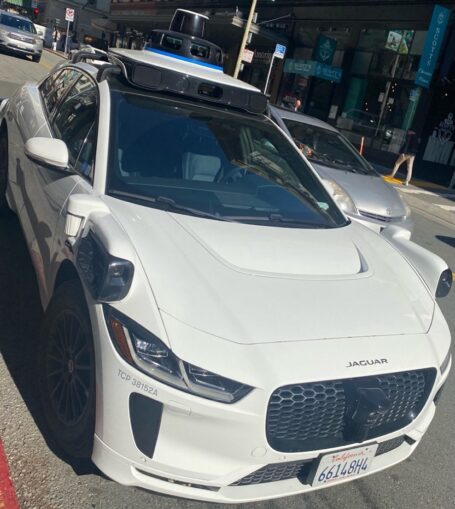
The car knows when you are stood close to it and an “Open Door” button pops up on the app. Pressing it unlocks the doors and you can choose to sit in the back or the front passenger seat – definitely NOT the driver’s seat! Even if it was allowed, that would be just too weird.
There is a big screen between the front seats with easy instructions, so when you are bucked up a big blue “Start Ride: button appears: just tap it and you’re away!
As a newbie, I sat in the back, and the first 30 seconds of the journey were wild, as we pull away and turn the first corner in traffic, but after that I quickly forgot that there was no driver. The ride was incredibly smooth, the car is very comfortable, and you can preset your favourite music to play and the temperature of the car on the app before it arrives to pick you up. If you need to, there’s also a button to let you speak to a human.
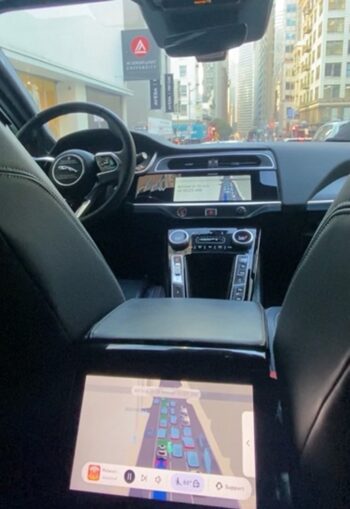
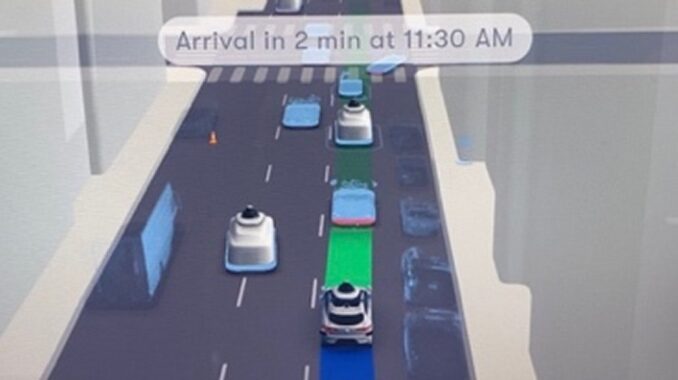
Once we were under way, the screen shows what the Waymo is “seeing” around it with info for you about the journey and arrival time. Each Waymo sees all the other Waymos and they interact with each other in real time. On the screen other ‘dumb’ vehicles that are moving show up as pale blue blobs, while the Waymos look a bit like white ‘french fancies’ with a black smartie on top. Parked cars are shown but ghosted out. The clear road is shown in green in front of the car, and behind in dark blue. Because they see each other, one will change lanes to let another one pull out!
The arrival at Fisherman’s Wharf was just as smooth as the departure, with the Waymo finding a safe parking spot to pull up, then checking for pedestrians on the sidewalk before unlocking the doors.
I have to say the journey was completely comfortable and safe, partly because the Waymos are limited to a cautious 20 mph and behave very courteously in the presence of pedestrians or cyclists. A much more pleasant experience than your typical big city taxi ride.
The only point in the journey where a human might have driven differently was when a vehicle in front was reverse parking into a space in front of us. The Waymo initially decided to overtake, but as the front of the parking car swung out to reverse, the Waymo stopped dead on the wrong side of the road with other cars heading for us. I think a human would have waited for the reversing manoeuvre to complete. I suppose there is an AI somewhere learning from all this to adapt the algorithm for next time.
It must also help the technology that most of the roads in SF follow a very regular grid system with a lot of one way streets. That must be so much easier to map and navigate than a typical English town or village. Of course you also need to be in a country with cheap and plentiful electricity made from oil and gas: are you listening mad Ed?
The journey was around $15, more or less exactly the same as the equivalent Uber trip, but there is no driver to tip, so that makes it about 10-20% cheaper depending on how tight you are with your tipping!
Another big advantage of a Waymo is that you don’t get a scruffy Chinese driver swerving around like a maniac whilst coughing up phlegm in a scruffy car that looks like he’s been living in it for a few years. Also imagine how many illegals can be sent home when no-one needs a taxi driver anymore…..hmmm.
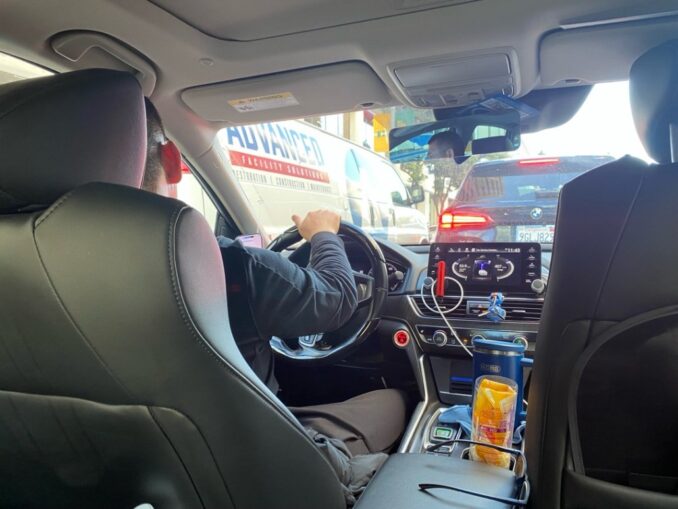
You will see from the pictures that the scanning technology mounted on the Waymo looks very clunky and, frankly, ugly. It must have cost a fortune to develop and install, but it will inevitably get miniaturised and more easily adapted as the technology develops.
Surely the designs will also adapt quickly – like why does it need a steering wheel and a driving seat at all, or be so ugly? They also need to be able to survive a comms outage, so they don’t just stop in the middle of the road, like what happened a few weeks ago in SF, but can find a safe place to pull in.
There are a lot more developments and cost savings in the pipeline I’m sure. Maybe the next big step will be to have cars able to switch between self-drive mode and autonomous when you arrive in certain cities where the mapping and technology is in place.
I’m sure that this article will strongly divide opinion, and I’m not a huge fan of electric vehicles at all, having ICE 4x4s at home for the last 30 years. But for me, having experienced it first hand, it seems an inevitable vision of what’s to come. If only they made a diesel version!
© Richard Puller 2026


