
Looting, pillage, theft, billions in disbursements, all on the honour system
We are all Somalis now
In the autumn glare reflecting off the harsh glass façade of the Minneapolis public library, temporary fencing encloses a once-welcoming arc of wooden planters and benches. During business hours there is an edgy assortment of dazed, hunched-over, or mumbling manifestations of Minnesota’s social wreckage fogging the sidewalk between the library and this little park. Either the fear or reality of their behaviour has seemingly denied the broader public of the opportunity to use it.
The library itself, a César Pelli-designed modernist ice cube that opened with great fanfare in the faraway year of 2006, is equally a relic, a monument to the bygone days when Minnesotans could read. “Minnesota nice, Mississippi smarter” goes a billboard around the corner on Washington Avenue in the heart of the yuppified postindustrial North Loop, the work of a local education-focused nonprofit. Only half of Minnesota schoolchildren now read at grade-level.
Symptoms of the state’s catastrophic decline, which is centred in but hardly confined to the Twin Cities, are impossible to avoid. Some have a poignant Minnesotan cast: “Need assistance walking to your car?” ask seasick-green notices plastered onto the trashcans in the deadness of central Saint Paul. “Call or text the downtown ambassadors.” The posters helpfully include a QR code to summon these benevolent neighbours, who are kind enough to assist in warding off lurking danger, yet strangely incapable of equipping a police department that can keep the business district of the state capital safe.
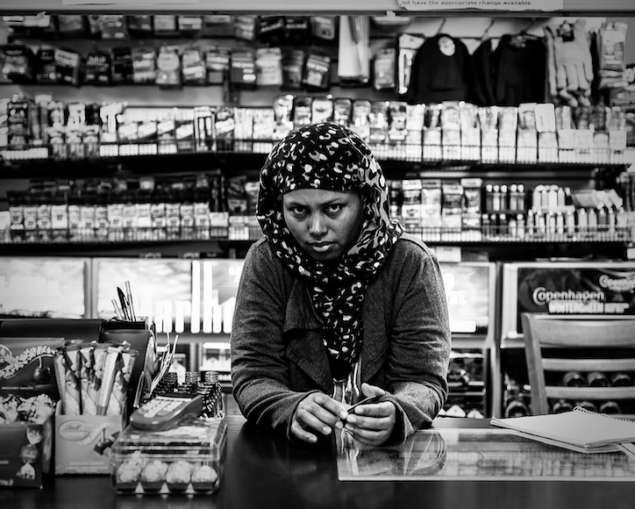
Minneapolis Convenience Store Counter,
Greg Parish – Licence CC BY-SA 2.0
Over in Minneapolis the headquarters of the third police precinct, which rioters gutted shortly after George Floyd’s killing outside a corner store in the summer of 2020, remain a burnt husk over five years later, though the City Council recently authorised a plan to turn it into a “democracy centre,” whatever that means. Minneapolis had 58 percent more murders in 2024 than it had in 2019, and both assaults and vehicle thefts remain high above pre-Floyd levels. The state itself lurched from rude financial health to impending brokenness. In 2023, Minnesota’s state government foresaw a $17.5 billion budget surplus for the next biennium; current forecasts instead show a $6 billion deficit by the end of the decade. Budgetary matters seem trivial compared to the June murders of state representative and former House speaker Melissa Hortman and her husband, alleged victims of a globe-trotting 57-year-old Christian supremacist and ex-missionary whose bizarre history included a long stint in central Africa and appointments to the Minnesota Governor’s Workforce Development Board under Democratic governors Mark Dayton and Tim Walz.
How did so much get so terrible so rapidly? One simultaneous cause and consequence of the Minnesota swoon is outright fraud, the rotten fruit of a partnership between some of the state’s leading politicians and sectarian interests that understand not as a society’s shared instrument to address its problems, but as a storehouse to pillage.
Attorney general Keith Ellison, a Democrat, is Minnesota’s highest law enforcement officer. In December of 2021, business leaders in the Twin Cities Somali community met with Ellison in his office in Saint Paul. Bill Glahn, a fellow at the conservative Twin Cities-based Center of the American Experiment and the former deputy commissioner of commerce for Republican governor Tim Pawlenty, obtained and published a recording of the meeting earlier this year. Its contents reveal how different the actual workings of Minnesota’s government are from what the citizens of any fair and generous and functioning society would probably like to believe.
Ellison’s guests were concerned that government monies for a Minneapolis nonprofit called Feeding Our Future (FOF) might be in jeopardy. In late 2020, the nonprofit had sued the state, claiming the Minnesota Department of Education had been discriminatory in delaying and in many cases denying funding to a Somali-run group affiliated with FOF. Organisations working through FOF claimed to be providing tens of thousands of meals a day as part of a federally funded but state-administered COVID-era food-relief programme. With even a little investigative initiative, Ellison’s office could easily have proven that Feeding Our Future was a $250 million fraud against taxpayers. Many of the nonprofits collecting state reimbursements under the FOF umbrella simply didn’t exist, and even those with some basis in physical reality invoiced the state for implausible numbers of meals. By December of 2021, Feeding Our Future had actually won its case in state court, with a judge determining several months earlier that the state had no basis to impede the flow of money to the group. But the ruling didn’t actually require the state to resume all payments. In December, Somali groups and FOF still complained that funding wasn’t coming in quickly enough.
In the meeting with Ellison were Salim Said, co-owner of the Safari Restaurant in south Minneapolis, and Ikram Mohamed, a consultant for Feeding Our Future. Both eventually faced federal indictments for their alleged role in the scam. (Said has been convicted on 21 counts of fraud, while Ikram is awaiting trial.) Ellison assured his guests that the money would continue flowing through FOF. It was the state government, which Ellison in theory represented, that would soon be on the defensive, the attorney general told them. “[Governor Tim] Walz agrees with me that this piddly, stupid stuff running small people out of business is terrible,” said Ellison. “Let’s go fight these people,” he declared, “these people” being rightfully cautious state officials. Ellison suggested that Salim “send the names of all these people who are hanging on by a thread” — the Somali businesses and nonprofits that existed at the public’s expense, many of them through fraud — so that he could personally needle senior bureaucrats into restoring their funding.
Ellison might not have extended such generosity out of pure nobility of spirit. Nine days after the meeting, Ellison’s reelection campaign received four donations at the legal maximum of $2,500, one of which came from Ikram’s brother, who also became a Feeding Our Future defendant. Salim Said made a $2,500 donation to the campaign of Jeremiah Ellison, Keith Ellison’s son, then a Minneapolis city councilman. In total, Glahn found that Ellison received $15,000 from FOF-linked donors. At the time, the state remained happily oblivious to the Feeding Our Future scam, which only broke open when FBI agents executed scores of simultaneous search warrants in January of 2022.
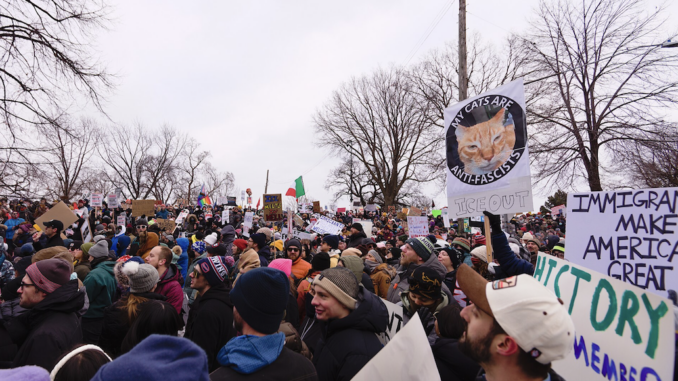
Protest against ICE in Minneapolis,
Fibonacci Blue – Licence CC BY-SA 4.0
Ellison’s job is to be the top legal advocate for the government and the people of Minnesota. On the recording, “he’s sitting with people who were suing his clients, the state agencies, and talking about how he’s going to fight his own client,” Republican state representative Walter Hudson, a member of the House of Representatives’ Fraud Prevention and State Agency Oversight Committee, explained when I met him at the Capitol in Saint Paul. Ellison, he said, “was downplaying very clear evidence of massive amounts of fraud in order to gain political patronage from the Somali community, at minimum. Now, from there, you can speculate all sorts of things.”
***
Being a place where the Democratic-Farmer-Labor Party (DFL) has won every election for statewide office since 2006, Minnesota is awash in public service swindles of humbling vastness. Feeding Our Future is merely an average-sized 21st-century Minnesotan fraud. Minnesota was the first state to offer housing stabilisation services for the homeless and transient through Medicaid, a programme that the state originally projected to cost $2.6 million a year. It has instead cost $310 million since 2020, with the first federal indictments of alleged Medicaid housing scammers coming down in September. “They can hardly find anyone who provided bona fide services under this programme,” Glahn said to me over the phone.
A whistleblower in Minnesota’s Department of Human Services claimed that one in five autism centres in the state are currently under investigation for allegedly fraudulent activity. The people who run these centres do not have to be licensed, and there is no standard for determining the recipients’ eligibility to receive whatever services the centres claim to provide. Unsurprisingly, given the overall lack of fixed standards or accountability, the bill for the state’s Medicaid-assisted autism-services programme has ballooned from $6 million in payouts in 2018 to $192 million in 2023, a time in which the state went from having fewer than 50 autism service providers to over 300. The first federal indictment related to Minnesota autism graft came this past September. Perhaps relatedly, the state isn’t sure where over $200 million of $500 million from a programme aimed at compensating frontline workers for their service during the COVID pandemic actually went. “Our state is far and away the leader in fraud now and everyone sees it,” acting US Attorney Joseph Thompson told the editorial board of the Minnesota Star Tribune in 2023.
The costs of the Minnesotan frauds go beyond bushels of wasted taxpayer money. “The most marginalised are going to be the most impacted,” Latonya Reeves, a member of the Democratic National Committee who is also the president of the Hennepin County parole officers’ union and a prominent activist in the Minneapolis DFL, told me when we met in the city’s downtown. “The people that really need these services are not going to get them because a few took advantage of the system.”
In discussions of the Minnesota frauds, everyone tries not to be too explicit about who these “few” people are, although Reeves at least hinted at the underlying sensitivities in any discussion of wrongdoing located in the state’s Somali community: “To me, it’s not racist and discriminatory to ask where taxpayer dollars are going.”
If one chooses to inhabit a fact-based world, it is impossible to ignore that the most thoroughly proven frauds, the ones that have dollar amounts and dozens of federal prosecutions attached to them, involve the distribution of social services through organisations serving Somali-Americans. All of the people indicted over alleged housing-stabilisation and autism fraud, and all but two of the 73 Feeding Our Future defendants, are Somali. Statewide, Somali children are seven times likelier than their non-Somali counterparts to receive autism treatment, suggesting that Somalis either have far better access to a specialised medical service than the average Minnesotan, or that Somali operators are illegally billing a large volume of phantom services to the state.
Still, explanations that attempt to pin blame solely on the nauseating corruption of Minnesota state government, the one-party rule of the DFL, the malfeasance of specific politicians, or the local Somalis all fail to fully capture how deep, how broad, or how far back the mass immolation of the people’s money goes. Picking on the Somalis tends to obscure as much as it reveals. American urban history is a grand pageant of ethnic mafias: For the newly arrived immigrant underclass, community-wide criminal activity has always been an engine of wealth, social cohesion, and protection amid the exclusions of an unfamiliar and sometimes hostile society. The Somalis are following a trail that Irish Catholics, Italians, and Jews all blazed. And what’s more American than fraud?
Such a neat accounting of our country’s rich criminal heritage is only reassuring if mass wrongdoing can, when squinted at retrospectively, look like a contribution to an inevitably successful national experiment in figuring out how to live together. In this hopeful interpretation, the criminals’ children always go straight, so straight that their forefathers’ feloniousness becomes a tragically necessary step in that uniquely American process through which belief in a civic ideal comes to triumph over the older, more atavistic connections of chauvinism, omertà, and tribe.
Alas, no compelling theory of the common good appears to be in operation these days in Minnesota. What’s replaced any firm notion of civic life is the unspoken hope that the mountains of free money that the tribunes of the DFL dole out to their tribal clients might make everyone ignore how bleakly incoherent things have gotten — at least until the bill comes due.
***
The first serious rumblings of public-service fraud within the Twin Cities Somali community came almost twenty years ago, when officials at the US attorney’s office in Minneapolis began receiving reports that Somali-owned medical-transportation and translation companies were systematically overbilling Medicaid-funded state programmes. However, the reports were too vague and the amounts too small to justify a full-on federal prosecution. More importantly, as the government learned from its 2015 case against a Twin Cities cell of Somali Islamic State recruits — products of the largest ISIS conspiracy ever uncovered on US soil — it was a difficult and time-consuming process to get area Somalis to cooperate with federal prosecutors even on matters of national security. Going after a few mid-ticket scammers for what amounted to peanuts hardly seemed like a way to build trust.
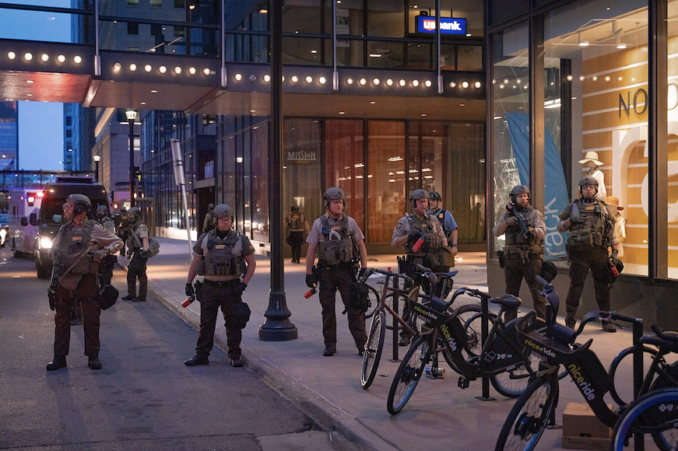
Minneapolis downtown riot in August 2020,
Chad Davies – Licence CC BY-SA 2.0
The Twin Cities Somalis, who number somewhere around 60,000, are largely a refugee population that arrived during and after the 1991 collapse of their homeland into tribal warfare, foreign military adventurism (including the well-meaning and clueless American variety), and jihadist mania. The community is the result not of a voluntary movement of ambitious people seeking a new life in America, but of the US-government’s mass resettlement of entire families at once, including those who served the American-allied regime of military dictator Siad Barre, overthrown in 1991. Minneapolis congresswoman Ilhan Omar, the world’s most famous Somali, is the daughter of a former senior officer in Barre’s army.
The Somalis brought the language, culture, and complex clan system of their shattered homeland to Minnesota, a frigid oasis of high social trust then overwhelmingly white and Christian, and thus the social and geographic opposite of a place they’d never planned on leaving. In Minneapolis, former regime henchmen like Omar’s father lived alongside Barre’s recent victims in apparent peace. But the cultural forces that allowed Somalis to resume a version of their prior lives also had the effect of walling them off from other Minnesotans.
“The historic Somali society is a kind of Janus-faced society,” explained Ahmed Samatar, a political scientist at Macalister College in Saint Paul and the founding editor-in-chief of Bildhaan: An International Journal of Somali Studies at his skylit campus office. “On one side there is the intimacy of the local community, the family subgroup and kin group. Here there is mutuality and responsibility and respect, and certain traditional laws… But the civic culture was not part of that tradition.” After Somalia won its independence from British rule and United Nations trusteeship in 1960, it became necessary among Somalis “to extend yourself and become a citizen of a country where you don’t know everybody,” Samatar detailed. That country lasted only 30 years, less than half a lifetime. A culture of “civic virtue,” Samatar said, “died with the Somali state” in 1991. For a large number of refugees, American notions of civic virtue were never strong enough to displace the old country’s cynical and disenchanted attitude towards the public commons, a concept which enjoyed only a brief and troubled existence in Somalia before its long, violent plunge.
“There is a mentality, therefore, that comes here,” Samatar continued, “which is: Grab what you can now because the world has almost ended for you. It is a new beginning. Grab it now, rather than banking on the possibility that mutual trust will be a way of creating a new life for yourself and your family and the future.”
In the Western imagination, civic trust is something both natural and infinite — the product of a virtuous feedback loop, with acts in service of the common good creating bonds of cooperation and interdependence that produce additional acts in kind. Minnesota is so trusting that there are no turnstiles to enter the Twin Cities light rail, which now has prominently posted codes of conduct that gently remind riders that it is illegal to poop on the trains or in the stations. Somalis — like the vast majority of people on earth, who do not live in prosperous or stable democracies — tend to have the hard-earned attitude that trust is a limited commodity, something to be jealously guarded and reserved only for the tiny sliver of the human race with whom they share some organic, non-externally constructed bond. Compared to the clan, or Somali culture, or Islam, the state is something meaningless or temporary, or at best instrumentally useful.
Mutual trust hadn’t worked in Somalia, and hadn’t even really been tried. A large enough number of Twin Cities Somalis continued to believe it wasn’t worth trying out in Minnesota, either. The weak belief in a shared public sphere motivated the Somalis of the Twin Cities to create an enclave during an era in which cultural distinctiveness and even cultural separatism became one of America’s leading liberal values. In tolerant Minnesota, respect for the war-battered Somali newcomers meant offering them help while also leaving them alone.

Karmel Square – Somali Mall,,
Tony Webster – Licence CC BY-SA 2.0
The Karmel Mall of Somalia is multiculturalism in its most thoroughly realised form, the manifestation of the idea that true diversity lies in giving minority communities the assistance and protection needed for them to achieve their own separate destinies outside of what Americans had once widely understood to be their common culture. Here, in a cruise-ship-like high-rise on the west end of Lake Street, Minneapolis’s immigrant downtown, the Somalis of the Twin Cities shop for incense, cologne, jewellery, traditional clothing, and spices from the other side of the planet in a mostly windowless simulation of the best markets of Mogadishu, or of the heavily Somali Eastleigh neighbourhood of Nairobi.
On the complex’s upper levels, Somalis can find Somali-speaking lawyers, tax preparers, and religious teachers for their children, as well as a handsome stained-glass-panelled mosque with the rows on its green-and-white carpeting angling towards Mecca. At prayer time, the adhan echoes through the mall and its parking garage, as engorged with late-model SUVs as any other midwestern shopping center. Numerous storefronts offer to send money abroad by way of East African cash exchanges. Spicy and milky Somali tea, among the most soothing yet complex of the world’s national teas, is on offer in diverse regional forms. One travel agency has clocks showing the local times in Amsterdam, Mogadishu, and Hyderabad — the fourth-largest city in India. “All Africans go to India for medical care,” explained Jama, a community activist who guided me around the complex. “It’s cheap.”
The colorful and fragrant stacks of merchandise at the Karmel Mall re-create faraway places, only fleetingly acknowledging the surrounding culture. In the food court, where Al Jazeera English plays on a lone TV, you can eat halal cheesesteaks and halal quesadillas — Zaki’s Chicken and Waffles also serves goat, a Somali staple. The only non-Somalis a visitor is likely to see are security guards in ersatz police uniforms, handcuffs clipped to tactical vests with empty bodycam emplacements and the words “Sabri Properties” stitched on the back.
Sabri, a Palestinian-American developer, is currently being sued by Fannie Mae for failing to make over $530,000 in required repairs on two Minneapolis residential buildings he owns. Many Twin Cities Somalis yearn for the construction of a new mall, and the liberation of a major communal nexus from its non-Somali owner. “He started as a slumlord, and now he has all this,” Jama said, speaking wistfully of Sabri’s achievements. “It’s the American dream, man.”
© Armin Rosen 2026
Armim Rosen is an independent journalist, published in County Highway, and presented here through A.W. Kamau.