G-P correspondent AW Kamau responds to Armin Rosen’s Minneapolis dispatches, noting the Kenya connection.
Local Kenya taxi driver seeking asylum in Canada used a Kenya broker (Kalenjin, same tribe as Ruto) witnessed numerous Somalis at same broker. The broker’s location is a small 1st floor office (no name on building, no number) in Parklands Road, just past Parklands Police station.
As of 2023 (just after the election here), taxi driver paid Ksh 400,000 circa (US$2,500 at the rate then) covering “agency fees, ticket etc” then with the intent of claiming asylum in Canada which he eventually did.
He asked about the large number of Somalis, his “broker” confirmed Somalis preferred US to Canada, the prime area being Minnesota. Their “fees” back then were Ksh 800,000 (US$5,000 – then rate) which included Kenyan passport (hence the close proximity to Kenya Police Station), all payments in cash (no Mpesa).
The Kenya lad didn’t push the issue of Kenya passport. Being close to Parklands police, the Govt would have definitely been involved in the process smoothing immigration, passport and no checks. This coincided with Biden seeking migrants that would vote for him in exchange for “favours” aka the Somali money laundering Feed Our Future scam during Convid.
Now the Don’s pulled the pin, the core issue is when they deported, where do they go? If it hits the newswires in Kenya, it will explode in Ruto’s face and across Kenya. Not by coincidence, in early 2025 Ruto opened a passport office in Garissa (NE Kenya).
Furthermore c/o Ruto’s own website, he subsequently cancelled all vetting.
Post the Don’s election and his exposing of the Democrats scam (Minnesota, Ohio, Seattle, Washington, New York – with more to be unravelled), Ruto shifted to Plan B to get illegals back into Kenya. With the demise of Raila Odinga and therein no “controlled opposition in Kenya”, the intention is to create the same agenda as happened in US and is still ongoing in UK (which you know about) in getting illegals voting for Ruto.
The Don wanting his money back, will eventually (it’s in process) strong arm Ruto, as US Govt know returning Somalis claiming to be Somali Kenyans of Somali descent cannot return here.
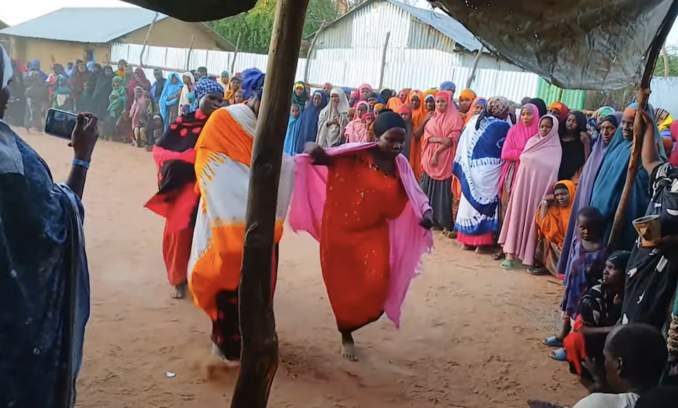
Somali Bantu dancing in the Kenya Dagahley Refugee Camp,
Studio Ali Adan – Licence CC BY-SA 4.0
While US federal prosecutors work their way through what has become the largest Covid 19 and voter fraud, its crystal clear the money trail so far uncovered leads indelibly to Kenya and Kenyan authorities from President down are unable to stop it due to local vested interests around the next Kenya election and beyond. Post the 2020 US election, the scale of fraud has rocketed.
The high end in financial terms obviously points directly to the Kenya real estate market (and elsewhere) together with high value assets. Known here (and there will be more uncovered), properties in Nairobi’s Kilimani, Kileleshwa, Lavington, Karen, Eastleigh, South B, South C (Nairobi), Diani beach resort, land parcels in Mandera and investing in Kenyan real estate companies, all cash payments via shell companies.
Mandera is also a key area with investment (cash / hawala) in remote border areas while simultaneously acquiring high end Nairobi properties (already constructed or built) achieves geographical diversification, asset concealment and political protection.
The Gray List Warning
Kenya’s inclusion on the Financial Action Task Force (FATF) Gray list for money laundering deficiencies is no coincidence. The designation, which places Kenya under increased monitoring, reflects ongoing failure in combatting financial crimes, given the high end of the political structure are likely to be involved.
Real estate is the primary vehicle for money laundering in Kenya. Back channel payments to the highest level of Governments also provides a veneer of protection. With property transactions conducted in cash provides anonymity and “legitimacy”. Aka a laundered US$ becomes a concrete apartment, dirty money becomes a title deed.
Kenya’s boom in traditionally expensive neighbourhoods and new construction is being artificially inflated by illicit capital flows. Wage earning Kenyans then find themselves priced out of market where foreign fraud proceeds compete with legitimate local earnings.
The ID, passport fraud while not on the scale of real estate, provided a further back channel for further influx in US immigration within existing clan structures.
Despite current and presumably with more arrests, mounting evidence and international “cooperation” between Kenya and US law enforcement, prosecutions in Kenya remain non existent. Aka no parallel investigation in Kenya? Local prosecutions for money laundering? Why haven’t shell companies been identified and dismantled?
All fingers point back to the Presidency and government organs established to pursue all cases. Either institutional failure or institutional complicity; Kenya’s anti money laundering framework exists on paper and remains toothless in practice.
The Asset Recovery Agency, the Financial Reporting Centre, the Ethics and Anti-Corruption Commission all have the mandate and legal authority to investigate the cartel networks, as with the Presidency, are mute.
One of the defendants in the FOF fraud case, Ahmednaji Maalim Aftin Sheikh (claiming to be a Kenyan national of Somali descent) who it is understood entered the US diversity Visa lottery (whatever that means) in November 2024 as a refugee, after his brother had already been arrested, charged and convicted of 20+ federal crimes.
Sheikh had even married his brother’s sister-in-law in Nairobi in 2021, with her later attempting to sponsor his US residency. This does suggest at the bare minimum the confidence that Kenyan authorities posed no threat to their operation.
The clear pattern that needs to be addressed, the overwhelming majority of defendants in your fraud cases all share (and claim) to be Kenyan nationals of Somali descent, simply exploiting diaspora connections as an established criminal network, coordinating operations. Hence, while at lower end of the financial ladder, the passport route via broker(s?) in cahoots with Kenyan Government. Therein, the ethnic dimension can’t be dismissed, nor weaponised aka Ilhan Omar as discrimination.
What appears to be clear is a methodology utilising / exploiting trusted diaspora networks, kinship ties and cross border mobility. The obvious conduit being Dadaab.
Not aired at any Government level in Kenya are the broader potential implications regarding Kenyan’s sovereignty. Kenyans can’t compete with laundered millions, legitimate businesses confront crime funded enterprises and undue competition. Further the clear reality in Kenya is illicit wealth without doubt buys political influence, especially in NE Kenya and the coast, as well as protection.
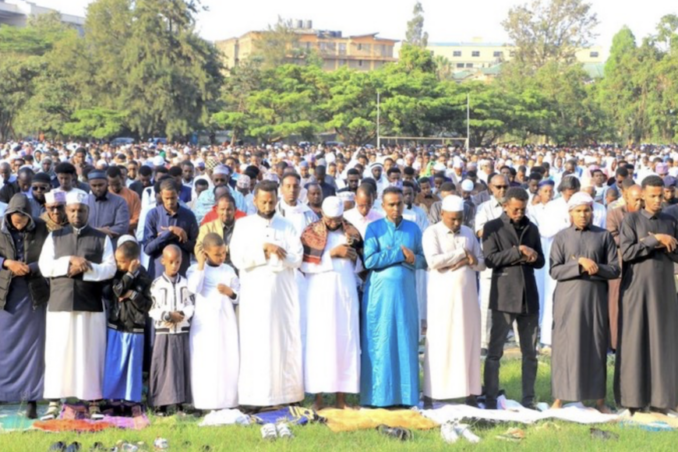
Somalis in Nairobi for Eid al-Adha prayers,
Daljir – Licence CC BY-SA 3.0
In essence the cartels are indelibly linked in with the Kenya Government at all levels and if not removed, will likely have a key role in the next Kenyan election offering votes for Ruto and his surrounding coterie.
If, or once the word gets out in the global financial markets that Kenya is known as a laundering / washing machine haven will hit legitimate foreign direct investment. This raises the issue your end, when federal agencies pursue financial crimes across the board which Kenyan authorities ignore, raises the key issue of who really controls Kenya’s financial system?
What’s obvious to Kenyans here but ignored by the government, addressing this requires full US government (Presidential?) pressure and political will on the Kenya government, not additional legislation.
From the local network feedback here, moving forward actions as a starting point:
- Immediate asset freezes on properties, land parcels, assets for all individuals currently named in US indictments, that can be widened as and when more is uncovered which is likely given other States have already opened the pandoras box in Ohio, Seattle, Washington.
- Starting parallel prosecutions in Kenya for all those named in US indictments, including their cogent network links in Kenya.
- Open beneficial ownership registries that provide full open public disclosure in Kenya of property ownership claims.
- Cash transaction limits in real estate with mandatory bank channels for large “purchases”.
- Full international cooperation including asset sharing agreements with US authorities
- US political pressure / direct US entities directing / assisting Kenya’s Director of Public Prosecutions, Asset Recovery Agency and Financial Reporting Centre with transparent (live broadcast?) response aka Truth and Reconciliation approach.
Given evidence already compiled with US prosecutors have already done the heavy lifting, with active guidance and on the ground support, Kenya will then act.
With evidence already uncovered Stateside, there is a well established Somali led cartel with complicit support (direct and indirect) from Kenyan authorities across the board, in order for Kenyan authorities from the President down through all government instruments, with US government pressure to confront what the rest of the world can clearly see.
One key challenge facing the US Government is the limitations of US power when assets are held overseas. In this instance real estate holdings outside the US are beyond the reach of US law enforcement, cannot be seized or forfeited. What started in Minnesota exposes gaps in international asset recovery frameworks with assets, properties etc. bought in Kenya remain untouchable without extensive bilateral cooperation and enforced legal proceedings in Kenya courts.
It’s not just Kenya, the “money web” also includes Somalia obviously as well as China, Djibouti, Somaliland, Turkey. Local feedback here surrounds Taaj Money Transfer which I’m told is / was operating in Minneapolis without known outlets in Kenya, Somalia, Djibouti and elsewhere.
While Taaj is as far as I can determine isn’t involved in the direct involvement in the FOF gig, it’s highly likely to be involved in the disappearance of US$ etc. into the hawala network and thereafter into al Shabaab and elsewhere in Somalia outside of traditional banking channels.
In Kenya, whilst yet to be validated (complete lack of financial oversight in Kenya money service sector), Taaj Money Transfer operates two financial systems in Nairobi. One system is visible to the central Bank of Kenya, a second hidden system launders large sums through deposits, transfers and off record transactions. Given Kenya’s endemic corruption environment make Kenya a safe zone to operate, in contrast with the US with stricter laws and enforcement.
The Elephant in the Room
Fairly obvious are the money transfer nodes back to al-Shabaab. Well known information from here is Mohamed Mire Jama, who served as al-Shabaab’s finance chief and was responsible for financing the 2013 Westgate Mall and 2019 DusitD2 Complex Attacks, eventually killed in Somalia.
Also well known is that Al-Shabaab funds its operations through imposing taxes, controlling trade routes, and smuggling goods, among other methods. In February 2025, the UN reported that the group’s annual revenue ranges between US$100-US$200 million. Since the Covid fraud began unravelling in the US, Al-Shabaab has proven that they have the ability to diversify their financial tactics.
Charcoal smuggling
Despite having lost important trade centres, al-Shabaab still makes significant amounts of money from smuggling and drug trade. One source of income that is frequently mentioned is Somalia’s charcoal production, which is the reason why the UN has banned the import of Somali charcoal.
Al-Shabaab does not only tax coal bags before they reach harbours for export, forcing drivers to pay bribes on roads controlled by the group, but have been able to export charcoal from the port of Kismayo despite losing it to the Kenyan Defense Forces (KDF) since 2012.
In fact, residents of Kismayo have testified to the KDF’s minimal attempts to quell al-Shabaab’s illegal export of charcoal and do little to provide security in the surrounding areas, insinuating that KDF forces are mainly concerned with operating the port. Testimonies from KDF soldiers have revealed that the KDF even supervise the loading of charcoal onto ships.
According to eyewitness accounts from Kismayo, the charcoal smuggling from the port is the result of an illicit partnership between al-Shabaab, the KDF and the Jubbaland administration of Ahmad Madobe, who was previously a member of the Ras Kamboni militia.
In this partnership, al-Shabaab reportedly controls about 30% of the trade.
The operation was previously overseen by Brigadier General Walter Koipaton, who has risen very fast through the ranks in recent years, demonstrated by his appointment as Deputy Commander of the Kenyan Armed Forces. Koipaton has worked closely with the Kismayo port manager, Abdullahi Dahil Shil, (also known as ‘Hadun’), who was installed in that position by his relative, former Kenyan Defence Minister Yusuf Haji.
Nairobi-based trader Haji Yassin has also been pointed out as an important player in this equation and it’s no coincidence he’s also a Kenya Real Estate Investor at Yasco holdings ltd. Similarly, the Jubbaland Centre of Commerce has also been accused of hosting several members who all profit off of this trade.
This suggests that the reason why charcoal is still being shipped out of Somalia, and why al-Shabaab continues to make money off of it despite a UN embargo, is due to the self-interest of KDF and the Jubbaland administration.
The two may gain as much as US$200 million through their combined shares in the charcoal trade. Given the seniority of the KDF personnel involved in this operation, one cannot exclude there is knowledge and direction of this operation in high-level Kenyan cabinet and above positions.
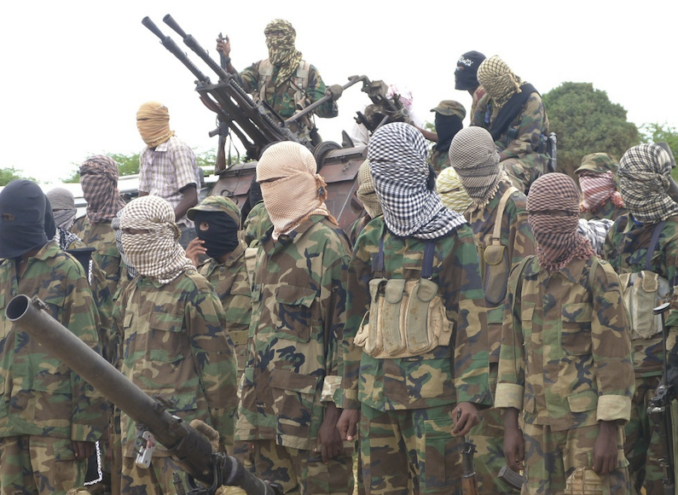
Harakat al-Shabab al-Mujahideen fighters,
Radio al-Andalus – Public domain
Although the amount of money al-Shabaab makes on charcoal’s diminished since 2012, various estimates have shown that al-Shabaab might still make as much as US$15-US$50 million per year on trade. Estimates have even shown that one single road checkpoint can gather as much as US$8 million revenue per year. Despite the UN embargo, businesses in countries like Saudi Arabia and the United Arab Emirates (UAE) have regularly imported the product since.
Sugar trade
A similar routine has been established with the illicit sugar trade between Somalia and Kenya, where sugar smuggling makes up for the failure of domestic suppliers to meet Kenyan demand. About two thirds of all illegal sugar enters Kenya from Somalia. Al-Shabaab plays a big role in this.
The group usually charges drivers passing through roads controlled by the group, and have been said to tax as much as US$1,000 per truck. These trucks then make their way to Garissa in northern Kenya through the Dadaab refugee camp. In 2011, the UN’s Somalia Monitoring Group estimated that al-Shabaab made between US$400,000 and US$800,000 on sugar trade, a sum which the group believes has grown significantly since.
Problematically, there have been indications of Kenyan Army complicity in sugar smuggling too. According to one report, high ranking military officials, KDF commanders and members of the Ministry of Defense are all involved in this smuggling ring, which allegedly receives protection from the highest echelons of Kenyan power.
The sugar smuggled into Kenya usually arrives through the Kismayo, where according to eyewitness accounts the KDF levies US$2 per bag. Apparently, 14 tonnes may leave Kismayo each week, numbers which have been corroborated by sugar traders in Dadaab and Garissa.
The sugar trucks are taxed by al-Shabaab a few kilometres outside Kismayo, which grants them passage through al-Shabaab controlled territory towards Kenya. At the border, drivers usually pay around US$600 to get through.
Truck drivers at the Amuma and Liboi border crossings have attested that payments are made at the border to tip off police and customs. The sugar is then transported to Garissa, where it is stored before being distributed across the country.
UN officials have stated that this procedure is well known by people in President William Ruto’s circle. EU and US officials have also indicated that businessmen Mohammed Hussein and Sheikh Kassim are involved in the illicit sugar trade.
The UN Monitoring Group, which investigates al-Shabaab’s involvement in the illicit sugar trade, has according to a UN official been reluctant to look into the cooperation between al-Shabaab and KDF as they feel that the result of such an investigation would compromise their ability to live and work in Kenya.
It should be mentioned that Kenya has obviously denied these allegations, and has established a so called ‘sugar unit’ within its national intelligence service in order to address the al-Shabaab sugar trade issue.
Remittances and Money Transfers
Aside the Minnesota node, the US State Department years ago identified hawala transfers as one of al-Shabaab’s most lucrative source of income. Besides direct donations from sympathisers abroad, this is also a result of al-Shabaab’s network of informers which enables the group to be aware of hawala transfers being made between parties and consequently demand tax transfer.
It’s estimated that US$1.2 billion is annually sent to Somalia through remittances and hawala transfers. Most remittances are wired through firms based in the Gulf area. One Dahabshiil (the money transfer service that was used by 95% of all NGOs including the UN present in Somalia) employee, South African Abdirizak Mowlana, was arrested in Nairobi for having abused his position to funnel money through to al-Shabaab, although Dahabshiil denied any affiliation with him.
The American branch of Dahabshiil was in 2015 sued by a Somali-American man who claimed that the firm had helped fund the assassination of his mother, Somali singer and politician Saado Ali Warsame. Dahabshiil was one of the 13 money transfer services that were shut down by Kenyan authorities in 2015, but was reopened a few months later due to criticism from the UN and NGOs. The other services were Kendy, UAE Exchange, Amal, Iftin, Kaah Express, Amana, Juba Express, Tawakal, Bakaal, Hodan, Continental and Flex.
Dadaab
Another pool of Somalis that used the UN resettlement scheme to move abroad as witnessed across the US, many over the last decades with Al-Shabaab connections. Recent independent coverage gives a generic overview. Also floated in the link is looking at a pilot program similar to that in Uganda for integrated local settlement providing “refugees” conditional legal status, to live and work beyond the camp.
This would provide a conduit for al-Shabaab players / affiliates to easily gain entry then disappear either within Kenya or elsewhere. The camp whilst not top of the US’ priority list needs to be factored into the matrix.
When (or if) the US recognises Somaliland, closing Dadaab will reduce the incentive for people, informer and money movement both directions. It would certainly reduce attacks such as Garissa University massacre, Dusalit D2, Westgate and US run Manda bay (Camp Simba) airfield.
This would be in US interests given they have placed a US$10 million bounty on Abdullahi Banati, the key al-Shabaab operative behind Garissa and Manda Bay airfield attack who passed through Dadaab. It will also focus the Kenya Government mindset that the old way of business is over.
The Kenya govt at all levels (top to bottom) are mute as are Kenya newswires. Everyone with smartphones here is 100% aware of Nick Shirley’s podcast.
AW Kamau 2026