

Donald Trump speaking at the 2013 CPAC,
Gage Skidmore – Licence CC BY-SA 2.0
A early as 2019, President Donald Trump made headlines by suggesting that the United States should consider buying Greenland from Denmark, a proposal that immediately sparked debate and international attention. While the idea seemed unusual to many, it is part of a long history of U.S. territorial expansion through land purchases. The United States has repeatedly acquired territory to strengthen its economy, security, and global influence. Trump’s proposal, framed as a modern extension of these historic deals, highlights the ongoing American interest in strategically valuable lands, particularly in the Arctic region, which is increasingly important for defence, shipping, and natural resources.
1803 The Louisiana Purchase
The Louisiana Purchase was a landmark event in American history that took place in 1803, when the United States bought a vast territory from France. At the time, President Thomas Jefferson was concerned about American access to the Mississippi River and the port of New Orleans, which were vital for trade, especially for farmers in the western states. When France, under Napoleon Bonaparte, regained control of the Louisiana Territory from Spain, Jefferson feared a powerful European nation could threaten U.S. interests.
Unexpectedly, France offered to sell the entire territory. Napoleon needed money to fund his wars in Europe and had lost interest in maintaining an empire in North America after a slave revolt in Haiti weakened French power. These days, we think of Louisiana as being the Pelican state sat at the mouth of the Mississippi, but in those days the name territory covered avast area. For $15 million, the United States acquired approximately 828,000 square miles of land strecching from the modern day gulf of America tom beyond the modern day Canadian border, effectively doubling the nation’s size.
Although Jefferson worried that the purchase might be unconstitutional, the Senate approved the treaty. The Louisiana Purchase had enormous consequences: it expanded American territory westward, strengthened national security, encouraged settlement and economic growth, and set the stage for the United States to become a continental power. It remains one of the most important and cost-effective land deals in history.
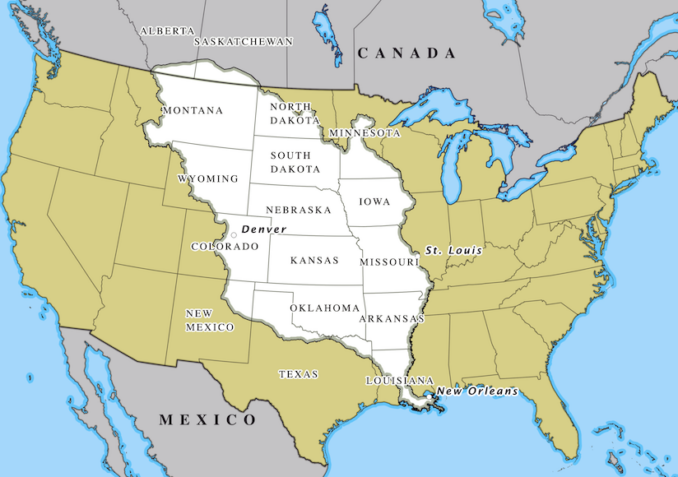
The Louisiana Purchase,
William Morris – Licence CC BY-SA 4.0
1819 Florida
In the first quater of the 19th century the United States acquired several important territories from Spain through negotiation and diplomacy, reflecting its growing power and desire to expand westward and southward. The most significant transfer of land from Spain to the United States was Florida, which Spain ceded in 1819 through the Adams–Onís Treaty, also known as the Transcontinental Treaty.
By the early 1800s, Spain’s control over Florida had weakened. The region had become a refuge for escaped enslaved people, Native American groups such as the Seminoles, and outlaws, which caused tension with neighbouring U.S. states. American settlers were also moving into the area, and the U.S. military had already conducted raids there under General Andrew Jackson. Spain, facing internal problems and independence movements throughout its empire in Latin America, lacked the resources to govern Florida effectively.
Under the Adams–Onís Treaty, Spain agreed to transfer Florida to the United States. In return, the U.S. assumed responsibility for $5 million in claims made by American citizens against Spain and formally recognised Spain’s borders in Texas, which at the time remained under Spanish (and later Mexican) control. The treaty also clearly defined the boundary between U.S. territory and Spanish lands in the West, stretching to the Pacific Ocean.
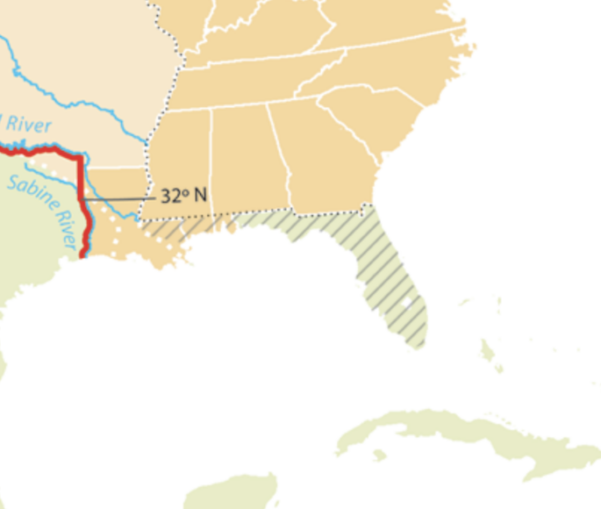
Map showing the results of the Adams-Onís Treaty of 1819,
Citynoise – Licence CC BY-SA 2.5
Although Florida was not purchased outright with cash, the agreement functioned much like a land deal and marked a peaceful expansion of U.S. territory. These acquisitions reflected America’s belief in expansion, later called Manifest Destiny, and helped shape the nation’s borders, influence, and growth during the 19th century.
1848 & 1853 Mexican Cessions
The United States acquired a large portion of its southwestern territory from Mexico in the mid-19th century, primarily as a result of war, diplomacy, and expansionist goals. The most significant transfer occurred after the Mexican–American War, which lasted from 1846 to 1848. Tensions between the two nations grew after the United States annexed Texas in 1845. Mexico had never recognised Texas’s independence and still considered it Mexican territory, leading to disputes over the border.
President James K. Polk strongly supported westward expansion – the Manifest Destiny — the idea that the United States was destined to spread across the North American continent. After fighting broke out along the disputed Texas border, the U.S. declared war on Mexico. American forces eventually occupied key Mexican cities, including Mexico City, putting pressure on Mexico to negotiate.
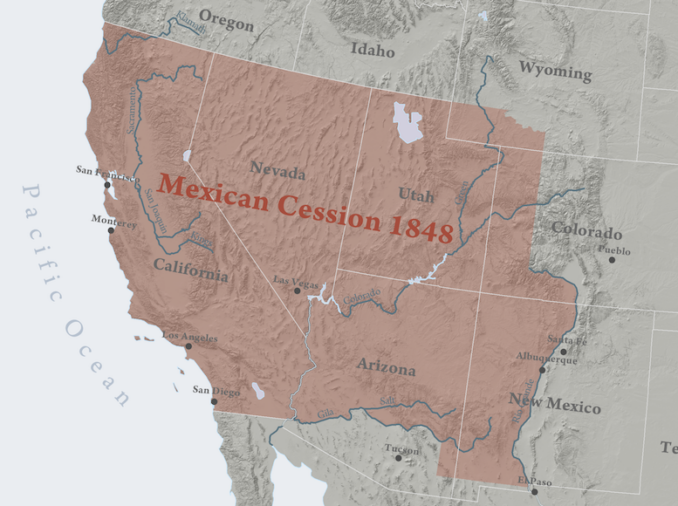
The territories ceded by Mexico to the U.S. in 1848,
Kballen – Licence CC BY-SA 3.0
The conflict ended with the Treaty of Guadalupe Hidalgo in 1848. Under the treaty, Mexico ceded nearly half of its territory to the United States in exchange for $15 million and the U.S. assumption of $3.25 million in claims by American citizens against Mexico. The land acquired included present-day California, Nevada, Utah, most of Arizona and New Mexico, and parts of Colorado and Wyoming. This massive acquisition greatly expanded U.S. territory and gave the nation access to valuable resources, including gold, which was discovered in California shortly after.
In 1853, the United States gained additional land through the Gadsden Purchase, paying Mexico $10 million for a strip of land in southern Arizona and New Mexico. This land was important for building a southern railroad route.
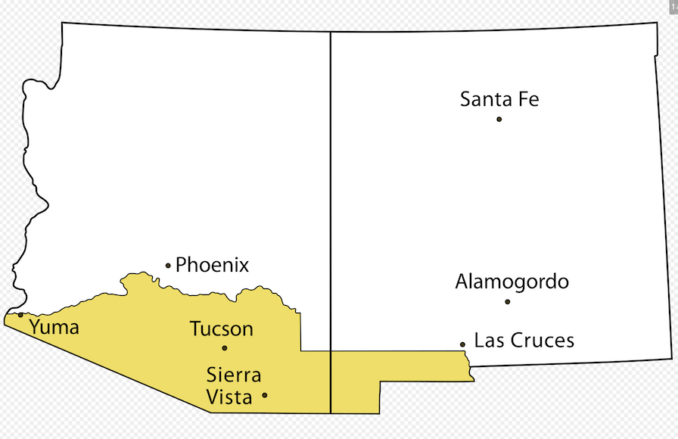
Gadsden Purchase,
PhilFree – Public domain
While these acquisitions strengthened the United States economically and territorially, they also intensified national debates over slavery, displaced Native American populations, and left lasting resentment in Mexico, shaping relations between the two countries for generations.
1867 Alaska
The United States purchased Alaska from Russia in 1867 in a deal that initially puzzled and even angered many Americans but later proved to be extremely valuable. At the time, Russia owned Alaska but found it difficult and expensive to defend and govern the remote territory. Fearing it might lose Alaska to Britain in a future war, Russia decided it would be better to sell the land rather than risk losing it without compensation.
U.S. Secretary of State William H. Seward negotiated the purchase with the Russian government. The United States agreed to pay $7.2 million for approximately 586,000 square miles of land—about two cents per acre. The treaty was signed on March 30, 1867, and approved by the U.S. Senate later that year. However, many Americans criticised the deal, calling it “Seward’s Folly” or “Seward’s Icebox,” believing Alaska was a frozen, useless wasteland.
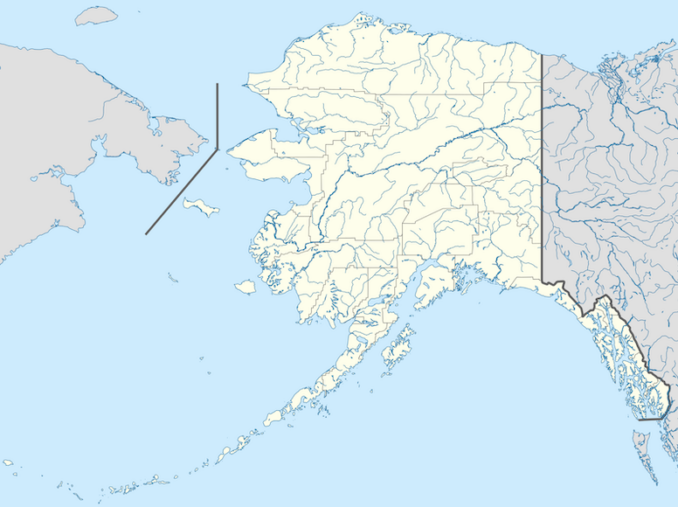
Location map of Alaska, USA,
Alexrk2 – Licence CC BY-SA 3.0
Over time, these criticisms proved wrong. Alaska turned out to be rich in natural resources. In the late 1890s, the Klondike Gold Rush brought thousands of prospectors to the region, highlighting its economic potential. Later discoveries of oil, natural gas, timber, and fish further demonstrated Alaska’s value. The territory also became strategically important, especially during World War II and the Cold War, due to its location near Asia and the Arctic.
Alaska was governed as a U.S. territory for many decades before officially becoming the 49th state on January 3, 1959. Today, Alaska plays a crucial role in U.S. energy production, national defence, and environmental conservation. What was once mocked as a foolish purchase is now widely regarded as one of the smartest land deals in American history, greatly strengthening the nation’s economy and global position.
1822 Liberia
The United States did not purchase Liberia in the same way it bought territories such as Louisiana or Alaska. Instead, Liberia was founded in the early 19th century through the efforts of a private organisation called the American Colonisation Society (ACS), not the U.S. government itself. This distinction is important for understanding Liberia’s origins and its relationship with the United States.
The ACS was formed in 1816 by a group of American politicians, clergy, and slaveholders who believed that formerly enslaved African Americans should be resettled in Africa. Some members opposed slavery, while others hoped to remove free Black people from American society. Beginning in the 1820s, the ACS sent groups of African Americans to the West African coast. To establish settlements, the society negotiated treaties and purchases of land from local African leaders along the coast, using trade goods and payments rather than a single large cash deal.
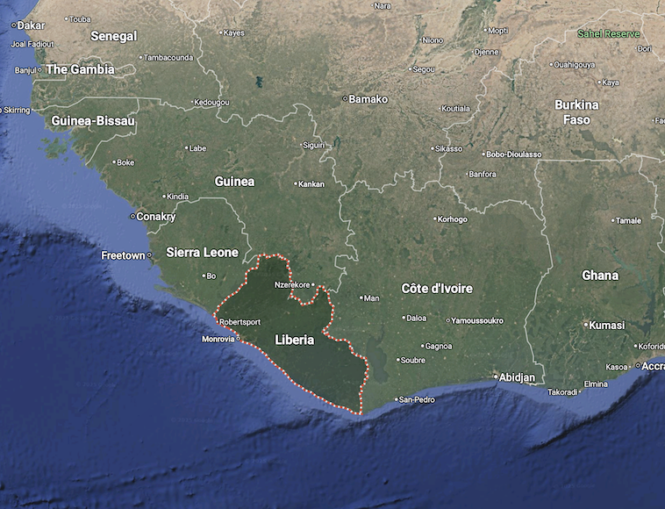
© Google Maps 2026, Google licence
In 1822, the first permanent settlement was established, and over time, the colony expanded. Although the U.S. government supported the effort with funding, naval protection, and political influence, Liberia was never officially a U.S. colony. In 1847, Liberia declared independence and became a republic, making it Africa’s first independent republic. Its government and constitution were heavily modelled on that of the United States.
Americo-Liberians—descendants of the settlers from the United States—dominated Liberia’s political and economic life for more than a century, often marginalising Indigenous peoples. While Liberia maintained close ties with the U.S., including trade and diplomacy, it remained formally independent.
Therefore, rather than being a land purchase by America, Liberia emerged from a colonisation project supported by Americans, shaped by U.S. ideas and influence, but developed as a separate nation with its own complex history and challenges.
And we’ve hardly mentioned Greenland! Next time we will, and, believe it or not, there is a prescedent with a connection to Geoffrey Epstein.
To be continued …
© Always Worth Saying 2026


_(2).jpg)


