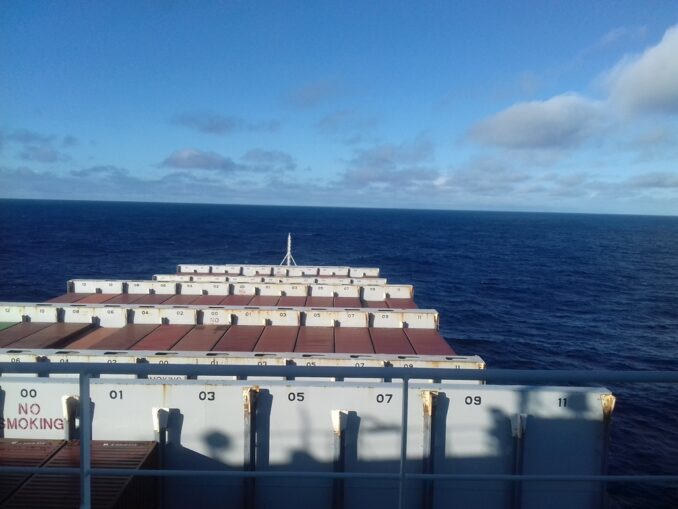
I unpacked my belongings and noticed that outside of my cabin windows was a little orange motor boat that was lowerable down to the water via a crane that swung the thing away from the side of the ship. I observed it lowering into the water full of crew – not good if you don’t have a head for heights as it swung around in the breeze. The crew must have been performing some refresher training and they seemed to take it in turns to be lowered to the water, start the engine, do a few loops of the dock and then get winched back up again. I took a little wander around, and popped my head onto the bridge which was devoid of personnel. I then bumped into an elderly passenger, a German (I didn’t mention the war) who explained that he was also a passenger and had boarded back in Germany and was heading to New York where his wife would meet him, she was travelling by air. Us two were the only passengers on this leg. He offered to show me around the ship which took all of about 10 minutes as other than the top two decks worth of accommodation and offices etc the rest of the ship was cargo space and engine room. Another junior officer found me, “good afternoon Mr Puff, I need to take your passport from you and deliver it to the captain and also show you the route to the lifeboat.’’ As we threaded our way towards the stern of the ship where the thing was located, I noted that we were moving and seemingly heading for the lock that would allow us to pass into the River Mersey. The Lifeboat was one of those things that slid down rails at about a 45 degree angle and then plunged into the water with a huge splash, I imagined that it would be a fun ride but if being used in anger then probably not something to dwell on too much. There was a tug at the rear of the ship that was fastened on with a rope which went very tight very quickly and made alarming creaking sounds, the officer yelled at me to get out of the way but he need not have done so for I was already clearing off PDQ, these ropes can kill you with the recoil if they snap. That was my first experience of life at sea that regular cruise ship passengers never experience. The officer also suggested that it was unwise to move around the cargo areas when at sea and that the lifts on the ship had a tendency to jam within the shafts if the ship was flexing in heavy seas so suggested the stairs as the best option.
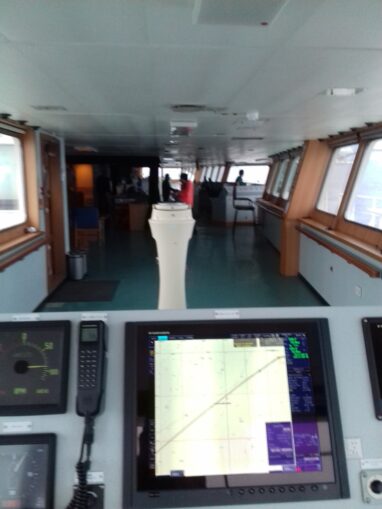
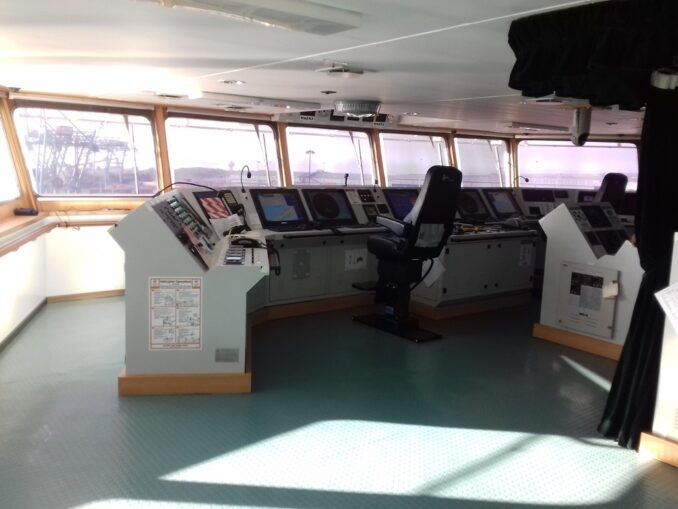
We returned to the bridge that was now crewed up and I noted the Mersey Pilot was onboard and chatting to the Captain while we waited for the outer lock gates to open. Two other officers and a seaman were also on the bridge. It was a lovely October evening with calm conditions and a blue sky. A tray full of food arrived for the Pilot which I thought was a nice gesture and the seaman chap made fresh coffees for us all. Eventually the outer lock gates opened and the engine telegraph was set to dead slow ahead and very slowly, inch by inch, we slid out into the Mersey. Once clear of the lock the rudder was put hard over to starboard and a tug at the rear gave us some extra pull to get the stern around and the bow pointing towards the open sea. The route out of the Mersey to the ‘’Liverpool Bar’’ which is a light ship is quite odd, it takes you closer to the shore at Crosby than you would imagine and is a buoyed dredged channel with ‘’training’’ walls of deposited rocks that are submerged in all but the lowest of tides. The idea is that the strong tides assist in scouring the sea bed to keep the channel deep but dredging is still needed in practice. As we exited the dredged channel the pilot disappeared and climbed onboard his little pilot boat which had pulled alongside. The captain I noted had turned his attention to setting up the route in the navigation computer and he was saying that the route he would take would be influenced by weather reports and could be varied as he thought fit. I also noted that the ship’s engine was slowly being asked for more power from full ahead to full ahead sea speed which I was informed was limited by a maximum engine boost figure, any more than that and the engine room chief would be on the blower to the bridge, which actually happened once or twice when I was on the bridge. So that was that, the engine would be running at its maximum allowable power for the next 8 days and I noted that it was consuming 3 tonnes of fuel oil per hour to make its 25,000bhp at around 95RPM.
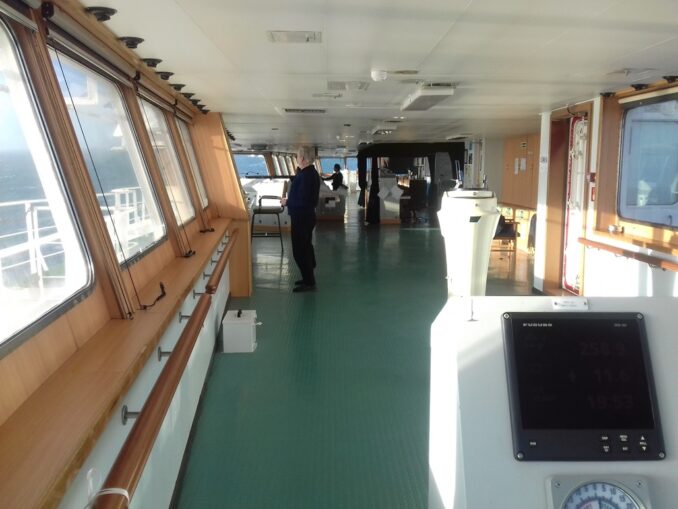
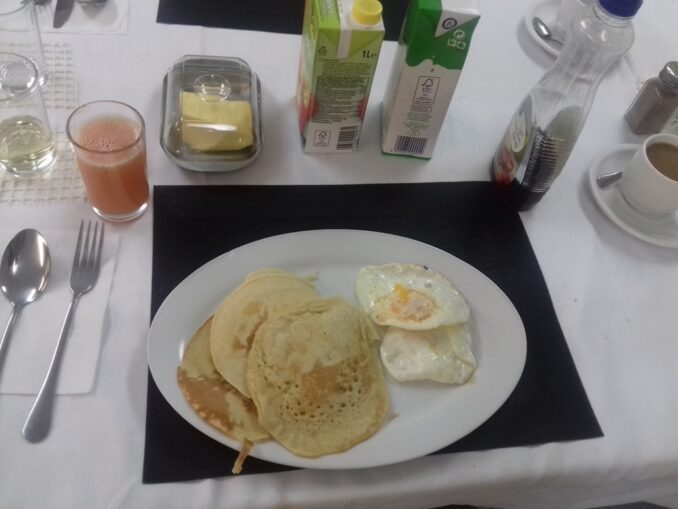
The phone on the bridge rang and it was the chef in the galley to say that dinner was ready so the German chap and I duly trotted off to the eating area. It was a pleasant spot with a division between the officer’s area and the other ranks. We were allocated our own table in the officer’s area and food was served. There was no menu as such and you got what you were given, luckily I’m not at all fussy. I have to report that the food was always agreeable and freshly cooked and there was always something decent on the plate like a large pork chop, with soup and fresh bread for starters and some sort of sweet like pancakes or ice cream. Breakfast was a little odd, no full English as such but the chef discovered that I liked fried eggs and pancakes and so one morning my breakfast consisted of a plate of fried eggs and pancakes! Fresh juice, fresh coffee and fresh bread was baked daily and so you really could not complain. Interestingly the other ranks, usually tucked into rice and some sort of chicken stew for breakfast, they were Pilipino mainly and this is what they prefer, arguing that it fills them up and lasts until lunchtime. There was a little vestibule area where all the extra food is kept warm together with a coffee machine, cereals, fresh fruit and milk etc. This area is stocked 24/7 and you are free to help yourself any time you fancy. The Chef and his mate were friendly people and we frequently had a chat in the galley, it seems he was the chef on the Odyssey marine exploration vessel that located HMS Victory, if I have the story correct. I noted that a little tweety bird sat outside the galley door, I imagine it found itself at sea and too far from land and so the ship was its new home. The chefs fed it which was nice to see.
We were always given a tin of beer for lunch and dinner, but the German chap and I decided to save it up and drink it in our cabins. Alcohol is strictly forbidden for the ship’s crew and we decided that slurping beer under their noses was unfair.
The ship progressed along it’s track towards Halifax and we soon got into a routine. Mine was to set the alarm clock and have a shower and shave and then go to the bridge to see how we were doing first thing. The rotor for night shift on the bridge always meant that the third officer and his mate were there. He was a Pilipino chap and very pleasant, together with his mate who at that time was always sweeping up and cleaning the windows in preparation for the next crew to take over. Nevertheless, he always brewed some fresh coffee for me. I asked the third officer why he was working in the North Atlantic, so far from his home, and he basically said that you go where the agency want you to go or else the work offers dry up. I noted that the ship’s depth sounder had gone blank and suspected it had packed up, but nope, we were in very deep water, too deep for it to register. Our first morning at sea had us somewhere abeam Londonderry. Every couple of days the ships clocks got knocked back by an hour during the night so that had to be allowed for regarding breakfast. During most mornings the ship was tasked with releasing a weather balloon and so we could get involved helping them with that. The ship’s radars were briefly turned off so it was safe up on the very top deck and the balloon was inflated via a bank of helium cylinders. Once the radiosonde was confirmed as working we let it go and off it floated. The ship has no radio sonde capable receiving equipment and so I suspect the data is fed to a satellite although I have no real idea. Once launched, the box is ticked and we drop down from the top of the ship so that the radar could be switched back on again.
As we progressed towards Halifax, our track took us north and we met with frequent and heavy snow showers interrupted by strong sunshine, just the sort of weather that affected the convoys during the war. The wind had been steadily increasing and getting colder and being out on deck became unpleasant, a five minute walk and then back in for a coffee became the norm. I had taken my computer to the captain’s cabin and he did some work setting me up on the ship’s wi-fi. The ship obtained its wi-fi data from satellites and the service was very slow, pre Starlink for sure. Videos etc simply would not play, but it was possible to slowly load regular web pages and emails could easily be sent. It was stressed that the ship’s equipment and the captain had absolute wi-fi priority and the regular crew (and me) had very limited service. Anyway, it was no worry as I had a book or two to read and the ship also had a small library with an assortment of reading material available. The ship also had a small gym and a laundry facility that was free to use.
On or around day four or five at sea there was a notice saying that there would be a lifeboat drill and we would be expected to be on the bridge at a certain time. Everyone on the ship, except for the chief engineer who remained in the engine room assembled on the bridge all wearing life vests and the captain announced that we were on fire, flames coming out of the funnel. The small boat was made ready for launching together with countless other requirements that the crew seemed to busy themselves with and then the exercise ended as obviously we were not going to put ourselves into the Atlantic for real.
The following morning I awoke and took my usual shower, I noted that the water was not flowing down the shower tray drain and mostly remained on the opposite side of the tray. I applied some thought and dismissed the possibility that the laws of gravity had changed and determined that the ship was listing. Well, there had been no alarms or sirens so I doubted that this was a serious issue. I entered the bridge and noticed that the ship was indeed listing by a few degrees and I asked why this was. I was informed that we were being hit by 70mph winds on our beam and the wind was pushing us over. Seemingly the ship had heeling tanks to correct this but it wasn’t something that they normally bothered with. It was also suggested in a nice way that going out on deck was not advisable for now. The lookout on the bridge was outside cleaning the windows and I asked why he took a bucket of water with him when the ship had an array of water jet sprayers like a car. The guy showed me the plumbing to these jets and it was all warped, twisted and punctured due to water inside freezing and expanding.
By now we were in the approximate vicinity of the Titanic’s resting place. There had been an iceberg warning received and I noted with some alarm that the visibility was about 100 yards or so, but it appeared that this warning applied to an area well away from our current position. The wind and associated rough seas were slowing us down markedly during the day, the captain regularly appeared on the bridge advising those on watch to be careful to prevent the bow slamming into the waves. The engine was repeatedly slowed down to ensure that the boost levels didn’t exceed the limitation much to the annoyance of the captain, but nothing could be done as the chief engineer was in charge of this one. They had also off-loaded the ship’s electrical load from the main engine shaft generator and started up one of the 4 diesel engine generators in an effort to make a little more power for propulsion. After around a day of this they swapped back again as I think they had concerns regarding regular diesel fuel levels for the things, the main engine burns a much heavier bunker oil.
Even though we were in pretty rough seas with perhaps 6 metre swells the ship didn’t really move much at all, I think 100,000 tonnes takes a bit of moving. On deck you could see the stacks of containers gently swaying around inside their stowage and I wondered where the swaying originated from. I concluded that it must be due to the ship flexing in the rough seas and decided to think about something else less alarming instead.
This went on for a few days with variable weather, one minute infinite visibility punctuated with heavy snow showers and then fog, well maybe not fog but very poor visibility.
© text & images Cardinal Puff 2026