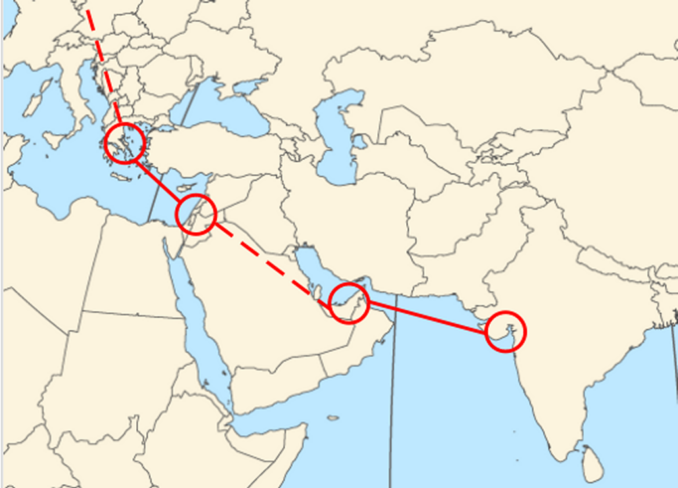
The sequence began in 2017, when Kushner was appointed as Trump’s special adviser for the Middle East. His method was geo-economics: financial incentives and commercial integration as a substitute for political solutions. He called forty years of the peace process a failure and proposed something different. What he built was the Abraham Accords — normalisation agreements between Israel and the UAE, Bahrain, Sudan, and Morocco, signed in August and September 2020. Kushner negotiated all four deals in four months, leveraging Israeli annexation threats, Gulf concerns about Iran, and American security guarantees into a bloc of aligned states bound together by economic interest. The strategic logic of the Abraham Accords and the strategic logic of IMEC are identical. Both assume that commercial integration produces regional stability. Both assume that a shared threat from Iran provides the necessary political glue. Both require Israel to be normalised as a transit and logistics node in the regional economy. The Abraham Accords created the political foundation. IMEC is the infrastructure built on top of it.
Kushner left government in January 2021 and founded Affinity Partners, a venture capital firm of which he is the sole owner. He raised $2 billion from Saudi Arabia’s sovereign wealth fund. He secured $1.5 billion from Qatar’s sovereign wealth fund and the Abu Dhabi-based Lunate. These are the same Gulf sovereign entities that are cornerstone investors in IMEC infrastructure. Kushner designed the diplomatic framework that made IMEC possible. He then positioned himself financially in the very Gulf capitals that are funding it. That is not a coincidence. It is a business model. In Trump’s second term, Kushner has no formal appointment. He does not need one. Working alongside special envoy Steve Witkoff, he co-authored the 20-point Gaza peace plan and helped broker the October 2025 ceasefire between Israel and Hamas. Then, on January 22, 2026, at the World Economic Forum in Davos, Kushner presented the reconstruction masterplan for Gaza at the signing ceremony for Trump’s Board of Peace — and Trump announced him as an envoy of peace alongside Witkoff.
The Abraham Fund, established under the first Trump term to raise $3 billion for regional infrastructure including a gas pipeline between the Red Sea and Mediterranean, was overseen by Adam Boehler — Kushner’s college roommate. Under Biden, the fund never received money and no projects were begun. It has now, in effect, being relaunched through the Board of Peace under a different name with a far larger balance sheet. The same network. The same logic. A bigger canvas. Trump’s Board of Peace was signed into existence at Davos on January 22, 2026. Trump pledged $10 billion in U.S. commitment. Member nations announced $7 billion in investments. Kushner serves on its executive board. The Board is framed as a coordinating mechanism for Gaza’s reconstruction. What it actually is : an externally governed development authority that sets investment conditions, defines governance standards, and manages the sequencing of reconstruction in a territory whose previous government has been militarily eliminated. Kushner’s Gaza masterplan — presented at the same Davos ceremony — envisioned a territory subdivided into zones, with large areas designated for industry and parks, and a population density that UN-Habitat analysts note is significantly lower than pre-war Gaza. ‘New Gaza,’ in Kushner’s renderings, looks like Dubai or Doha: gleaming towers along a redeveloped coastline, a new port at the southwestern end near Egypt, an airport adjacent to it, 180 high-rise towers, 500,000 promised jobs in construction, agriculture, manufacturing, and the digital sector.
To be continued
© DJM 2026