At my Pilates class in the village hall this week another participant introduced us to the new Posada which was journeying around the parish. It was a wooden cabinet housing a very pregnant Mary on a Donkey and Joseph with an appropriate painted background scene. It was lit by 2 tiny spotlights. It sat on the stage during the class and continued its journey to the local primary school where it spent the night. The next day it journeyed on to the local pub but I borrowed it for a couple of hours to bring it back to the village hall to display it at our community cafe. The Posada was made by parishioners. I joked that its last stop should be at the local riding stables.
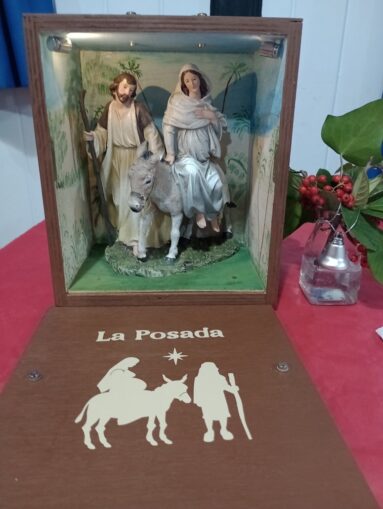
The tradition of Posada (Spansish for inn) started in Mexico commemorating Mary and Joseph’s journey to Bethlehem in search of shelter. It is also known as a Travelling Crib and, in the UK, is a Church Army initiative. The nativity figures of Mary and Joseph travel from house to house, community spaces, schools, pubs and businesses spending the night is a different location each time before arriving in church on Christmas Eve.
The tradition began in the UK as a way to engage communities with the true message of Christmas through worship and outreach. The figures are often accompanied by a folder containing prayer suggestions, activity ideas, and a journal for hosts to record their experiences. Photographs of the figures in each location are shared on the church facebook page.
The initiative has been used successfully to build relationships, strengthen community ties, and increase attendance at church services such as the Carol Service. The tradition is typically observed from December 16 to December 24, mirroring the nine-day celebration of Las Posadas in Mexico, which symbolizes the nine-month pregnancy of Mary and culminates in a re-enactment of the nativity on Christmas Eve.
Brave’s Leo has provided me with the background to the tradition’s origins.
Las Posadas is a beloved Mexican Christmas tradition that commemorates Mary and Joseph’s journey from Nazareth to Bethlehem as they searched for lodging before Jesus’s birth. The word “posada” means “inn” or “lodging” in Spanish.
Las Posadas takes place over nine consecutive nights, from December 16 to December 24 (Christmas Eve). The nine days symbolize the nine months of Mary’s pregnancy. Each evening at dusk, a procession takes to the streets with participants—often children dressed as angels and shepherds—carrying religious figures, images, and lighted candles. The group representing the Holy Family goes from house to house, singing traditional songs like “Pidiendo Posada” (Asking for Shelter) and requesting lodging. They are traditionally refused at several homes until they reach the designated host house for that evening, where they are finally welcomed inside.
Once inside, the celebration includes: Prayer and song (villancicos – Christmas carols), traditional foods like tamales, ponche navideño (Christmas punch with dried fruits and cinnamon), and pozole, and breaking piñatas shaped like stars, which is especially exciting for children. The final night (Christmas Eve) typically features midnight Mass
This tradition has been celebrated in Mexico for over 400 years, originating in Spain and starting in Mexico in 1586. While most closely associated with Mexico, Las Posadas is also celebrated in Guatemala, Honduras, Cuba, and in Latino communities throughout the United States, particularly in the Southwest.
© text & image Audrey’s daughter 2025