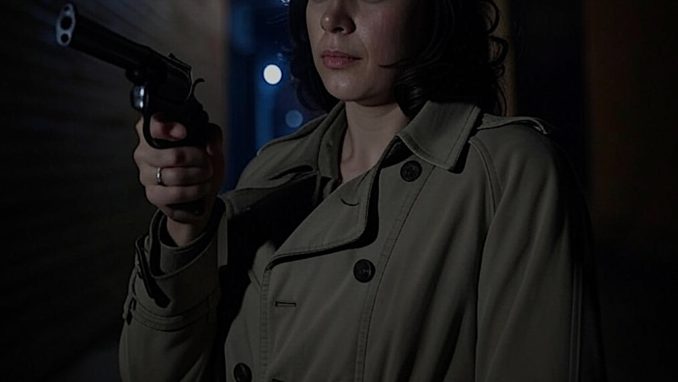
Image generated using GROK AI
Jinnie and Penny were stiff after the car journey from Berlin. So far they had not been stopped at any checkpoints, but they had been waved through several. The police seemed to be looking for something in particular. Karl, who was driving, said it was because they were heading east and anyone trying to get out of Berlin would not be heading towards Poland but be going west to neutral Switzerland or south to try to get over the border into Free Italy or Austria. They had arrived in the town of Forst on the German side of the river Lusatian Neisse, the centre of which was the official border between Germany and Poland. As Poland was officially part of Greater Germany, there had not been a hard border for years, but occasionally the people crossing the border were checked to ensure that travellers had the correct paperwork.
Forst had been chosen as the border crossing point for two reasons. There was a railway bridge there and Hanna had a particularly good friendship with Stanislaw, the leader of the Polish resistance in the area immediately over the border. The plan was for the sisters to walk over the railway bridge in the middle of the night, where they would be met by Stanislaw’s people and transported towards Poznan, that was in Free Polish hands. Karl dropped the girls near the railway line and headed back towards Berlin.
The sisters followed the track towards the river. After a while the tracks began to hum, and the girls moved off the tracks and into the undergrowth at the side. The lights of a locomotive appeared, and they watched as it trundled past hauling coal wagons full of Polish brown coal for a German power station. Jinnie checked her watch and said to Penny, “Typical German efficiency. Bang on time. We have an hour and a half to cross the river before the next scheduled train. Let’s go.” Together they recommenced their walk alongside the tracks. They had both been given H&K USP pistols for personal protection, and Jinnie saw her sister pat her pocket to ensure the gun really was still there.
The bridge slowly loomed ahead of them, and the girls stopped and watched to see if there was a guard on the bridge. They had been told by Hanna that there normally wasn’t. The resistance regularly used the bridge as one of its routes between the two countries, but in the decades that Poland had been part of the Third Reich, or Greater Germany, internal security had dwindled to virtually nothing unless there was a raised level of security for a specific reason, like the Berlin attack.
It was over a week now since the destruction of the Berlin TV tower, and security in the city had dropped considerably before they had left. The resistance infiltrated into the police and Gestapo, reported large numbers of PfP had been rounded up, but they all consistently denied having downed the tower. More satisfactory was that there had been a report in the press saying that the postmortem of two lift repair men had revealed the fall had killed them. There were no suspicious circumstances; the deaths were being put down to misadventure.
Manfred warned the report could be a blind, but the police had left the apartment block, and the goods lift had been returned to service and the embedded agents all said the investigation into the ‘lift repair men’s’ death had been abandoned. Manfred had upped the security in the apartment by installing his own CCTV cameras, both overt and covert, feeding separate recording systems. The alarm code had been upgraded from a simple four-number code to a six-digit alphanumeric code, and London had advised on how to deactivate the alarms’ built-in maker’s override code, which was believed to have been how the Gestapo had shut it off.
Hanna had said there was no reason for the security to be any different from normal on the bridge, but Jinnie didn’t want to take any chances, so they watched and listened for 30 minutes and saw nothing. The sisters agreed that the bridge was unguarded, so they crossed the river with Jinnie in the lead and Penny 20 metres behind, both with pistols in hand. As Jinnie neared the Polish side of the river, a man rose from the track sign and raised a hand like a police officer stopping a car. Jinnie and her sister stopped and stood still. The man was armed with a British KS-1 rifle, but it was pointed down at the ground. The man walked forward and stopped about 5 metres from Jinnie, saying in reasonable English, “Good evening, ma’am, we are expecting you.”
Taking an ultraviolet torch from his pocket, the man shone it on the ground about a metre in front of him and said, “Look, there is a trip laser. You would have walked straight through it and set off an alarm in the local police barrack without knowing you had done so. Just step over it and you are in Poland, and we will escort you to Stanislaw.” “We?” said Jinnie. “Yes,” said the man, “you think I would be on an operation like this on my own, the unit is out there covering us,” and waved in a semi-circle behind him.
Jinnie and Penny stepped carefully over the illuminated laser line and followed the man who said his name was Piotr. He led them a short distance before turning off the railway line, over a fence and into a lane. Piotr flashed his torch down the lane and engines started. By the time three cars arrived they had been joined by five more armed men. Without a word being said the men climbed into the rear two cars, and Piotr and the sisters the front one. The doors were hardly shut before the cars set off in convoy. At the first junction the second car peeled off, and the other two carried on. Piotr said, “It is bad to travel together in the night, they will go the long way.”
A few more miles and they themselves turned onto another road while the second car went straight on. About two hours later they arrived at the small town of Głogów, took a number of left and right turns in the suburbs before driving up to a garage where the driver opened its electronic doors before diving in and closing the door behind them. “Good,” said Piotr, “we will stay in the house today. Come on, you meet Stanislaw.”
They entered the house via a connecting door into the kitchen and Piotr led them into a hall and stopped by a closed door, rapped on it and they all entered. Stanislaw was ready for them, having watched them arrive on a CCTV monitor. “Hello, ladies,” he said, “it is nice to meet you after such a successful operation. I hear the Germans are chasing shadows, they think it was a PfP operation and are looking for them. In truth they never existed in any numbers, they were the resistance. It was a textbook operation, not a shot fired, not a single resistance fighter hurt, and none arrested.”
Piotr, who had slipped away while the sisters talked with Stanislaw, returned with a big pot of indifferent coffee. Stanislaw apologised, “I am sorry the coffee is not good, it is German. We sometimes get treats from Britain when we are resupplied with arms and ammunition, they include chocolate, coffee and ration packs. Even the ration packs are good, I have developed a taste for baked beans with sausages. But we have run out, still I understand the British are shipping in container loads of food into Gdańsk. The Germans have never seen 40‑foot containers and the special army trucks that haul them from the port to the front line.”
“I’m sorry,” Stanislaw continued, “I’m sure these things are second nature to you, but the German army are primitive by comparison to what I see the FPA have. Even I have a military satellite phone from Britain, I can talk to London, Washington, Hanna in Berlin, or the FPA liaison on a crystal‑clear encrypted line. I know better how the war is going than the Germans. It was Napoleon who said an army marches on its stomach, and the British have shown the FPA that logistics win wars. It is essential to keep the men on the front fed, watered and supplied with ammunition.”
Jinnie smiled and replied, “Like you, I was in the resistance, the British Resistance, and like you I was amazed to see how the British and American armies rolled over the Germans. In the British War of Liberation, the Germans fought a few big battles, but the Allied armies were better equipped, better supplied, better trained and above all better motivated. The Germans were soon doing what they are doing here, retreating. I was involved in the liberation of Italy, France, Slovenia and Austria. It has been the same everywhere, the Germans put up an initial fight but were soon on the retreat. It is this war with Russia that is a little different this time. Neither side has the equipment to match the Allies, and they appear to have fought to a standstill, much to your advantage. The Nazis have put all their resources into the Eastern Front and virtually given up on Poland.”
“That is very true,” said Stanislaw. “I have been to Gdańsk, I have seen the Royal Engineers turn what was a sleepy port into a bustling container port in months. They converted a Luftwaffe station into a combined Free Polish Air Force base and civil airport. It is amazing, the logistics are incredible, we are even building missile boats for our navy in shipyards of Gdynia. We already control half of Poland and thanks to the Typhoons at Gdańsk we have air superiority, and we shall soon have F‑35s. Our control grows daily.”
“Please, can I ask,” said Jinnie, “How do you plan to get us back to London?” “That is quite easy,” replied Stanislaw. “Tomorrow, when it is dark, we move you on to Luboń. It is not far to Poznań, which the Germans abandoned the day before yesterday when they pulled back to Dopiewo. Poznań will fall to the Free Polish Army very soon if it has not done so already, and Luboń directly after. The Germans do not fight, they retreat west down the Autobahn back to Germany. They have left the road from here to Luboń undefended, there is a token force between Luboń and Poznań, but it will not fight, it will melt away when the FPA rolls through Poznań. But it is enough not to be able to take you all the way to Poznań, instead we will leave you in Luboń and tell our FPA liaison where to collect you. We have done this several times before and I assure you it works.”
***
Jinnie and Penny sat in the kitchen of the safe house in Luboń eating a breakfast of coffee and what the lady of the house had called ‘a sandwich’, but it was nothing like a British breakfast sandwich. When Jinnie had said yes, she would like a sandwich for breakfast, she hoped it would be egg and bacon or egg and sausage. But what the sisters got was a slice of sourdough bread with scrambled eggs piled on it. It was tasty, but nothing like she had hoped for.
Just as Stanislaw had predicted, the journey from Głogów to Luboń had been uneventful. The trip had taken only 90 minutes, and as they were dropped in the street outside the safe house, the door had opened and before they were inside, their car was on its way back to Głogów. The lady who greeted them spoke only Polish and German, so they had communicated in German. Katarzyna explained that the Germans had insisted that all schooling was conducted in German, so children had spoken Polish at home and German at school. Jinnie told Katarzyna that was common throughout Greater Germany. Both she and her sister had learnt German at school, and she had studied it at university.
Jinnie had slept well under a duck-down duvet, not worrying that the Gestapo would charge through the door at any moment. The town was now in no man’s land and the Free Poles could be there very soon. As she sipped a second cup of indifferent coffee, she said to Penny, “How do you think they will get us home?” “I expect an overnight ferry to Sweden, then a flight to Heathrow,” she replied. “That means I might see the twins tomorrow,” said Jinnie with a smile.
The gentle knock on the front door made the girls jump. Katarzyna held a finger to her lips and said, “I’ll go. You stay quiet.” A couple of minutes later the kitchen door opened and Katarzyna stood there with two uniformed men standing behind her. Jinnie relaxed when the first soldier stepped into the room and said in a broad Yorkshire accent, “Good morning, Major DeLuca, we are here to escort you to Gdańsk.” Jinnie saw the Union Flag patch on his shoulder, his name tag said ‘Gladstone’ and he wore three stripes, but no unit markings on his camouflage parka. “Thank you, Sergeant Gladstone, I assume you are with the Regiment.” “Yes, Ma’am,” came the reply. “The transport is outside waiting, so we can be underway the moment you are ready.”
In the street were three Boxer APCs, one of which was covered in whip aerials and was obviously a command vehicle. All around the house were a dozen Free Polish troops, which Jinnie was delighted to see were all facing away from the house in a defensive stance. Several neighbours were watching from front doors and windows, and one appeared with a Polish flag. Sgt Gladstone led the sisters to the command vehicle and as they climbed aboard he gave a hand signal to a Polish corporal who blew a whistle. The troops piled into the APCs, and they quickly moved off.
Before they had turned at the end of the road, the radio operator was sending a message. “Blue Two-Two to Blue Base, we have retrieved the two packages. Blue Patrol will be crossing the front line at point Zulu Alpha in seven minutes. Three times FPA Boxers incoming.” Jinnie remembered the fuss when the Boxers were being developed, about the ride and the noise, but both faults had been fixed. The ride was decent, not limo standard, but perfectly acceptable and there was hardly any road or engine noise.
A few minutes later the radio operator said, “Blue Two-Two to Blue Base, Blue Patrol will cross the front line at point Zulu Alpha in sixty seconds.” Two minutes later, Gladstone said, “Have you ever seen an army advancing, Ma’am? Look at the screens, they give a 360° view. It is awesome.” Jinnie replied, “We were involved in the Nice landings, and I was in the War of Liberation, so yes, I have seen big concentrations of armour, but I’d like to see the Poles.” Penny joined in, saying, “And I was also in the Slovenia invasion.” “Gosh,” said Gladstone, “I didn’t realise you were veterans. I thought you were spooks.” “We are actually specialist snipers,” said Jinnie, “and have worked with the Regiment on several occasions.”
“Now I know who you are,” said Gladstone. “There are tales of the Sniper Sisters’ exploits at the lines. It is a privilege to meet you both.” On the screen were tanks and APCs rumbling forward. There were specialist engineering vehicles behind the tanks: bridging vehicles, mine layers, mortar vehicles, command vehicles, heavy guns, anti-aircraft missiles and artillery rockets, all mounted on tracked and multi-wheeled chassis. Behind came the logistics tail: ambulances, fuel and water tankers, self-loading pallet and container trucks, reloads for the rockets, ammunition for the guns, finally more tanks on heavy transporters. “That’s impressive,” said Penny. “It’s 98% Poles,” said Gladstone. “There are just a few of us ‘advisers’ and a few Yanks, but we don’t do any fighting. Since the defended landings, the Germans have only put up sporadic resistance. It’s as if they have decided to give up on Poland.”
The small convoy halted outside a large hotel in central Poznań. The sisters jumped out and looked around. Everywhere there were Polish flags fluttering in the light breeze, there were shops open and even Polish police on the streets. Jinnie asked, “How long has Poznań been liberated?” “Two days,” replied the sergeant. “Come on, the Colonel is waiting.” Sgt Gladstone led them through the hotel’s reception and into the ballroom. They weaved through organised chaos until they were next to a group of Polish officers poring over a large-scale map.
Gladstone saluted and said, “Sir, I have the two packages for you as ordered.” The Colonel returned the salute and said, “Thank you, Sgt. I’ll take it from here. You and your team can rest until we have another special mission for you.” As Sgt Gladstone saluted and walked away, the Colonel turned to the sisters. He said in perfect English, “Ladies, I am Colonel Dobiecki of the Polish Free Army. It is my great pleasure to welcome you to free Poland. I know you have been in Poland before, but in very different circumstances. I understand you met my son when he was the captain of HMS Agamemnon.” “I remember him well,” said Jinnie, “although last time I met him he was commanding a desk at the Admiralty.” “I believe he is still there,” said the Colonel, “but he is now a commodore and missing commanding a submarine.”
“I understand that you have had a successful mission,” Dobiecki continued. “It is now my job to get you to the Gdańsk airbase, from where it will then be the RAF’s job to get you back to Brize Norton.” Penny smiled and said, “That’s excellent. We should be home this evening. I was anticipating an overnight ferry to Sweden and a commercial flight from there.” “I’m afraid I can’t offer you much for lunch, we are preparing to move to follow the advance, so it’s corned beef sandwiches and coffee, and then my driver will take you to Poznań airport and a ride on a Free Polish Air Force transport going back to Gdańsk. It’s a very short flight.”
***
The airstrip at Poznań was busy with military movements. Its single runway had a continuous stream of planes taking off and landing. There were several FPAF Typhoons in concrete revetments that looked old, so were probably German. But there was a stream of A400Ms and C130s taking off and landing, and even a C17 Nightingale hospital plane on the apron, all in Free Polish livery. Penny said to Jinnie, “This is impressive. This airbase can’t have been in Polish hands very long and they have already got it jumping.” “Yes,” said Jinnie, “I’m impressed. Admittedly, they don’t seem to be hitting a lot of resistance, but gosh, do they seem to know what they’re doing. They have taken the logistics lessons very seriously.”
As the sisters stood watching the planes, an FPAF corporal approached them and said, “Ladies, please follow me. We have an A400M returning empty to Gdańsk.” The sisters were driven out to the plane in a camouflage green FPA Toyota Land Cruiser and dropped at the bottom of the plane’s loading ramp. The loadmaster greeted them and led them up the ramp and through the cavernous fuselage to a single bank of four seats at the front of the aircraft before returning to the tail of the plane to raise the loading ramp. With everyone belted in, the loadmaster used the intercom to inform the pilot the plane was ready, and a few minutes later they were taxiing.
Jinnie found it odd that there were no windows, and she could only guess what was happening. When the plane stopped and 30 seconds later the turboprops spooled up and the plane moved forward, she guessed it was on its take-off run. The nose of the plane rose, and it climbed steeply. Somewhere behind Jinnie there was a metallic clanking, and as soon as the plane levelled out, the loadmaster slipped out of his seatbelt and went to investigate. The clanking quickly stopped, and the loadmaster slid back into his seat saying, “It was buckle on a load strap bang on fuselage. I fixed it.”
In under an hour, Jinnie felt her ears popping as the plane descended into Gdańsk. The pilot buzzed the loadmaster, who quickly checked Penny and Jinnie were buckled up for landing. The landing was quite hard, and the landing run was surprisingly short, before the plane taxied to its parking slot. When the plane came to a halt, the loadmaster spoke to someone outside over a built-in comms system before lowering the ramp to reveal several trucks laden with cargo net-covered pallets. Looking at one, he chuckled and said to the sisters, “It’s essentials on the next run, it’s toilet paper and hand sanitiser for the front line. Not my worry, we have done three rotations, and we are off for twelve hours.”
The transport this time was an RAF Range Rover driven by a female RAF corporal who took them to a holding area and said in a broad Liverpudlian accent, “Here we are, Ma’am, where you are to wait for your flight to Brize. It shouldn’t be long. We must have had twenty or more flights in already today. Mind, it’s been a bit of a mixture, A400Ms, C17s, Voyagers, and an Envoy bringing in a couple of senior brown jobs. We’ve even had a couple of Yankee C5s from Lakenheath bringing in specialist mine-clearing vehicles. There’s coffee and sandwiches on the side, please help yourselves. There is usually only bottled water on the flight back to the UK. I expect the WinCo will be around to tell you when you fly.”
***
Jinnie had looked at the sandwiches, a choice of cheese and pickle or more corned beef, and went for the corned beef because they looked fresher and there was a bottle of HP Sauce she could liven them up with. But for the first time since Switzerland, the coffee was decent. The sisters were halfway through their first sandwich when the Wing Commander arrived saying, “Good afternoon, ladies. Either the gods have been shining on you, or you know someone in high places, you are on the Envoy back to Northolt. It’s basically a VIP transport, so you are highly privileged. I’m informed you will be met at the VIP terminal as there is to be a debrief. You have about forty-five minutes as the plane must be refuelled and serviced. Corporal Braithwaite will be back to pick you up when the plane’s ready.”
“Now, before I leave you,” he continued, “I don’t suppose you have your passports to identify yourselves.” Jinnie fished her fake Swiss passport out of her handbag and said, “This is the best I can do. Where we have come from, a British passport would have got us immediately locked up, if not shot.” The Wing Commander replied, “Sorry, that was a damn stupid question. One other thing, don’t eat too many sandwiches. I understand there is in-flight catering on the way back, they brought out a full complement of meals for the return flight.”
Jinnie and Penny stood by the window watching the planes. In the short while they had been watching, two RAF Voyagers had disgorged what Penny said must be about five hundred Free Polish soldiers. Jinnie said, “How the hell have the government managed to keep it quiet that we had thousands and thousands of Poles training in the UK?” “Well, I guess we just weren’t looking for them,” answered Penny. “I suppose they had them in all the remote training areas, and probably used Canada, Australia, South Africa, the USA, and only brought them back to the UK when the invasion was due to be launched.” “I suspect you are right,” said Jinnie. “But all that equipment, all those tanks, all that logistics, and not a whisper in the media. There must have been a ‘D’ notice on that lot.”
As they watched, a pair of FPAF Typhoons raced down the runway and took off, only after using about a third of its length, and with afterburners roaring, went up at an incredible angle and speed. “Impressive,” muttered Penny. “It is,” said Corporal Braithwaite, who had arrived without them hearing. “That’s the CAP. There is always a pair circulating above the city, docks and air base for protection. There is another pair sitting on alert in revetments at the end of the runway. The Poles boast they can have the alert aircraft in the air in under a minute and a whole duty squadron in under six minutes, and I believe them. But they haven’t been tested yet. The Nazis seem to have moved all their aircraft to the Eastern Front. The Luftwaffe bit of this place was abandoned when Polish Special Forces stormed in, and the civil side hasn’t seen a flight in days.”
The sisters were driven, in the same Range Rover, to the Envoy, where they were greeted, at the bottom of the airstairs, by a female RAF sergeant. She showed them into the fourteen-seater jet and suggested they pick any of the cream leather armchairs, as they were the only passengers back to RAF Northolt. With the passengers on board, the sergeant pulled up the airstairs on the back of the door, closed the door and informed the pilot that they were all set to go.
The little jet roared down the runway and climbed away, heading west. When the climb levelled out, the sergeant disappeared into the aircraft’s galley. The co-pilot appeared between the sisters’ facing seats and said, “Good afternoon, ladies, welcome aboard. I’m sorry to say that we have to make a slight detour over Denmark, as a straight line would take us over Germany. It means a slightly longer flying time. But that will give you plenty of time to eat dinner.”
The sergeant fixed the table between the sisters and served a three-course meal which was as good as Jinnie had eaten in any first-class airline cabin. The main difference was that only water or soft drinks were served with the food. Jinnie knew from past experience that RAF flights and ground stations were alcohol-free, so she made do with a Pepsi Max. The plane landed on Northolt’s main east–west runway and taxied to the military side of the RAF station where the normal SIS Lexus LM was waiting for them.
Jinnie and Penny climbed into the back and relaxed into the leather upholstery. The second driver said, “Good evening, ladies. This is something new, I don’t think we have ever picked you up from here, it’s usually Gatwick or Heathrow.” As the Lexus joined the A40 heading into London, Jinnie said, “I suppose it’s an easier run into the Cross for you from here.” The driver talked to Jinnie via the rear-view mirror, saying, “It’s much easier than Gatwick, but we are not going to the Cross. Tonight, it’s the Palace.”
***
The car went straight through the main gates at Buckingham Palace, through the arch into the forecourt and stopped at the main entrance. A liveried footman opened the rear door and helped the sisters out. Jinnie saw the King and Queen in the doorway, and just behind them stood ‘C’ and the Prime Minister. Having been greeted by King William and Queen Catherine, they followed them into a sitting room and were shown seats.
William shooed away all the officials and said, “We have been following your recent escapades with interest. The attack on Sir Nigel, then on your children’s school, and now this spectacular in Berlin. I had Richard keep me fully on the operation and I can tell you the satellite pictures are excellent. The Germans are not going to rebuild that any time soon. So, when I heard you were on the way home, I suggested you be brought here so we could personally thank you for your services to the nation.”
Jinnie smiled and replied, “Thank you, sir, but my sister and I did very little on this mission, it was all the work of the SIS planners, the SAS, the German and Polish resistance and the Free Poles. They are the ones who deserve your thanks, not us.” The King said, “But it was you who went to Tunisia. It was you and Sgt. Williamson who saved Sir Nigel, and it was you and the sergeant who prevented a massacre at the first school. You will be pleased to hear that the sergeant is to receive the Police Gallantry Medal and Larry is to receive the Dickin Medal.”
What adventures in store for Jinnie in Book 9 of Jinnie’s Story?
© WorthingGooner 2025