

© Colin Cross, Going Postal 2026
When I was at school, many moons ago now, history was something that was taught to us without the strictures surrounding Colonialism, White Supremacy, Racism and the usual “phobia”. When I discovered that a replica of The Santa Maria (a ship and the voyage it had made I’d learned about in those heady days of yore) was visiting Whitehaven harbour I took no convincing to take a day off from sitting in my shed and shitposting on X in favour of making the forty minute journey to get a look at it and hopefully refresh my memory a little. The hull of the replica is fibreglass, clad and decked in the same types of timber as were used to build the original, but that doesn’t detract from the visual impact this small (by today’s standards) ship has when you first see it. If you book a ticket you can take a self guided tour of this little (full scale) ship and marvel at how, without cabins or, for that matter, much shelter of any kind allowed as many as forty five crew to traverse the Atlantic ocean without the loss of a single member, only for the Santa Maria to run aground and be wrecked off the northern coast of Hispaniola on Christmas Eve 1492. Columbus, not having room on either the Nina or the Pinta left the crew to their own devices, promising to return for them as soon as he could. These hardy fellows dismantled the Santa Maria and, somewhat resourcefully, built the aptly (ironically) named Fuerte Navidad (Christmas Fort) with the timbers. Sadly, when Columbus returned his crew were all dead, slain either by each other, after falling out over who owned which pair of pantaloons as part of a gambling debt, or, and far more likely, slain by the local Indians for taking liberties with their previously excellent hospitality. There’s a lesson in there somewhere. It would be difficult to spend more than thirty minutes on the ship, so at £12 a ticket it’s a little pricey (no pensioner discount) but, as I always say, it’s worth a visit if you like that sort of thing. As an aside, making a point of having a chat with one or more of the young volunteer crew is a must if you do pay a visit.
© Colin Cross, Going Postal 2026
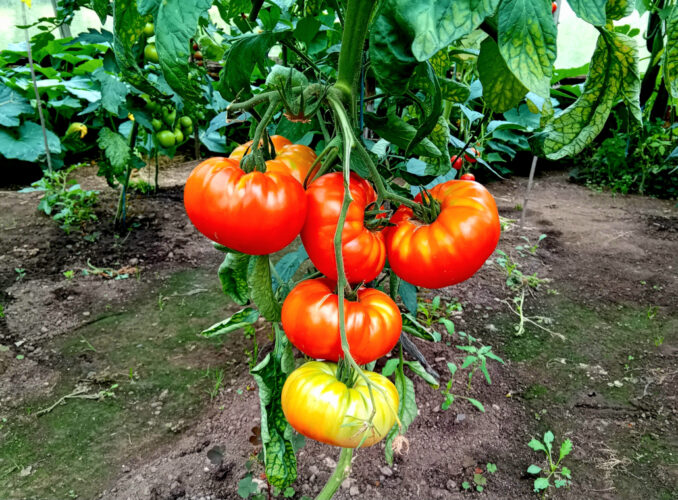
A quick return to the “Greek” tomatoes, if only to point out that the long spell of hot weather, not unlike a Greek island in high summer (at least in my limited experience of Zakynthos in early September) has done wonders for them in terms of size, speed of ripening (which is more than can be said for many of the other varieties I’m growing) and, most importantly the flavour. They’re great eaten on their own with a sprinkle of salt, although t’skin can be a little chewy and the ratio of flesh to seed and core makes them perfect for soup. I very nearly gave up on growing these, but I’ll be saving the seed for future plantings. Well done to all the fossil fuel billionaires who’ve created the Klimate Katastrophe conditions required to grow big, juicy, very Greek tomatoes in England!
© Colin Cross, Going Postal 2026
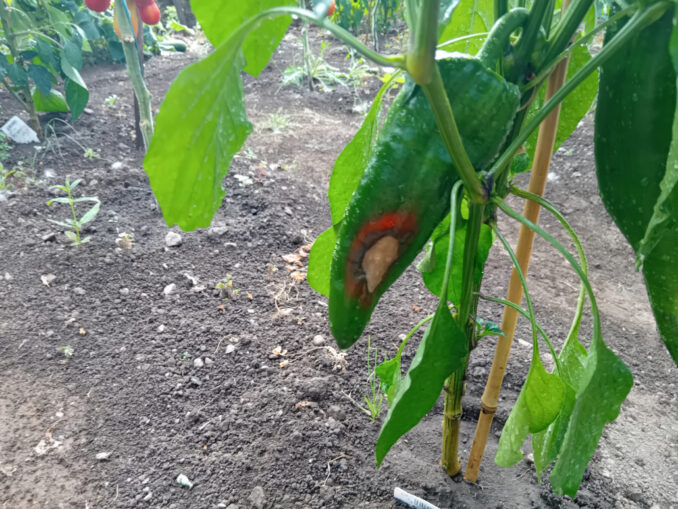
All of my pepper plants, of which I have more than a sufficiency, are beginning to bear fruit, some of the quite copiously, but a couple of them, primarily those bearing what should be those long, sweet red peppers, are forming soft patches on their “bodies” which quickly turn a soft beige colour before rapidly spreading to the whole fruit. I’ve done the whole A.I thing and am repeatedly being told that it’s caused either by “blossom end rot” (understandable if it was starting anywhere near where the blossom had been), over-watering (they all get the same amount of water), under-watering (see previous bracket), lack of calcium (I’ve now introduced calcium) or excess of nitrogen (I’m leaning towards this). Nitrogen, apparently, stimulates leaf growth on peppers and tomatoes but does nothing for the fruit itself, whilst pot-ash (found in good quality tomato feed) promotes large, healthy fruits. The situation’s under review, but it’s might frustrating. I’m guessing I’ve lost as many as twenty decent peppers, and counting. We soldier on, but if anyone has a better idea, then I’d be grateful for a heads up.
© Colin Cross, Going Postal 2026
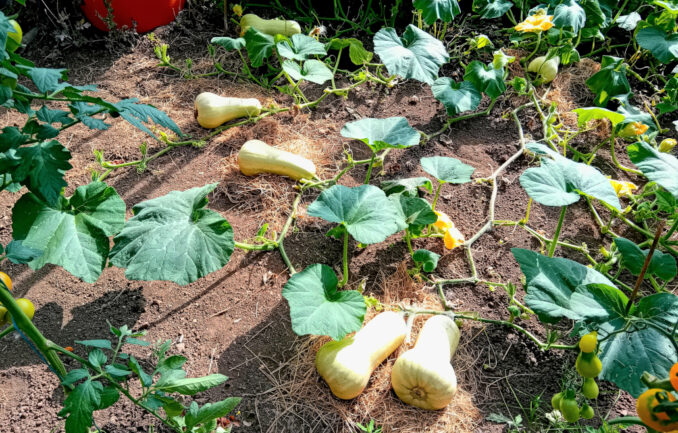
I’m guessing that I’ve mentioned the squash “experiment” in at least one of this years previous missives, but I have to say that it’s been an almost unqualified success (based on very limited experience). The three plants that we started off with have, between them, produced (up to now) fifteen healthy, decent sized fruits. The larger ones have ceased to increase in size (we’ll leave them attached to the plant until such time as they lose their stripes), and one or two new fruits are appearing, but all in all they’ve grown well and responded to the feeding of nettle water fertiliser, which I’ve now stopped. I know that squash isn’t to everyone’s taste, and I’ve yet to discover how it best responds to preserving, but there’ll be a bowl or two of spuo to be hade, maybe enhanced with a little chili, if I’m not mistaken.
© Colin Cross, Going Postal 2026
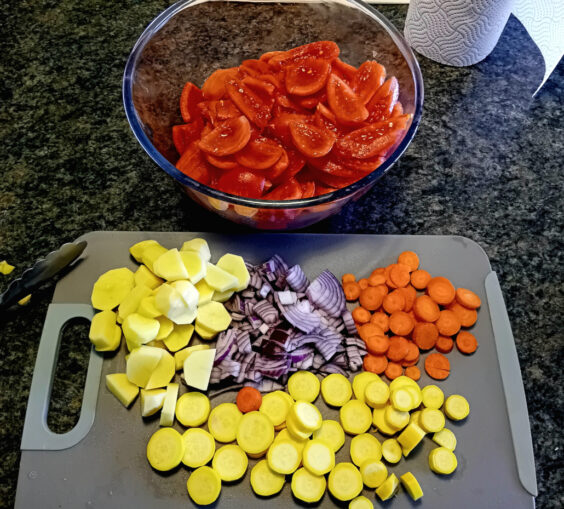
Talking of soup, it’s that time of year again when I refresh the memory of my loyal reader regarding the recipe for my famous tomato soup recipe, created using only produce from t’greenhouse and the adjacent plot, plus a couple of vegetable stock cubes (I use Kallo organic), some tomato paste and some seasoning. A “sofritto” of two carrots, a decent sized red onion and a couple of stalks of chard (not pictured) is softened in a tablespoon of olive oil, before adding half a pound of peeled potatoes and the same of courgette (any colour) to act as natural thickeners. After five minutes or so, ensuring the vegetables have a coating of the oil, stir in the tomato paste and fry it off before adding around four pounds of tomatoes (unpeeled weight) of peeled, cored and de-seeded ripe red tomatoes and two pints of stock (two cubes), a teaspoon of salt, a teaspoon of herbs (I use marjoram and oregano) and a good grind of pepper. Simmer until the potatoes are soft, add a pint of water (adjustable once blended to achieve the required viscosity), cook for another few minutes, allow to cool a little, then blend. These amounts should produce around eight decent bowls of soup, dependent on how big your bowls are, of course.
© Colin Cross, Going Postal 2026
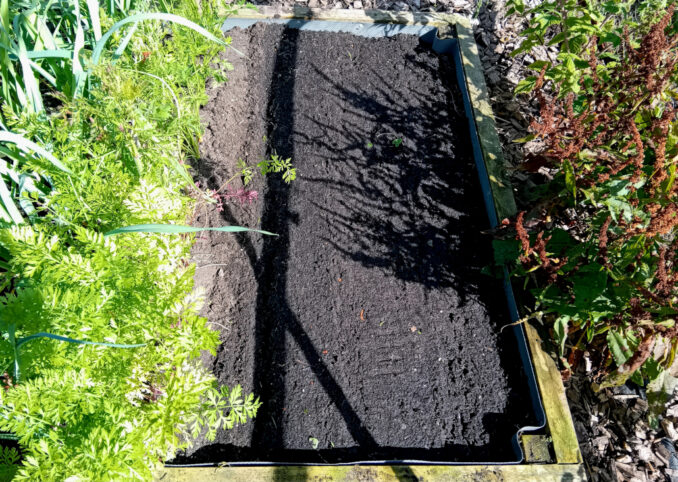
I’ve tidied up the carrot bed a bit, which has been reasonably productive, it would probably have been more so if I’d have bothered to properly thin it out and chanced my arm with a bit of late planting. I’ve put in a row of mixed salad leaves, a couple of rows of radish (they’ll look after themselves) and a row of Cavalo Nero for “winter” greens”. The last row of carrots is still in the ground and seems to be doing well. The theory regarding planting carrots adjacent to onions and leeks, to discourage carrot fly, seems to work. Let’s hope the Klimate Gods continue to smile on us all and we get some October salads!
© Colin Cross, Going Postal 2026
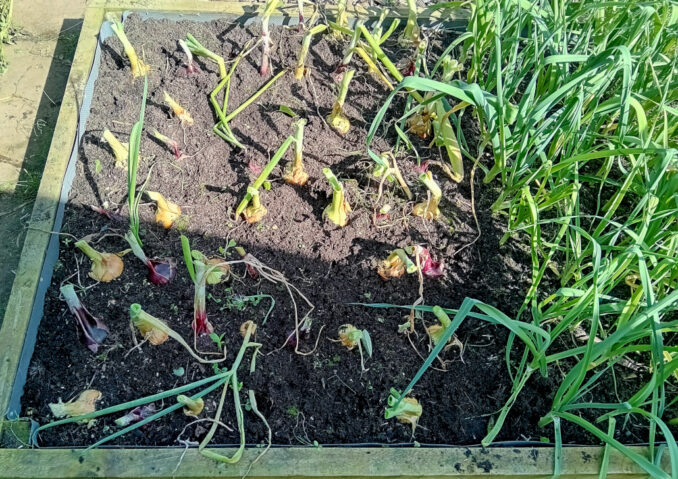
Given that several of my onions had bolted, I decided to take the tops off them all and leave them in the ground for several days to naturally start to “dry” off. It should have crossed my mind when I did so that the leeks might need a drink at some stage, but I’ve never really been one for thinking that far ahead, but then, leeks, by their nature, are hardy plants and seem to be able to withstand all manner of weather conditions. They didn’t seem to have taken any harm when I did get round to lifting the onions and I have high hopes for a decent crop of them. You can’t make leek and potato soup without leeks (recipe to follow)!
© Colin Cross, Going Postal 2026
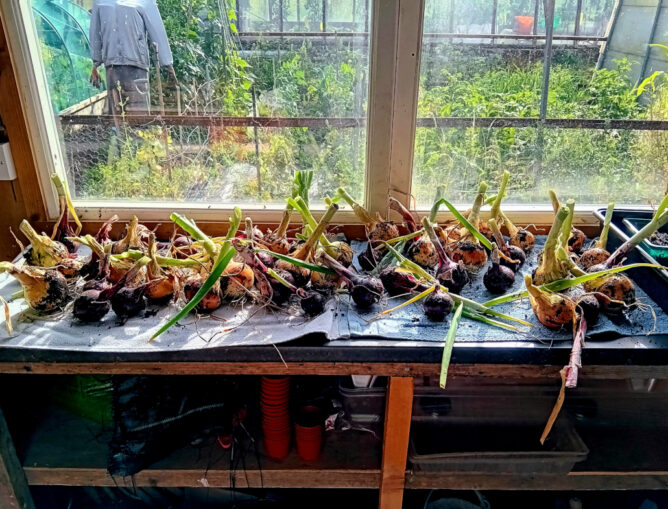
As we go to press, said onions are lifted and finishing off their drying out stage of life by residing in the shed window, which gets full light for most of the morning. A bumper crop, with half a dozen or so that have bolted, but will still yield a little usable flesh and, unusually for me, larger bulbs from the whites than the reds. I will hang them this coming week, mainly because, although I think they’ll be fine on the towels, the memory of last years debacle. I set off to dry them out in the greenhouse (I thought I was being clever) on the long wooden table, only for them to start to rot before I noticed the problem.
We hear a lot about “northener-ness” these days. Those of my few loyal readers that know me will also know that I’m inordinately proud of my own background and have, to some extent, cultivated my own brand of this particular trait by retaining both my accent and my attachment to my roots. Having said this, those living in the wilds of the far north east of England, Geordies, Mackems, Smoggies and the like and those residing in the hinterlands of the north west, Lankys, Marras, Jam Eaters and Carlislers (they care little what you call them) might not even consider Doncaster to be actually in “the north” but that’s an argument for another day. Our new PM is a professional northerner. Having been born a Scouser, I suppose he has some claim to be considered as such, but he was raised in a leafy Cheshire village, rather than the hard streets of the inner city he’d have you believe he cut his teeth in. Being a man true to his roots, he’s surrounded himself with like minds and he likes nothing more than to take to Tik-Tok to discuss the pressing matters of the day, such as what a bread roll might be call “oop north”, often accompanied by one or more of his adoring, often female, sycophantic colleagues. A typical conversation, which I heard a snippet of just this last week, piqued my interest. One such female colleague, who was born in 1980, claimed that, in all her poverty stricken “northerner-ness” she’d collected empty pop bottles, before returning them to the vendor to collect the 1p deposit. Ten such finds, she revealed, were all she needed to allow her the luxury of t’trip to t’corner shop where she could then purchase a 10p mix.
My old Nana sold pop our of her back door, probably it made her a couple of bob a week, while, at the same time, affording her the opportunity of a bit of neighbourly “crack”. I served many a neighbour, back in the early 1960’s, with a pint bottle of Heath & Smiths Dandelion & Burdock, Orange Crush or Cherryade (the posh people in the next street loved Cherryade). I remember, as if it were yesterday, that a bottle of said pop cost the princely sum of 1/-, unless, of course, you had an empty (it had to have it’s stopper with it), in which case it’d cost you 9d, because the deposit on the bottle was, at that time, 3d. Now I’m not saying government ministers would lie about something as simple as a pop bottle deposit, or even make up a story surrounding the collecting of said deposits to embellish their “working class northerner” credentials to impress their adoring public with their northerner ordinary-ness, but I’d bet my house on the fact that a 1p pop bottle deposit has never actually existed and, if it has, it certainly won’t have existed in the mid 1980’s. Meanwhile, whilst all this pointless “I’m more northerner than what you are” government by Social Media posturing goes on, “super dinghies” rock up on our nations shores, full of people who’d have your eyes out for a slice of what you’ve worked all your life to achieve. Where are the Tik-Tok pieces to camera telling us how and when the dinghies are going to be stopped and how much they cost us in the meantime (currently between £18k and £40k a year each, you do the math). But pop bottle deposits and bread rolls, eh?
© Colin Cross 2026


