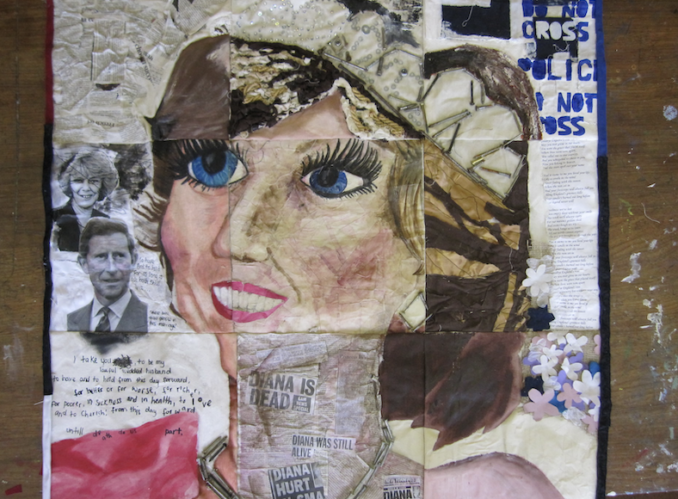
Princess Diana Story Quilt,
Verity Louise – Licence CC BY-SA 2.0
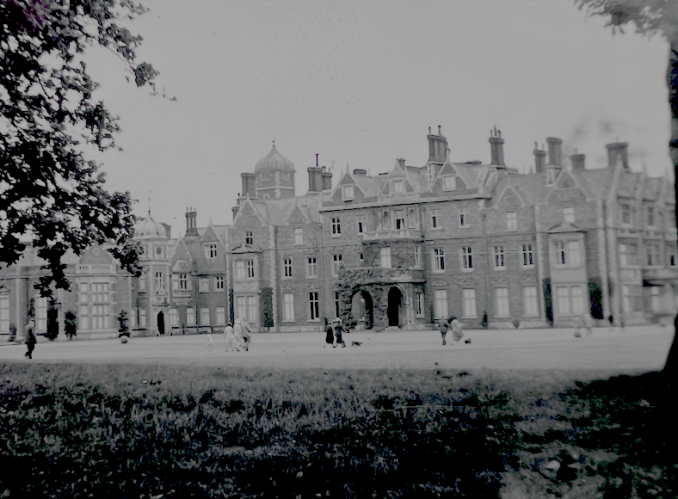
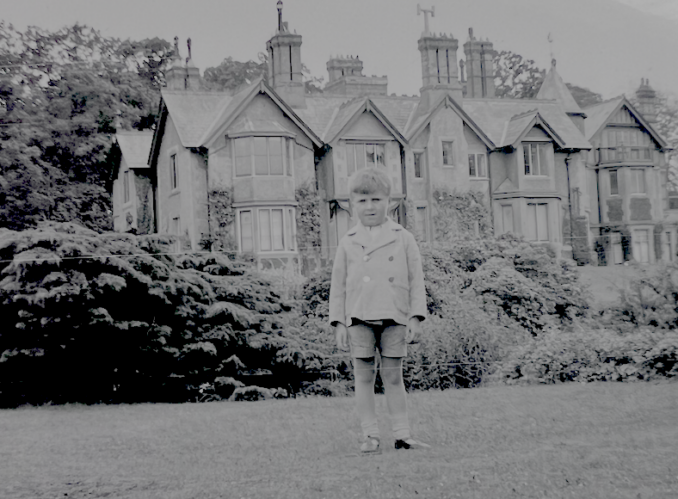
I’m plodding through Earl Spencer’s Swan Song so that you don’t have to. Likewise, almost a century ago, my infant father and his parents visited the Earls’ in-laws’ Norfolk home at Sandringham and took photographs to spare your grandparents the embarrassment.
For rather than being one of Europe’s great royal palaces, this fenland outpost is defined by several insulting architectural critiques. The writer and royal biographer James Pope-Hennessy compared the main royal house to a golf course clubhouse or a Scottish railway hotel. Pevsner described a chaotic, ‘frenetic Jacobean’ mishmash, while other architectural historians have condemned its ‘grim’ and ‘institutional’ appearance.
My father is pictured outside York House, the estate’s overflow residence, which fares even worse. Described as ‘the Ugliest House’ and a cramped, ‘glum little villa’, it is a chaotic architectural afterthought cobbled together by an army colonel with no formal architectural training.
© Always Worth Saying 2026, Going Postal
© Always Worth Saying 2026, Going Postal
Equidistant from the main Sandringham house, but to the west rather than the south, lies Park House: a rather finer proposition, a spacious, grand, 16-bedroom Victorian country house. Here, the Venn diagram of the Worth-Sayings’ two acts of selfless sacrifice for Puffins overlap. For it is at Park House that Earl Spencer opens Swan Song with an account of his and his sister Diana’s early childhood.
After Eton, Sandhurst and a good war — as a captain in the Royal Scots Greys, landing the day after D-Day and mentioned in dispatches — their father, Edward John ‘Johnnie’ Spencer, began married life renting Park House. A former equerry to both George VI and Elizabeth II, he married well: Frances Ruth Roche, one of the County Cork Fermoys. The family pile, Althorp, with its 13,000 acres, remained home to Johnnie’s father, Albert, the 7th Earl Spencer, whom Johnnie succeeded on his death in 1975.
It was at Park House, on 1 July 1961, that Princess Diana entered the world. Her younger brother Charles followed three years later. They had two older sisters, Sarah and Jane; a brother, John, died days after birth. Diana and Charles Spencer attended the same local primary school before being dispatched to different boarding schools. Thereafter, Diana went to finishing school in Switzerland, and Charles took to Oxford via Eton.
Even in his own words while giving his side of the story and overusing words such as ‘inseparable’ and ‘confidents’, the subtext perpetuates the open secret that Charles and his sister were not close. And, of course, when Charles Spencer was only 18 and still at Eton, Diana left the family nest for a difficult marriage.
Her spouse was rather less well-bred and less establishment: a middle-class Hanoverian-Saxe-Coburg-Gotha-Mountbatten Johnny-come-lately, the upstart Charles Philip Arthur George, Prince of Wales, destined to inherit sub-Althorp humiliations near Slough and in SW1A. For the Spencers can trace their ancestry to well before the Hanoverian Succession: wealthy Midlands sheep farmers, livestock and wool merchants, knighted by Henry VIII, made barons by James I, and elevated to earldom by Charles I.
As for difficult marriages, they run in the family, so to speak. The author is four times married, a father of seven and stepfather to six. This qualifies him to lecture on family life. Earl Spencer’s latest marriage, this May, is to Norwegian archaeologist Catarine, 18 years his junior. ‘We shape our buildings; thereafter they shape us.’ The chaotic bricks and mortar at Sandringham might well shake their heads in despair at the chaotic overflow of family units.
When Diana and her brother were young, Frances ran off with Peter-Shand Kidd. Johnnie Spencer remarried to ‘Acid’ Raine McCorquodale, the former wife of Gerald Legge, 9th Earl of Dartmouth. Raine’s mother was Barbara Cartland. Rather than wait thirty years to write a single book about her sibling, Swan Song credits Cartland with the penning of 700 novels. Earl Spencer does his step-grandmother a disservice. Wiki puts the figure at 723.
The Daily Telegraph obituary of Cartland’s son, the jovial and kindly Ian McCorquodale, reveals another 160 unpublished works, still being released thirteen years after her death. Given that Cartland lived to 99, that amounts to an impressive novel every four and a half weeks throughout her adult life. Mrs AWS, however, has her own acid rejoinder: can you name any of them?
As for the Shand Kydds, Peter’s brother Bill married Christina Duncan, the sister of Veronica Duncan. It was Christina who introduced Veronica to a certain John Bingham. Another difficult union: John, better known as Lord Lucan, fled London after beating the family nanny to death, having mistaken her for his wife. Pausing at a friend’s house in Sussex, he penned two final, blood-stained letters addressed to Bill Shand Kydd. Furthermore, following Lucan’s disappearance and Lady Lucan’s struggles with her mental health, the Shand Kydds stepped in to raise the Lucan children.
Back in La Cartland’s step-grandson’s great work, Diana is forgotten about during a glorious, hilarious chapter in which her stepmother, Acid Raine, recieves a good, hard kicking. There’s no row like a family row! I won’t spoil it for Puffins, save for one anecdote. After dinner at Althorp, house guests were traipsed across the courtyard and expected to buy a few knick-knacks from Raine’s gift shop. *cringe*
Parts of the book have already been trailed as pre-publicity, not least through serialisation in the Daily Mail. We already know Earl Spencer claims Prince Charles was giddy with excitement when Dianna died, and believed she’d soon be forgotten. The then heir to the throne was ‘in love with his valet’ — an intriguing claim for which the book offers no further explanation. Piers Morgan was editor of the Daily Mirror when it published photographs of Diana in a private gym.
Or rather, he wasn’t and threatened to sue the very day the book went on sale. The usual counterproductive Penis Moron misjudgment, the prospect of a valuable first edition being banned and pulped obliged me to buy one sharpish. The publicity worked, sort of. The 380-page tome sits at number 22 in the Amazon bestsellers list, wedged between the Guinness Book of World Records and a Mary Berry cookbook.
But what of the contents? Besides awkward reminiscences of a childhood shared by siblings who didn’t care for each other, we take an insight into the dotty English aristocracy. There is a dachshund cemetery on an island on Althorp estate. These days, keeshonds are preferred. No doubt one of them is called Morgan, condemned to sleep outside in the snow and beaten daily.
Structurally, the book is built around the eulogy Spencer delivered at Diana’s funeral. Its chapter titles borrow phrases from that speech, taking us through Diana and Charles’s childhood and family history, the events surrounding her death and funeral in 1997, and Spencer’s recollections of writing and delivering the address.
The narrative shuttles between past and present through anecdotes and barbs aimed at the media and some members of the royal family. The funeral, and particularly the march behind the coffin to Westminster Abbey accompanied by his nephews, forms the final chapters, while Earl Spencer’s complete and defining eulogy closes the book.
© Always Worth Saying 2026